Leads E Commerce: How to Find and Qualify Buyers in 2026

69% of U.S. shoppers said they'd already made a purchase through social media in 2025, according to DHL eCommerce. That makes social audiences worth understanding, but it doesn't make every follower a prospective customer.
Finding e-commerce leads is like fishing: a bigger net won't help much if you choose the wrong spot. You need a relevant audience, evidence of commercial interest, permission to use the contact details, and a way to connect your effort to purchases. A spreadsheet is the starting material, not the result.
Table of Contents
- Choose the channel that solves your current problem
- Combine behavior with profile fit
- Contact yield needs its own interpretation
- Give every row an audit trail - Make restrictions enforceable
- Connect the file to purchase events - Compare like with like
- Inspect the handoff from conversation to checkout - Separate an observed problem from a promised uplift
- Match the follow-up to the tier - Make stopping as reliable as sending
- Set the decision rules before sending - Keep collection separate from the scaling decision
Lead Channels Compared by Output, Best Use and Risk
An e-commerce lead is a person or business that has shown enough interest in a product category to be worth contacting, and the channel determines how you reach them.
The opportunity is substantial: UNCTAD reports that businesses in 46 developed and developing economies recorded nearly $28 trillion in e-commerce sales in 2024. That includes business-to-business and business-to-consumer transactions, not just online retail. For an individual brand, though, the useful question isn't how large e-commerce is. It's which channel produces prospects you can qualify and serve.
| Channel | What You Receive | Best Use | Main Risk |
|---|---|---|---|
| Paid social ads | Clicks and form fills from targeted users | Launching a product to cold audiences | Rented attention; costs can rise as audiences saturate |
| Search ads | Users already searching for a product type | Capturing buying-ready demand | High cost per click in competitive categories |
| Lead magnets and quizzes | Email addresses exchanged for a guide or quiz result | Building a first-party list over time | Low-intent sign-ups when the offer is generic |
| On-site forms and chat | Contacts from visitors who already browsed | Converting existing traffic | Limited volume; cannot grow reach alone |
| Public audience extraction | Publicly listed contacts from followers, commenters, likers, or hashtag audiences | Outbound prospecting to a defined niche | Accuracy must be validated; permission and deliverability need checking |
| Purchased or rented lists | Bulk contacts from third parties | Rarely recommended | Unknown source, poor freshness, and compliance exposure |
Choose the channel that solves your current problem
Paid social requires fresh creative and audience monitoring, because repeatedly reaching the same people can make acquisition more expensive. Search ads capture explicit demand, but competitive product terms can consume your budget before you learn which visitors buy. AdCrunch's guide to choosing platforms for online store ads provides useful context for that advertising decision.
A quiz needs a product-relevant promise. A shoe-fit recommendation gives you more useful context than a generic prize draw, even if the prize attracts more sign-ups.
If your website already attracts visitors but you have no list, start with a useful lead magnet, product quiz, or on-site capture form. Add public audience extraction when you can qualify its output and measure downstream purchases.
Avoid purchased lists for most brands. Without a clear collection history and permission record, their apparent convenience can conceal the greatest uncertainty about freshness, lawful use, and recipient expectations.
Scoring Leads by Commercial Intent
A bigger list isn't necessarily a better list. A large audience can generate replies and clicks without producing customers, especially when you mistake general interest for an active shopping need.
Start with the behavior closest to a purchase decision. A commenter asking about shipping, sizing, price, or a restock has supplied buying context. A liker has shown a lighter form of interest, while a competitor's follower may appreciate the category.
Hashtag audiences are broader still. They can contain shoppers, creators, competing sellers, and people browsing for inspiration.
Combine behavior with profile fit
Check whether the profile's category matches your catalogue, whether its bio discusses the relevant product, and whether its location is inside your shipping area. A website can help distinguish a store owner from a consumer when you're prospecting for wholesale buyers. Follower count helps describe the account, but it doesn't prove purchasing power.
Say a skincare brand is promoting a fragrance-free moisturizer. Someone asking when that product will return to stock deserves closer review than someone who liked a competitor's lifestyle photograph. If the commenter also appears to be in a supported delivery country, the brand has both buying context and practical fit.
Use at least two relevant signals before placing a prospect in Tier A. Treat this as an operating rule to test, not a scientifically validated scoring model.
| Tier | Signals | Next Action |
|---|---|---|
| Tier A: Buying context | Price, size, shipping, or restock question, supported by a relevant bio, website, or other fit signal | Contact first with a specific offer, after permission checks |
| Tier B: Relevant affinity | Follows a competitor or niche account; category matches your catalogue | Nurture with relevant content, then test an offer where permitted |
| Tier C: Weak signal | Likes only; generic bio; no supporting commercial context | Hold for a permitted broad audience test or exclude |
| Tier D: Unusable | Duplicate, bounced, or suppressed contact; country outside your shipping zone | Remove from outreach import |
Attach the tier, supporting evidence, and scoring date to every export. A salesperson should be able to see why a prospect was prioritized without reopening the original profile.
A tier should decide the offer, not just the order of sending.
Tier A might receive an answer to a stock question and a matching product page. Tier B might need a category guide. Neither should receive a message claiming you know they're ready to buy.
Building Audience Lists From Instagram Audiences
Audience discovery and purchasing aren't interchangeable. A 2025 social-commerce estimate put social buyers at 47.5% of U.S. digital buyers, while social commerce represented 6.9% of e-commerce sales. Those measures describe different things, but their contrast is a useful reminder: participation doesn't tell you how much purchasing happens.
Use this workflow to turn an audience into a reviewable list rather than an unqualified collection of handles.
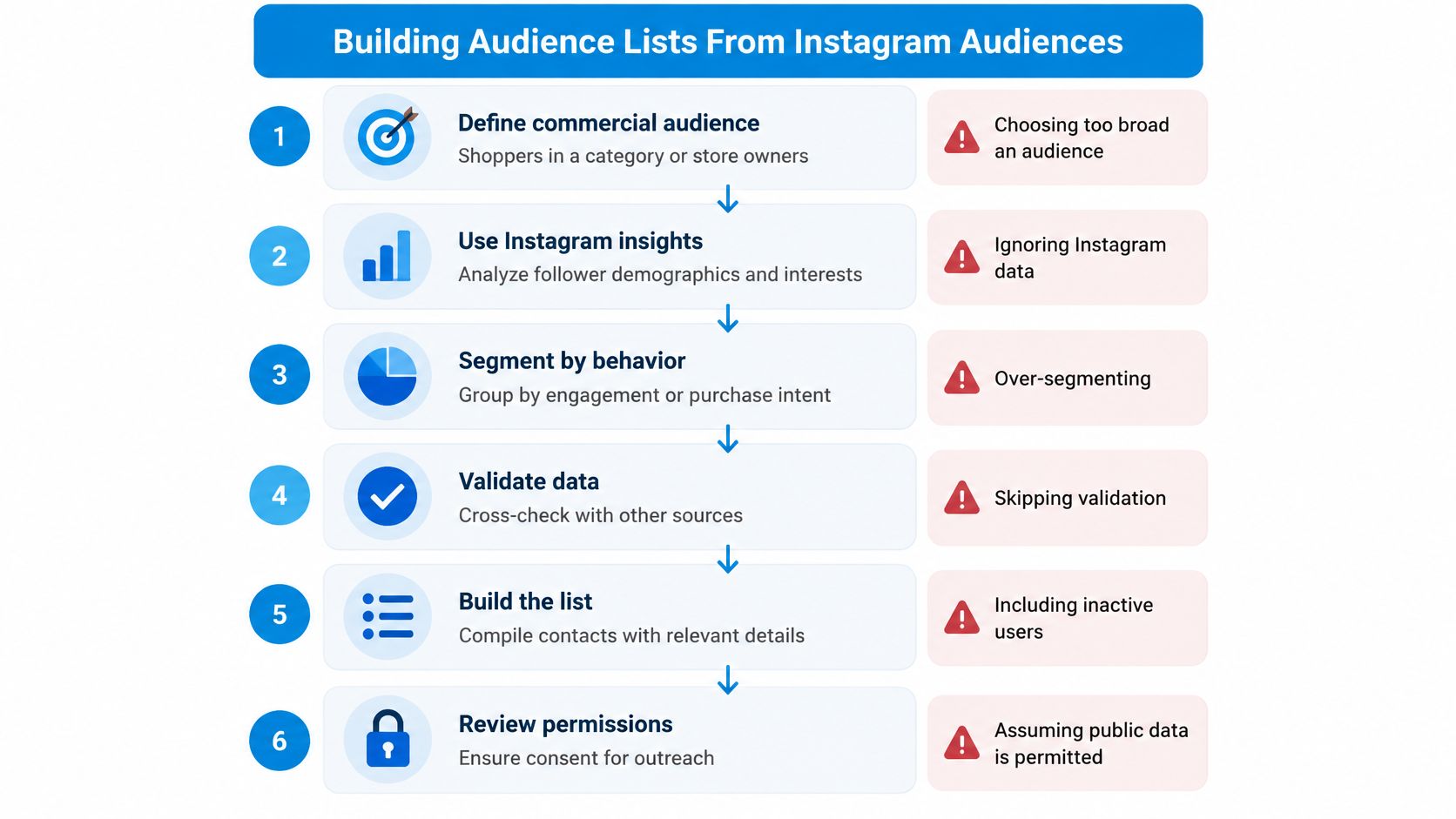
- Define the commercial audience. Specify whether you want shoppers in a product category, independent retailers, or potential creator partners. Starting with a broad hashtag and calling every participant a buyer is the common slip.
- Choose an audience source that matches that purpose. Compare followers, following lists, hashtag audiences, commenters, and likers rather than treating them as equivalent. Our guide to targeting an Instagram audience can help you narrow the source before collection.
- Collect only publicly visible information. Stop at what the profile makes available; don't attempt to bypass private-account restrictions. Access to a profile doesn't establish permission to contact its owner.
- Enrich the profile context. Retain username, full name, bio, follower count, category, and website URL where available. An email without that context is difficult to qualify, while an empty field should remain empty rather than being guessed.
- Deduplicate against your CRM. Match usernames and normalized contact fields, then separate existing customers, active opportunities, and suppressed records. Otherwise, a newly exported file can trigger an old conversation again.
- Export a UTF-8 CSV or Excel file. Keep a profile on each row and include the source audience, such as commenters on a particular restock post. Omitting the source makes later comparisons between audiences unreliable.
Contact yield needs its own interpretation
In our workflow, scraping a following list almost always gives better email rates than scraping followers. A carefully chosen account's following list can concentrate professional connections, but you still need to inspect what that account follows rather than assume commercial relevance.
Business pages, creators, and coaches also tend to publish email addresses more often than other account types. That makes them easier to contact, not automatically better buyers.
For a different business context, FOMOchat's guide to SaaS lead gen from Instagram offers a useful comparison when your target is a business decision-maker rather than a retail shopper.
Use the accompanying video as a practical companion while reviewing your collection workflow.
Checking Data and Permission Before Outreach
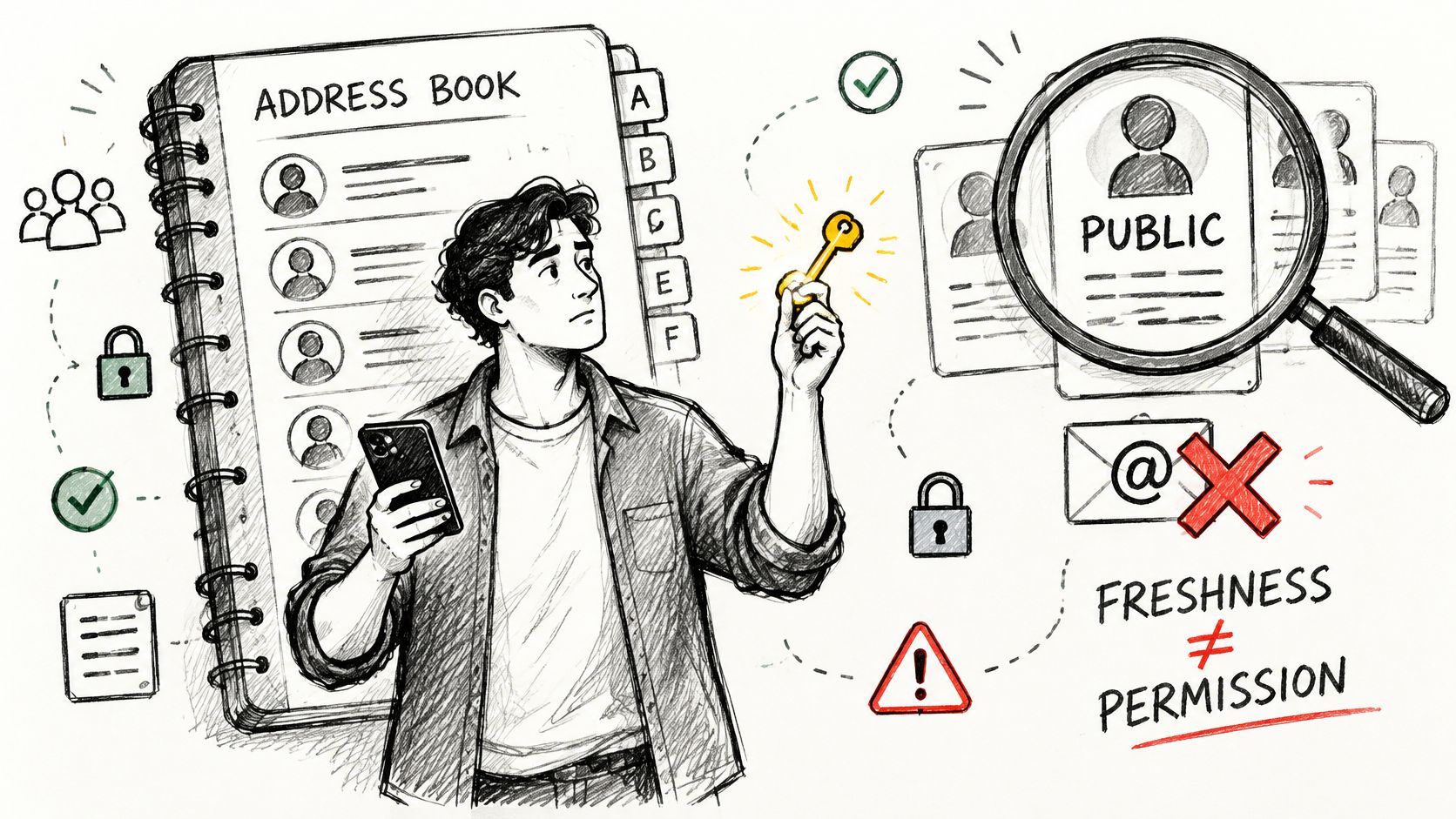
Freshness is not permission. A contact detail can be accurate, recently collected, and publicly displayed without authorizing the email, text, or call you intend to send.
An Integrate and Demand Metric survey found that nearly 75% of surveyed organizations estimated at least 10% of their lead data was inaccurate, outdated, or non-compliant, while only 31% expressed complete confidence in compliance. These are organizational survey responses, not an estimate of the quality of your particular list.
Treat validation and permission review as separate tasks before any import.
Give every row an audit trail
Build a spreadsheet or CRM staging area with these fields before records become sendable:
- Origin and timing: Record the profile or source URL, audience source, collection date, and public or private status at collection.
- Purpose and location: State the intended business purpose, available geographic information, and planned outreach channel. Mark unknown geography as unknown.
- Contact classification: Separate business and personal contacts, and record whether an address is shared, role-based, or associated with an individual.
- Validation status: Deduplicate and verify address formatting and deliverability indicators. Verification isn't a substitute for a permission decision.
- Permission and suppression: Retain the applicable consent or lawful-use assessment, opt-out status, and any reason the record must not enter outreach.
- Retention and ownership: Assign a review or deletion date and a named person responsible for carrying it out.
Apply country-specific rules to the actual channel before sending. An email assessment doesn't automatically cover SMS or telephone calls, and a business-looking profile doesn't remove privacy obligations.
Our GDPR email marketing guide is a starting point for planning that review. Get qualified legal advice when the intended processing or recipient jurisdiction is unclear.
Make restrictions enforceable
Our users agree to use data only for lawful purposes, comply with applicable requirements including CAN-SPAM and GDPR, honor opt-outs, and never use data for harassment or stalking. They also agree not to resell or redistribute raw data.
Put those restrictions into the workflow, not just a policy document. Restrict export access, check suppression records before every send, and make deletion requests visible to whoever manages the CRM.
Before import: Have a person inspect a sample from every audience source, including records the automated checks accepted.
Look for mismatched contact types, irrelevant accounts, uncertain geography, and missing permission evidence. If the sample exposes a recurring problem, fix the collection or qualification rule before releasing the full list.
Metrics That Prove a Lead Is Worth Buying
A source can produce plenty of email addresses and no revenue. Contact volume measures availability, not commercial value.
Keep the stages separate. A raw profile becomes a verified contact after validation; it becomes a sales-qualified lead when it meets your commercial criteria. An opportunity has an identifiable purchase discussion or buying action, while a customer has completed an order.
| Metric | Formula | What It Tells You |
|---|---|---|
| Contactability rate | Reachable contacts divided by profiles extracted | Share of the list you can actually reach |
| Qualified lead rate | Qualified leads divided by contacts reached | How well your filter matches real buyers |
| Cost per qualified lead | Total campaign cost divided by qualified leads | Whether acquisition is affordable at the qualified stage |
| Lead-to-purchase rate | Purchases divided by qualified leads | Whether qualified leads produce orders |
| Median time to purchase | Median days from first contact to first order | How long the sales cycle runs |
| Revenue per sourced profile | Revenue attributed to a list divided by profiles in that list | Which audience sources pay back |
Connect the file to purchase events
Google's e-commerce measurement guidance explains that Google Analytics requires implemented e-commerce events to report shopping activity and purchases; reporting generally begins after tagged users interact with the site. Google Ads enhanced conversions can supplement standard tracking with hashed first-party details and offline lead outcomes.
Hashing doesn't create permission to use a contact. Use permissioned first-party information for matching wherever possible, and apply the relevant privacy controls before transmitting it.
Normalize exported fields, assign a stable internal lead ID, and attach source-audience metadata. Preserve consent status and suppression information alongside the identifier, then return qualified-lead and purchase outcomes to your analytics or advertising workflow.
For wholesale or partnership sales, our B2B lead generation guide provides a related framework for handling opportunities that don't immediately become online orders.
Compare like with like
Use the same attribution window, qualification definition, and cost categories across sources. Include collection, verification, creative, sending, and staff costs rather than comparing a fully costed campaign with a file purchase alone.
Define whether lead-to-purchase rate counts first orders or all orders, and keep that definition stable. For revenue per profile, distinguish attributed revenue from incremental revenue.
Choose sources by revenue per sourced profile, not cost per email. Recheck results after each campaign cycle, allowing enough time for slower purchases to appear.
Where E-Commerce Leads Leak Before They Buy
A qualified lead is not a sale. Someone can want the product, reply positively, and still abandon the purchase because your site makes the next step difficult.
Baymard's checkout usability research, which includes benchmarking 344 leading U.S. and EU e-commerce sites, reports a global average cart-abandonment rate of 70.19%. Its usability research also estimates that the average large e-commerce site has roughly 32 checkout improvements available. That's a reason to examine the purchase path before blaming the audience.
Inspect the handoff from conversation to checkout
Long lead forms can demand too much before showing value. Unexpected delivery charges, forced account creation, and unclear arrival times can then interrupt an otherwise plausible purchase.
The landing page matters too. Someone who asked about clothing sizes shouldn't have to search a generic home page for the item and its measurements.
Diagnose the problem systematically:
- Map the path from reply to purchase. Record meaningful stages such as landing-page visit, product view, cart addition, checkout start, and completed order. Keep the audience source attached to each cohort.
- Find the largest drop between adjacent stages. If people visit the product page but don't add the item, inspect product information, price, availability, and fit guidance. If they start checkout and leave, inspect the checkout experience.
- Change an element and compare against a control. Keep the current version available to a comparable group while testing the revision. Avoid simultaneously changing the offer, landing page, and checkout, because you won't know which change mattered.
Come Together Media's PPC Vault audit checklists can help organize an advertising-to-site review when paid campaigns contribute leads.
Separate an observed problem from a promised uplift
An abandonment benchmark describes behavior; it doesn't diagnose your store. Likewise, modeled conversion opportunities aren't guaranteed results for your catalogue, audience, or checkout platform.
Compare outcomes by source audience rather than relying only on the storewide average. A sizing-focused landing page might help product-question commenters while doing little for visitors who are still learning about the category.
Fix the step where interested people get stuck before paying to bring more people to it.
Start with a source-specific landing page that answers the question behind the visit. Test it against the current destination, keep the offer consistent, and judge the result by completed purchases rather than clicks alone.
Nurturing Leads After the First Contact
Follow-up should help a prospect make a decision, not repeat the opening message. Begin only after a compliant first contact, and let the prospect's response change what happens next.
Match the follow-up to the tier
- Give Tier A a specific answer. Reference the relevant price, sizing, or availability question without overstating what you know about the person. Offer a matching product or helpful explanation with a clear way to reply.
- For Tier B, use a short, permitted content sequence about the category before introducing an offer. A cookware brand might explain pan materials and care, then test a relevant product recommendation with a subset of eligible contacts.
- Keep Tier C separate. Don't place weak-signal profiles in the same sequence as people discussing a purchase. Exclude them or use a permitted broad audience test that doesn't imply personal buying interest.
- Set a fixed stopping rule before launch. When someone doesn't respond within that sequence, stop automated follow-ups and suppress further messages from that campaign rather than restarting the sequence through another export.
- Send engaged prospects to a matching landing page. A wholesale buyer needs ordering terms and trade information; a consumer asking about fit needs the relevant product and size guidance.
Make stopping as reliable as sending
Every message needs a working opt-out, and each opt-out must reach the suppression list before the next send. Treat a negative reply as an instruction to review or stop contact, not an invitation to argue.
Track replies, unsubscribes, and product-page visits by tier and source. Classify replies by substance too: a removal request and a product question shouldn't both count as positive engagement.
Start With a Small Pilot Before You Scale
A pilot should answer a decision, not merely demonstrate that you can collect contacts. Choose a manageable audience and write down what would justify another campaign before the file arrives.
Set the decision rules before sending
- Choose an audience source with a clear commercial purpose. Specify the buyer type, product relevance, and supported market.
- Extract a small reviewable batch, not the entire available audience. Set a minimum sample size appropriate to the difference you need to detect; a handful of replies won't support a confident source comparison.
- Apply qualification and verification rules. Keep excluded records out of the sending file while retaining the suppression information needed to prevent reimport.
- Set success criteria in advance for contactability, qualified-lead rate, cost, and eventual purchases. Base acceptable acquisition costs on your own margins.
- Send a compliant first message with an identifiable sender, a relevant purpose, and a clear opt-out.
- Review the first campaign cycle by audience source. Inspect bounces, complaints, unsubscribes, substantive replies, and purchasing outcomes, not just aggregate engagement.
- Scale only a source that clears your criteria. If results are inconclusive, gather more comparable evidence instead of treating the larger list as the winner.
Keep collection separate from the scaling decision
HarvestMyData can deliver structured CSV and Excel files to your email, usually within an hour, or through its Telegram bot. You can close the browser while processing runs and receive the CSV by email when it's ready.
That handoff saves collection work, but the file still needs qualification, permission review, and measurement. The pilot's numbers, not the file size, decide whether to scale.
HarvestMyData turns defined public Instagram audiences into structured contact files for prospecting and analysis. Visit HarvestMyData to prepare an audience-based export, then use your qualification tiers, permission checks, and pilot results to decide which contacts belong in an e-commerce outreach campaign.
We built HarvestMyData to handle all of this for you.
No proxies, no code, no account needed.