B2B Lead Generation Strategies and Metrics

Brand building rose from fifth place in 2023 to first place in 2024, while demand generation and lead conversion fell from fourth to seventh, in a 2024 global study of 3,528 B2B buyers and 6,539 brand experiences covered by Marketing-Interactive. Buyers in that study ranked feeling safe signing a contract as their top priority. That's the uncomfortable context for B2B lead generation right now. A bigger export doesn't fix weak trust, slow follow-up, or a list sales can't trace back to a source.
B2B marketing teams celebrate contact volume while the CRM fills with records nobody owns, nobody can explain, and nobody contacts in time. Volume is a weak score. Traceable stages, response-time bands, and data provenance decide whether a list becomes revenue. Treat a public audience as a research signal rather than proof someone is ready to buy, and the decisions sharpen: who gets a call today, who waits, and who never belonged in the export.
Table of Contents
- What Each Stage Actually Means - Fields That Make a Rate Auditable
- Three Statuses You Must Not Collapse - The Check Order That Protects Sales
- Work Clusters, Not Just Contacts
Funnel Rates That Show If Leads Are Real
Paste four numbers beside your own funnel before you buy anything else. Benchmark evidence reported for B2B funnels by Reach Marketing places median conversion at roughly 1.8% from visitor to marketing-qualified lead, 13.7% from MQL to sales-qualified lead, 38.4% from SQL to opportunity, and 23.8% from opportunity to closed-won. Those medians aren't targets to worship. They're a diagnostic chain that shows where your program leaks.
What Each Stage Actually Means
A visitor is anonymous, however interested the page view looked. An MQL fits your ideal customer profile and took a defined action, such as a demo request or a high-intent download tied to a buying problem. An SQL is a record sales has accepted as worth a conversation, not a record marketing hopes sales will like.
An opportunity has a stated problem, a buying role, and an agreed next step. Closed-won is signed revenue, not a warm reply or a promising call. If marketing and sales use these words differently, every rate you report is fiction.
| Stage change | Median rate | What the later stage requires |
|---|---|---|
| Visitor to MQL | 1.8% | Fit plus a defined action, not a raw page view |
| MQL to SQL | 13.7% | Sales accepts the record as worth a conversation |
| SQL to opportunity | 38.4% | A stated problem, a buying role, and a next step |
| Opportunity to closed-won | 23.8% | A signed deal, not a positive reply |
Run the chain on a hypothetical 10,000 visitors and the medians give you about 180 MQLs, about 25 SQLs, about 10 opportunities, and about 2 wins. That arithmetic explains why raw volume feels productive and performs poorly. Doubling traffic while your MQL to SQL rate collapses just gives sales twice as many records to reject.
A smaller, better-fit list can beat a larger export when it lifts the first two rates. Say a niche audience produces fewer MQLs but sales accepts a much higher share because role, company type, and problem match your offer. You get more opportunities from fewer touches, at lower rep cost, with cleaner data for the next test.
Fields That Make a Rate Auditable
You can't audit a rate if the record has no history. Keep these fields on every record from the moment it enters the CRM:
- Source audience: The exact origin, such as a follower cohort, commenters, likers, or a hashtag audience.
- Acquisition date: When the record was collected, not when someone finally imported it.
- Contact type and geography: What's listed, and where the account appears to operate.
- Company or creator category: The segment you intended to reach when you built the list.
- Qualification status: MQL, SQL, rejected, or unworked, with no ambiguous middle labels.
- First-touch date, response, and disposition: When outreach happened, what came back, and why the record closed out.
Score records before handoff using firmographic fit, topical relevance, public contact availability, engagement signal, and buying-role likelihood. That score won't be perfect, but it'll force a conversation about why a record deserves a rep's time.
Practical rule: Judge every source by its SQL and opportunity rates, and let reply rate stay a diagnostic, not the headline.
Now price the chain. Put cost per SQL and cost per opportunity beside each rate so spend is judged against pipeline, not contact counts. A channel with cheap contacts and expensive opportunities is expensive. A channel with pricey records and cheap opportunities is efficient. I would mark which of the four rates was weakest last quarter before choosing any new channel. That single mark should drive the rest of your plan.
Channels Compared by Intent and Failure Mode
| Channel | Intent signal | Time to a usable lead | Usual failure |
|---|---|---|---|
| Content and SEO | High when the query is a buying problem | Weeks to months | Traffic outside the ideal customer |
| Paid search | High and query-led | Days | Spend on broad, low-fit terms |
| LinkedIn outbound | Medium; role and company are visible | Days | Generic pitches and low replies |
| Email to an owned list | High when permission already exists | Hours | Decay, bounces, and complaints |
| Events and webinars | Medium to high among attendees | Days after the event | No named follow-up owner |
| Referrals and partners | High because of peer trust | Unpredictable | Cannot be scaled on a quota |
| Social audience lists | Low to medium; topical, not buying intent | Hours after the file arrives | Treating public contacts as ready buyers |
Read the table against your weakest funnel rate, not against what a vendor wants to sell. If visitor to MQL is weak, content, SEO, and paid search deserve scrutiny first, because the query itself filters for a problem. Content compounds but takes weeks to months to produce pipeline you can trust, and it fails when rankings attract students, job seekers, or competitors instead of buyers. Paid search answers in days, yet broad match terms will happily burn budget on people researching definitions.
If MQL to SQL is weak, look at channels where fit is visible before outreach. LinkedIn shows role and company quickly, which helps you avoid pitching people who can't buy. It fails when every message reads like a template with a first name swapped in. If you want outreach that uses account context instead of generic sequences, it's worth learning how to automate context-aware LinkedIn outreach so relevance survives scale.
Where Each Motion Breaks
Email to an owned, permissioned list moves in hours and carries real intent when people opted in for something specific. It breaks when addresses decay, engagement drops, and complaints rise because the list was treated as infinite. Events and webinars concentrate interested attendees in one place, then die in the handoff when nobody owns follow-up, notes sit in a spreadsheet, and the first email arrives after the conversation is forgotten.
Referrals carry peer trust that no cold channel can manufacture. They also resist a volume target, so don't build a forecast that assumes partners will fill a quarterly gap on demand. Use referrals to raise close rates, not to rescue a pipeline shortfall in the final month.
Social audience lists, built from followers, following, commenters, likers, or hashtags, can arrive within hours and signal topical relevance. They don't signal readiness to buy. Their job is targeted discovery for segments that are hard to reach through search, such as independent operators who live on Instagram. Our longer breakdown of social audience prospecting workflows covers how that discovery step should feed research rather than a blind blast.
A channel isn't good or bad in the abstract. It's good or bad for the funnel stage you're trying to fix.
I would assign each channel one job and one metric it's allowed to be judged on. Search channels own problem-led demand. Audience lists own segment discovery. Events own concentrated conversations with a named follow-up owner. When a channel misses its own job, cut or redesign it instead of asking another channel to compensate with volume.
Quality Checks Before Anyone Is Contacted
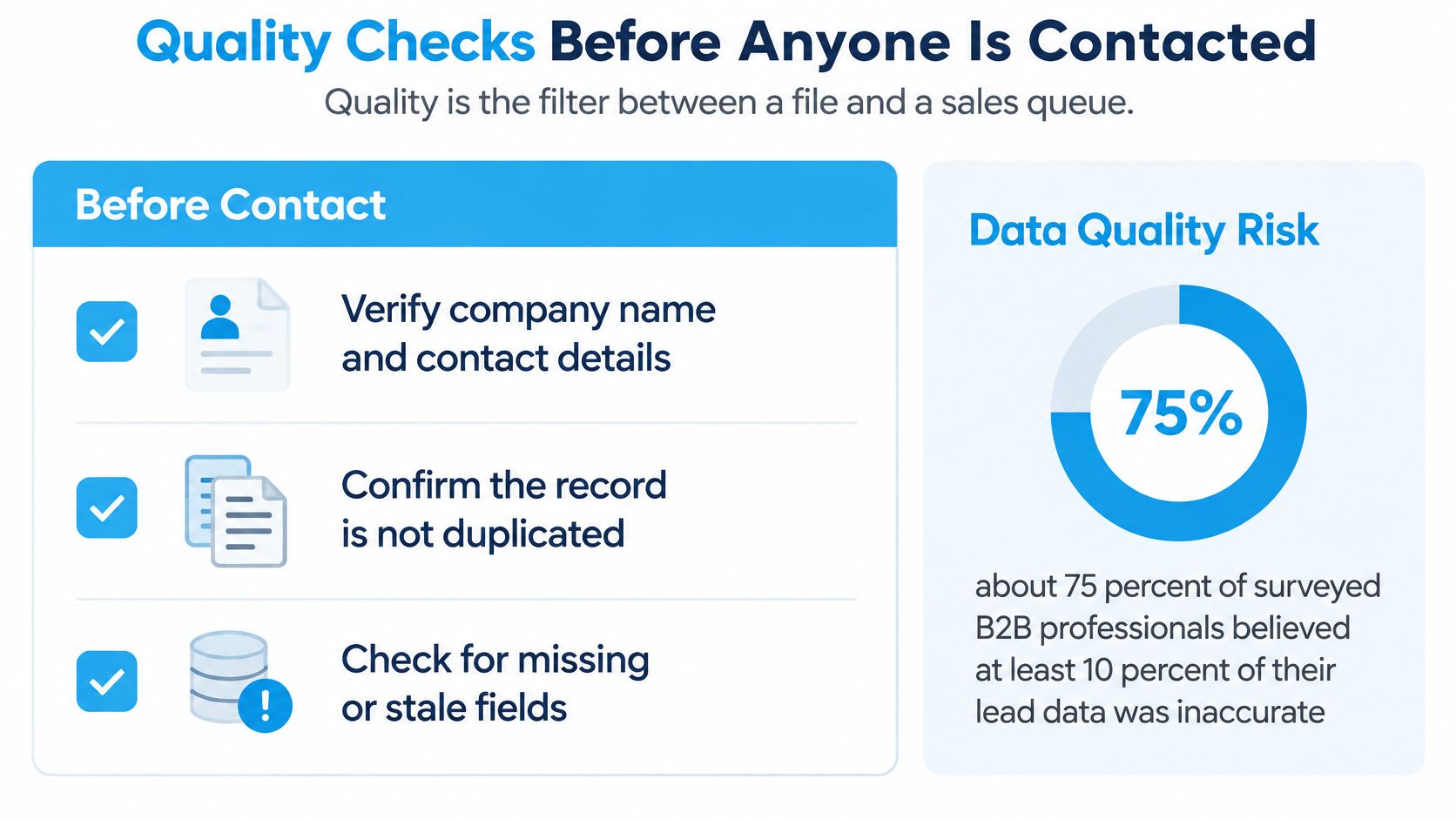
Quality is the filter between a file and a sales queue, and the survey numbers show how porous that filter usually is. Recent research covered by Demand Gen Report found that roughly 75% of surveyed B2B professionals believed at least 10% of their lead data was inaccurate, outdated, or non-compliant. More than 60% said poor data disrupted lead handoffs or reduced sales productivity, while only 31% expressed complete confidence in their compliance efforts.
Three Statuses You Must Not Collapse
A publicly visible address means a person or business chose to display contact details on a profile. A deliverable address means the mailbox accepts mail without bouncing. Permission to market means you have a lawful basis to send the specific message you're planning. These are three different facts, and treating the first as proof of the third is where teams get into trouble.
Public visibility is a research clue, not consent. Rules differ by country and by whether your message is a cold pitch or a follow-up to a request, which is why CAN-SPAM and GDPR belong in your record standard rather than in a policy document nobody opens. This isn't legal advice, and it doesn't replace counsel for your market. It is an operational requirement: if you can't show where a record came from, you shouldn't be contacting it.
The Check Order That Protects Sales
Run these checks in working order before any record reaches a rep:
- Verify the address: Confirm format and deliverability, and record the validation result on the record itself.
- Remove duplicates: Deduplicate against the CRM so two reps don't work the same account from different files.
- Drop orphaned role accounts: Remove generic inboxes that no named person owns or reads.
- Suppress aggressively: Exclude prior opt-outs, existing customers, and anyone on your do-not-contact list.
- Reject unsourced records: If there's no source audience and collection date, the record doesn't enter the queue.
Your minimum record standard is collection date, source audience, lawful basis or permission note where one exists, validation result, and suppression status. Our guide on building a data quality standard before import walks through how to set those fields up so they survive every future upload.
Fresher extraction still creates risk when provenance is missing. A list collected this morning with no source trail is worse than an older list you can fully explain, because you can't honor opt-outs, answer complaints, or prove what you did. End with the acceptance rule sales should use on every handoff: deliverable, relevant, sourced, and not suppressed. Email yield alone doesn't pass.
How to Move a Signal Into Sales
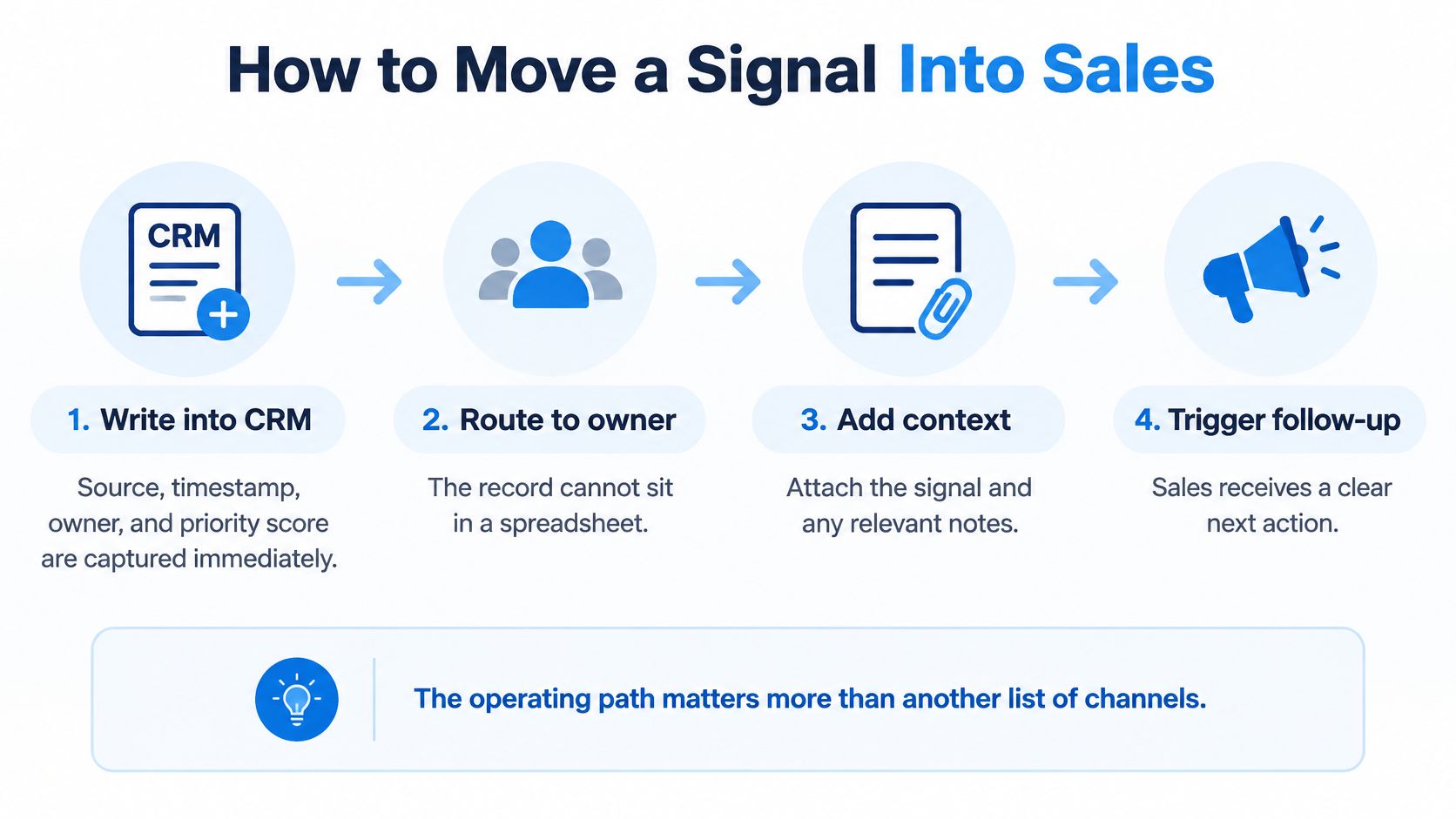
The operating path matters more than another channel. Here is the sequence I would install before spending on any new source, because a larger export only adds records to a queue that is already leaking.
Six Moves in Order
- Write the record into the CRM immediately. Capture source, timestamp, owner, and priority score the moment the record exists, so it can't sit in a spreadsheet waiting for someone to remember it.
- Contact high-intent leads within 5 minutes. For a demo or pricing request, speed is the strategy. The MIT/InsideSales Lead Response Management Study, cited by OnceHub, found that contacting a web-generated lead within 5 minutes makes qualification 21 times more likely than waiting 30 minutes.
- Send an acknowledgment while the owner is assigned. Automated routing plus an immediate confirmation bridges the gap, and the confirmation should state the expected reply window so the buyer knows a human answer is coming rather than wondering if the form worked.
- Set a same-business-day clock for colder segments. For audience-derived lists, the delay to minimize runs from file delivery through validation, segmentation, and first touch. Stamp each stage separately so you can see where the hours went. A follower of a competitor never asked to hear from you, so the first touch has to earn attention instead of assuming intent.
- Qualify on fit, problem, and buying role. A reply alone never qualifies the record. Count it as sales-qualified only when the account fits, a real problem is stated, and the person can influence or make the decision.
- Review outcomes by response band. Compare qualification rates across bands instead of hiding latency inside one average, and split the review by lead type so a slow demo request never gets averaged against a same-day list contact.
| Response band | Lead type | Measure |
|---|---|---|
| Under 5 minutes | Demo or pricing request | Qualification rate target |
| 5 to 30 minutes | Demo or pricing request | Compare with the under-5 band |
| 30 to 60 minutes | Web or event lead | Flag as latency gap |
| Over 24 hours | Any lead | Treat as operations failure |
Now hold that standard up against actual behavior. Many B2B teams take a day or more to respond to inbound leads, which is an operations failure even when the list, the offer, and the messaging are all sound. Buyers don't wait that long out of loyalty to your form. They talk to whoever responds while the problem is still on their screen.
Response bands tell you which failure you're fixing. If leads contacted in under 5 minutes qualify well and leads contacted after 24 hours don't, the channel is fine and the queue is broken. You need routing, coverage, and a clock. Our roundup of tools that support faster prospecting handoffs is useful once the process exists, because software can't compensate for an unowned queue.
Handoff test: Every new record has an owner and a clock, or it isn't a lead yet.
Treat response time as a pipeline-control metric reviewed weekly, next to SQL rate, in the same meeting where pipeline gets inspected. When a band slips, fix staffing or routing before you touch targeting. Pull the timestamps before you blame the list: if the file arrived Monday and the first touch went out Thursday, audience quality was never tested. Otherwise you'll keep blaming list quality for damage your own delay caused.
Demand When Buyers Never Fill a Form
Form-first advice assumes buyers announce themselves. Many don't. Recent coverage in a community and dark social playbook reports that 68% of B2B buyers already had a preferred vendor at the beginning of a purchase. It also reports that 67% preferred a buying experience without a sales representative and 45% had used AI during a recent purchase.
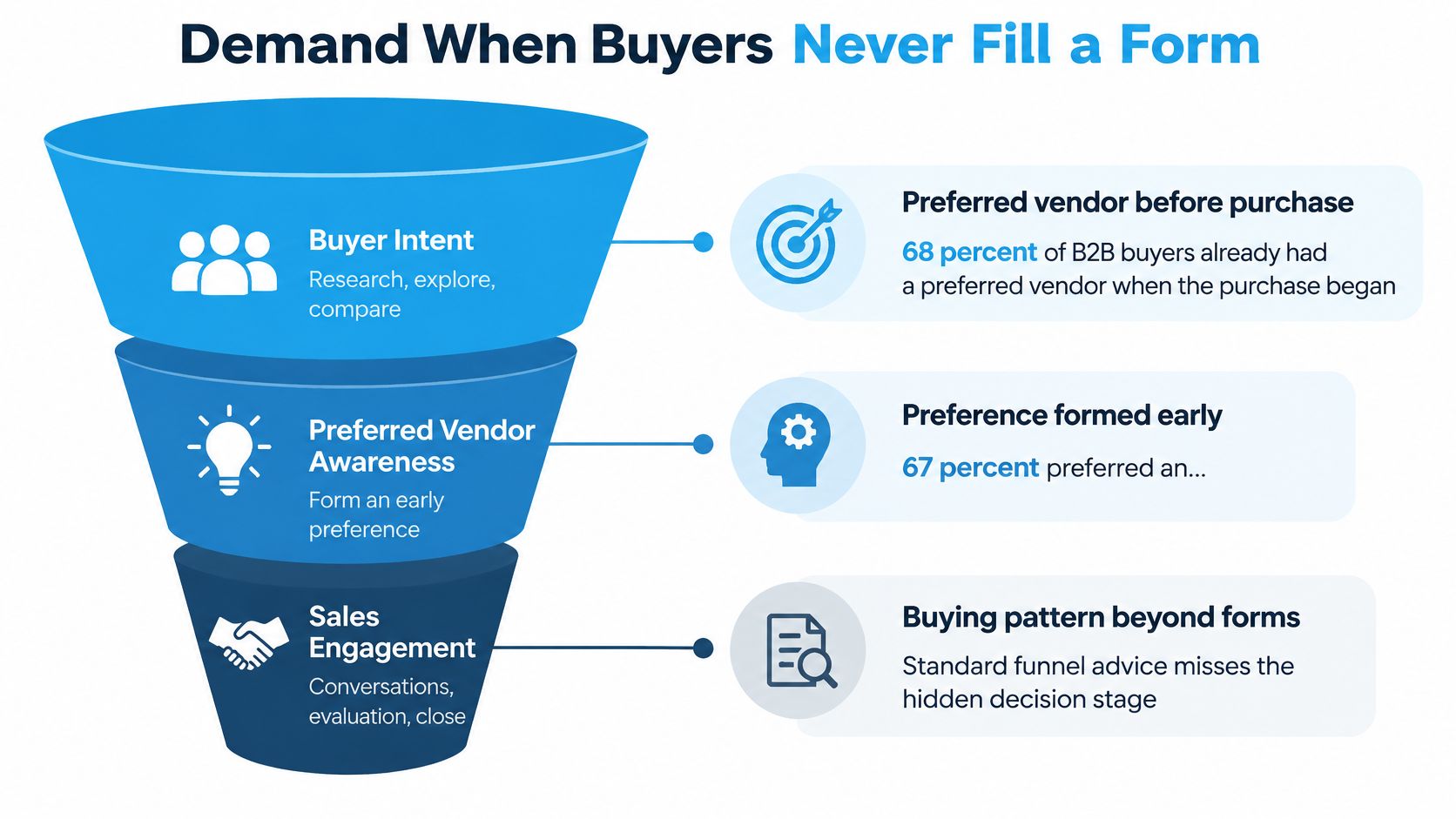
Those buyers research through communities, referrals, social profiles, private discussions, and AI assistants before they're identifiable in your CRM. If you wait for a form fill, you miss the shortlist entirely and compete only for buyers who haven't already decided, which is a smaller and harder pool than many organizations are willing to acknowledge.
Work Clusters, Not Just Contacts
Pick a tight account cluster, such as agencies, coaches, or operators in one niche, and use public audience signals to see who already pays attention to respected peers in that world. Then have a human check role and fit before any outreach happens. A relevant public profile is a reason to research, not a reason to pitch as if a demo was requested.
On the owned side of the same problem, anonymous website traffic holds similar clues about which accounts are researching you without converting. For teams trying to act on that signal responsibly, Captiwate's guide to identifying website visitors explains how visitor identification can surface interested accounts before a form ever appears.
Measure influenced pipeline when first-touch attribution isn't available. Practical measures include:
- Opportunities from worked segments: Accounts that entered pipeline after being part of a cluster you actively researched and engaged.
- Meetings that name the source: Conversations where the buyer mentions your content, a community, or a peer who pointed them your way.
- Revenue from pre-lead accounts: Deals from accounts you touched with useful material before they ever became a named lead.
Wider extraction can improve market coverage and still hurt results if you ignore buying timing, role relevance, and channel trust. I'd rather work a small cluster with segment-level insight, such as common offers, pricing patterns, or tools peers mention publicly, than blast a large audience with a generic claim.
Make one reporting change this quarter: add an influenced-pipeline line next to sourced pipeline. Dark-social and audience work shouldn't be judged by form fills it was never going to create. It should be judged by whether the accounts in your clusters show up in pipeline more often than accounts outside them.
One Audience List Becoming Pipeline
Say a small consultancy sells client-acquisition help to independent fitness coaches. The team picks a respected coach account in the 10,000 to 250,000 follower range and works that account's following list, because peer accounts are more likely to be working operators than casual fans gathered around a mega account. Business pages, creators, and coaches tend to list their emails more often than other account types, which makes this niche a sensible place to test.
The export they receive is a starting file of public profile fields, not a dial list. That starting point is what a team sees when it plans the review properly.
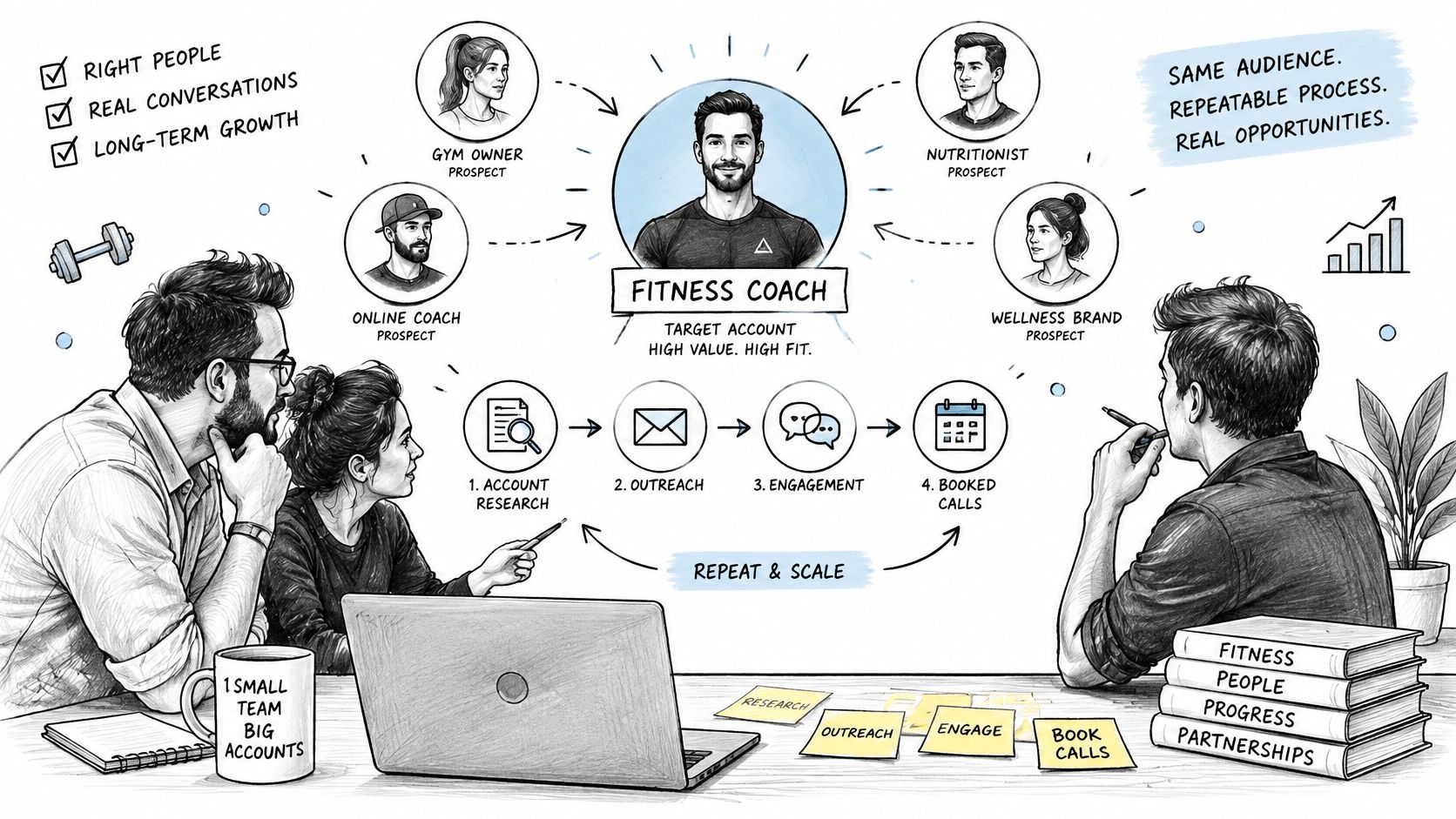
A person reviews a sample the same day, checking category, bio, website, and whether a public email is listed. They keep coaches who clearly sell a service, drop fans and meme pages, and suppress anyone already in the CRM. Scraping a following list almost always gives better email rates than scraping followers, and business-focused niches like fitness coaches typically yield 15–30% email rates, so the tighter source choice matters before a single message is written.
From Sample Review to SQL
The first note references the shared niche and one specific problem, such as turning profile views into booked consultation calls. It offers something useful up front, like a short teardown of the coach's booking page, and makes opting out easy. Nothing in the message pretends the coach asked to be contacted.
Replies get coded into three buckets: not relevant, conversation, or meeting. Only a meeting where the coach names a real problem, such as inconsistent inquiries or no follow-up system, becomes an SQL. Friendly replies that go nowhere stay conversations, however encouraging they felt.
Before scaling anything, the team watches a short walkthrough of the workflow to keep everyone handling files the same way.
Then comes the comparison that decides the budget. The team measures this cohort against last month's webinar list on positive replies, SQLs, and opportunities, not on how many emails were found. If the following-based cohort produces fewer rows but a higher SQL rate, they keep the tighter audience and don't chase raw count.
Watch the edge case. A celebrity fitness account's followers will look enormous and convert poorly, because mega accounts with over a million followers tend to draw casual users who aren't buyers of anything. The lesson isn't a new tactic. It's cohort discipline: one defined audience, one human review, one honest comparison.
Pick the Motion That Fixes the Weak Rate
Start from the weak rate you marked, not from a generic tool list. If visitor to MQL is weak, narrow the audience or sharpen the offer before buying more traffic. If MQL to SQL is weak, install the five-minute or same-day clock and name an owner for every record.
If sales keeps rejecting the file, run the provenance and suppression checks before another send, because the problem is trust in the data, not message copy. If buyers never appear in forms, build one peer cluster and report influenced pipeline beside sourced pipeline. For a broader map of motions you could layer onto that diagnosis, the overview of B2B lead generation strategies from Yalc is a solid reference.
For teams whose missing piece is specifically a fresh list of publicly listed contacts from an Instagram audience, HarvestMyData is one option. It's an automated Instagram email scraper that extracts publicly listed emails and phone numbers from followers, following lists, and hashtags, with no customer Instagram login required. Payment comes before processing, and results are delivered by email within 24 hours, typically under an hour.
| Profiles | Price |
|---|---|
| 1,000 | $3 |
| 25,000 | $18 |
| 50,000 | $25 |
| 100,000 | $49 |
| 150,000 | $69 |
| 250,000 | $99 |
The file remains a research input, not a permission slip. Users agree to use data only for lawful purposes, comply with CAN-SPAM and GDPR, avoid harassment, not resell raw data, and honor opt-out requests. Fix one weak rate this week, and order an audience file only if targeting, not speed or trust, is your actual gap.
If your weakest rate points to targeting rather than speed or data trust, start with a small, defined Instagram audience through HarvestMyData and measure it as a cohort from first touch to SQL. Run the quality checks, keep the source on every record, and let the opportunity rate, not the row count, decide whether you scale.
We built HarvestMyData to handle all of this for you.
No proxies, no code, no account needed.