Instagram Influencer Outreach Steps and Templates

Instagram accounted for 42% of influencer campaigns in 2024, according to Collabstr's 2025 Influencer Marketing Report. That makes it a mainstream partnership channel, but it doesn't make a spreadsheet of Instagram usernames a pipeline.
Effective Instagram influencer outreach starts with the finished work you need, not the biggest audience you can export. Work backward from published assets, qualify creators before contacting them, and make the commercial terms clear enough that someone can answer without opening a pitch deck. Sponsorship disclosure and a way to decline belong in that first conversation, not in paperwork sent after an enthusiastic yes.
Table of Contents
- Planning baseline for a 1,000-profile creator list - Work backward from published assets
- Build the working queue - Send, then manage the decision
- Pre-pitch screen for Instagram creators - Rank the whole account
- Template A for the first email - Template B for a follow-up - Template C for an Instagram DM - Delete the parts that create work
- Make transparency part of the creative agreement - Keep permission and provenance attached
- Use explicit hold and scale decisions - Expand a defined audience
What 1,000 Creator Profiles Actually Return
A useful starting forecast is about 207 replies and 147 completed collaborations from 1,000 contacted profiles, applying the results of a University of Novi Sad study of 116 influencers reported by InstaOutreach: 20.69% replied to an unpaid product offer, while 14.66% accepted and completed the collaboration.
That's a planning scenario, not a promise. The offer was unpaid product, the sample was small, and your niche, market, creator tier, and list quality will change the outcome. A relevant paid brief can perform better; an untargeted export deserves a more conservative forecast.
Planning baseline for a 1,000-profile creator list
The study-based rows below apply those reported shares to the hypothetical list. The remaining rows are measurements to collect, not additional benchmarks.
| Stage | Share of list | Count from 1,000 | What to record |
|---|---|---|---|
| Contacted | 100% | 1,000 | Source, niche, and why this creator |
| Replied | 20.69% | About 207 | Any human reply, positive or not |
| Accepted and completed | 14.66% | About 147 | Posted asset, not just a yes |
| Delivered | Delivered ÷ contacted | Count confirmed delivered | Bounce or DM-not-delivered versus reached |
| Qualified-positive reply | Qualified-positive ÷ contacted | Count interested and suitable | Fit, not a polite no or a rate-card dump |
| In negotiation | Negotiating ÷ contacted | Count with terms open | Fee, usage, timeline still open |
| Cost per accepted collaboration | Not a list share | Campaign cost ÷ accepted deals | Cash plus product; also divide by completed posts |
| Revenue or attributed conversions | Not a list share | Tracked sales or conversions | Code, link, or tracked landing page |
Keep cost per accepted collaboration separate from cost per completed post. An accepted deal that never publishes still consumes time and possibly product or payment. Combining the denominators hides that loss.
Work backward from published assets
Say your campaign needs 15 finished posts. Applying the study's completion share gives a hypothetical requirement of 15 ÷ 0.1466, or about 103 qualified contacts. That means a list on the order of a hundred suitable creators, not fifteen usernames.
Build room for replacements rather than booking every launch dependency against the expected outcome. A creator may like the product but reject the usage rights, need a later posting window, or require a fee outside your budget.
Planning rule: A reply is a conversation. A completed, approved, published asset is an outcome.
Reply rate alone is a vanity stage. A polite rejection counts as a reply; so does a request for more information that never becomes a booking. Track whether interested creators clear compensation, timeline, rights, and publication.
Before adding a prospect to the contact queue, record their niche, geography, audience size, and a recent post your opening message can name. Those filters make the forecast more credible and give the person writing the pitch something useful to say.
How to Run the Outreach From List to Yes
Keep discovery, qualification, messaging, and negotiation separate. Otherwise, a teammate will mistake an exported address for an approved prospect, and you'll spend your personalization time on accounts that should never have entered the queue.
This workflow keeps the decisions in order.
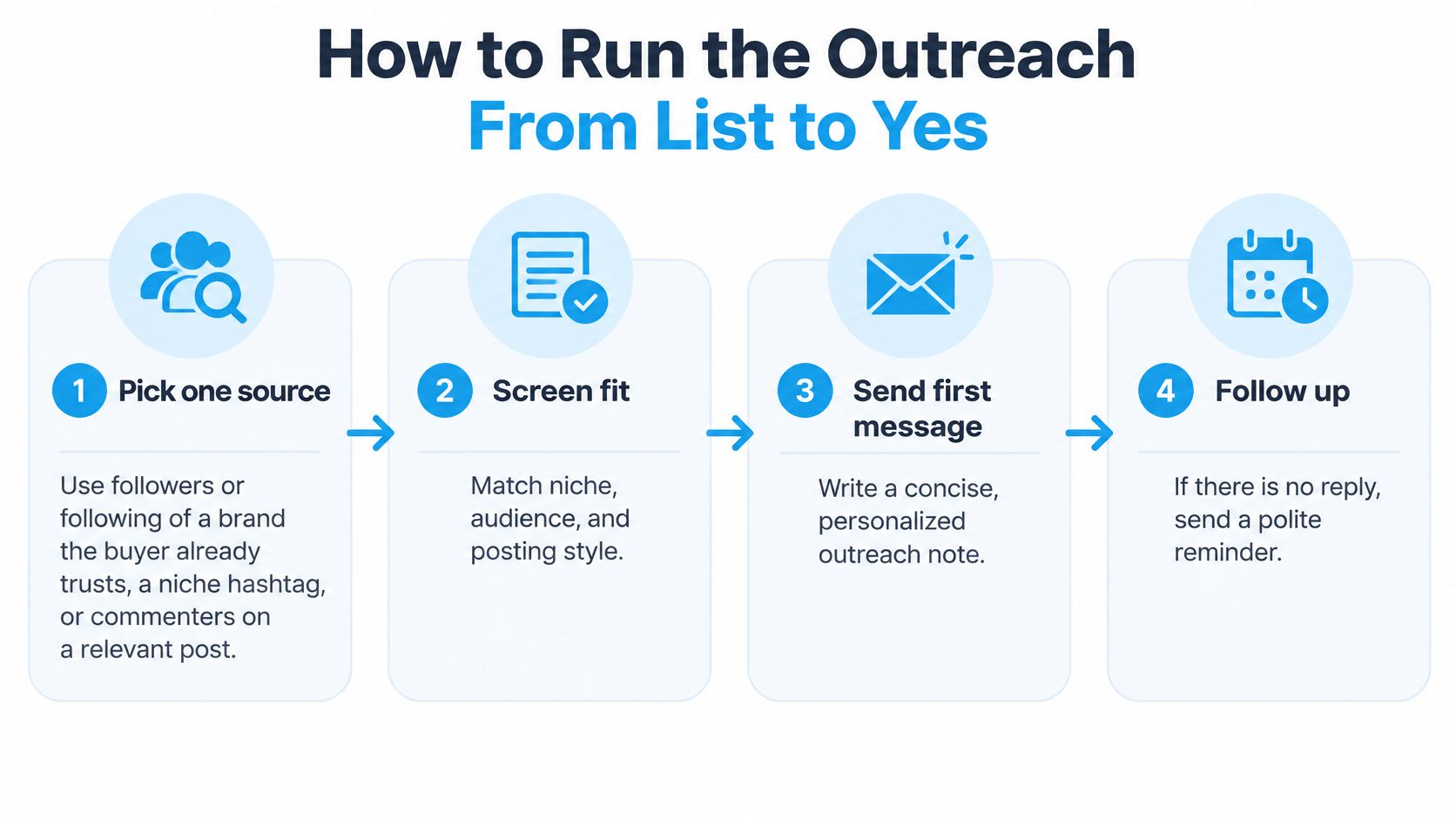
Build the working queue
- Pick a defined source. Start with the followers or following of a brand your buyer trusts, a niche hashtag, or commenters on a relevant post. Inspect a brand's following list when you want working creators rather than general fans. Don't combine unrelated audiences immediately, because you won't know which source produced useful prospects.
- Segment before researching thoroughly. Group profiles by niche, geography, audience size, and format, such as Reel, carousel, or Story. Check whether they already make the kind of asset you need. Treat follower bands as test ranges, not proof of value: a creator who teaches through carousels isn't automatically the right person for an on-camera demonstration.
- Write the fit sentence. Open recent posts and explain why this creator's audience would care about the product. If the explanation amounts to having followers, remove the profile. A structured Instagram influencer database workflow helps keep that qualification attached to the profile rather than scattered across browser tabs.
- Confirm the intended contact channel. Use a public business or partnership address the creator has published for commercial inquiries. Don't guess an address or choose a personal-looking mailbox just because it passes a technical check. If an agency handles partnerships, address the proposal to the representative rather than pretending you're writing directly to the creator.
Send, then manage the decision
- Send a short first note. Name the recent post, identify your brand, and state the proposed deliverable and compensation structure. Include the intended sponsorship label and a simple decline option. Don't attach a deck that makes the recipient search for the actual offer.
- Follow up selectively. Send a polite reminder, then stop if there's no engagement. Where appropriate, a final follow-up can clarify the posting window, usage rights, and disclosure approver. Don't introduce surprise obligations after the creator expresses interest. For another perspective on organizing that conversation, the guide to connecting brands with influencers through JoinBrands is a useful companion.
- Move the row, not just the email. Update delivered, replied, qualified-positive, negotiating, accepted, and completed statuses in Google Sheets or your CRM. Assign the next action and owner whenever terms remain unresolved. An inbox thread without a named owner is easy to leave unfinished.
The qualification handoff should include evidence, not just a green cell. Save the post reference, audience-fit explanation, and any concerns the campaign manager needs to resolve before committing money.
A partnership inquiry is not a newsletter subscription. Keep creator conversations out of unrelated marketing automations, even when the same email platform could technically handle both.
Screen Fit and Engagement Before You Pitch
A larger follower count does not guarantee a stronger campaign. The useful question is whether the creator's audience fits your offer and whether recent posts show credible engagement.
Influencer Marketing Hub's 2021 benchmark report reported 3.86% average engagement for Instagram micro-influencers. Treat that figure as context, not a universal pass mark: performance varies by niche, format, and account size.
Use this checklist to assess the full account before you pitch.
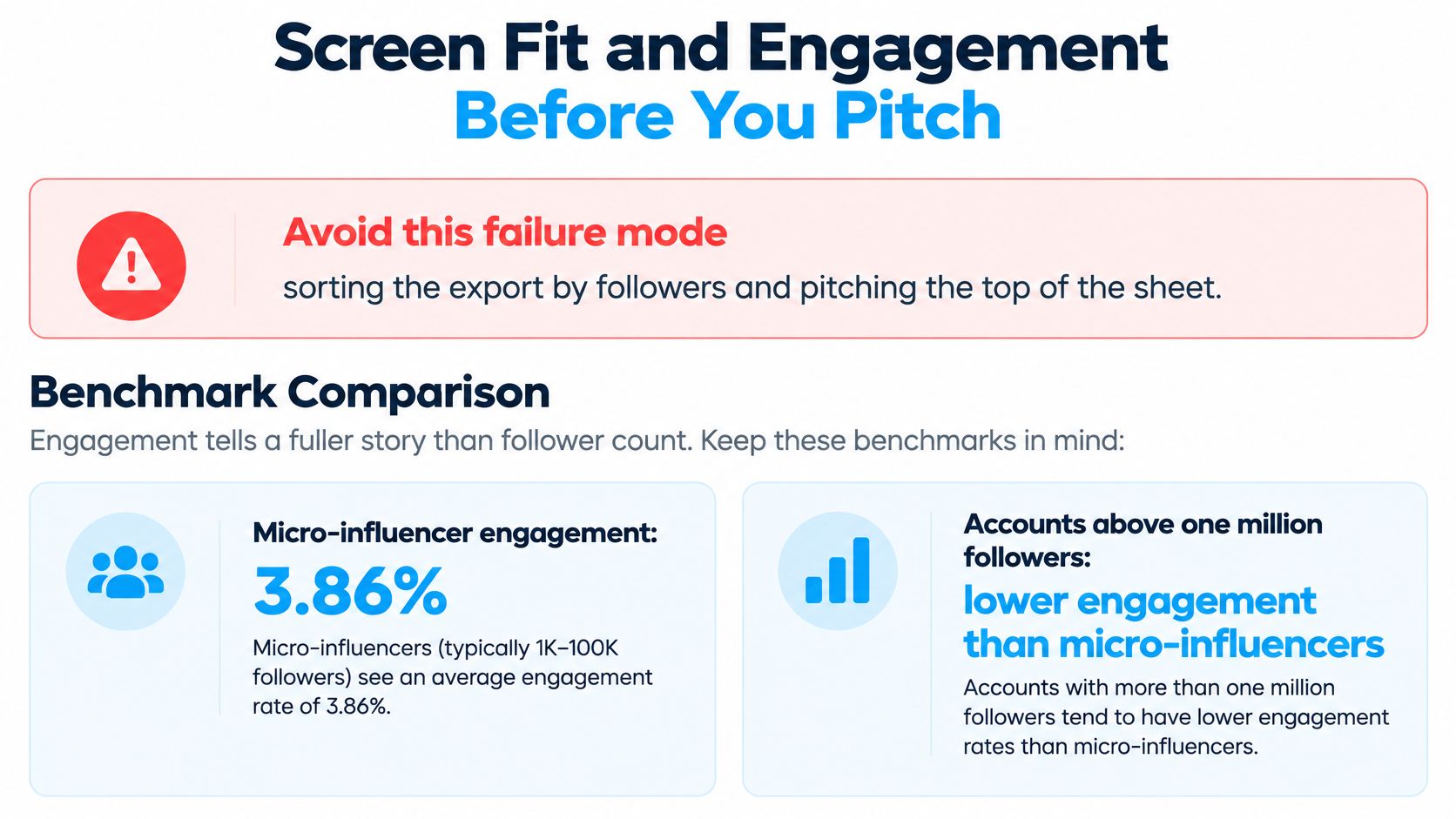
Pre-pitch screen for Instagram creators
| Screen | How to read it | Signal to check |
|---|---|---|
| Engagement rate | Compare interactions on recent posts with follower count; look beyond a single viral post | Use the same calculation across comparable accounts |
| Reach or views | Record separately from the like-based rate when the creator shares insights | Compare similar formats and reporting periods |
| Comment quality | Scan for repeated, templated, or off-topic comments | Empty or repetitive comments weaken the engagement signal |
| Follower spikes | Match growth jumps to real posting dates | Investigate unexplained jumps before booking |
| Audience country | Compare audience geography with the market you sell in | A mismatch may mean the audience is poorly aligned with your buyers |
| Fraud exposure | Review patterns and request relevant analytics before a paid booking | Unexplained engagement patterns need clarification |
Calculate follower-based engagement consistently: divide interactions by followers and express the result as a percentage. If you only have public likes and comments, label the measure accordingly. Saves, shares, reach, and audience composition require information the creator can choose to provide.
Compare recent medians, not the best-performing post. Keep Reels separate from static posts when reviewing views and interactions, and account for giveaways or unusual collaborations. A single exceptional post is weak evidence of typical campaign performance.
Rank the whole account
Comments can reveal whether people are paying attention to the creator's subject matter. Questions about technique, product suitability, or recommendations are more useful than repeated compliments with no connection to the post. Repetition warrants a closer look, but does not prove manipulation.
Before agreeing on a paid fee, request analytics for the relevant format, reporting period, and audience geography. A detailed Instagram audience analysis can help assess whether a creator reaches the market you sell in, even when their location differs from their audience.
Build a composite assessment using:
- Topical fit: Does the product belong in the creator's existing content?
- Posting consistency: Can they deliver the format without reinventing their production?
- Audience-market fit: Can you serve the people likely to respond?
- Engagement quality: Do people ask relevant questions and receive meaningful answers?
- Estimated reach: Do recent comparable posts support the proposed fee?
- Fraud risk: Are unusual patterns explained by credible analytics?
Choose thresholds that fit the niche, format, country, and account size. Public contact information is a starting point for appropriate business communication, not permission for bulk blasts. Prioritize the creator whose audience fit, recent performance, and comment quality support the fee, even when a larger account looks more impressive on a slide.
First Messages and Follow-Ups That Get Read
Consider a hypothetical campaign: GlowKind, a skincare brand, wants a fitness coach to demonstrate a post-workout routine. The proposal should explain the connection between the coach's content and the product, not praise the size of the account.
Keep the message visible on a phone screen without turning it into contract negotiations.
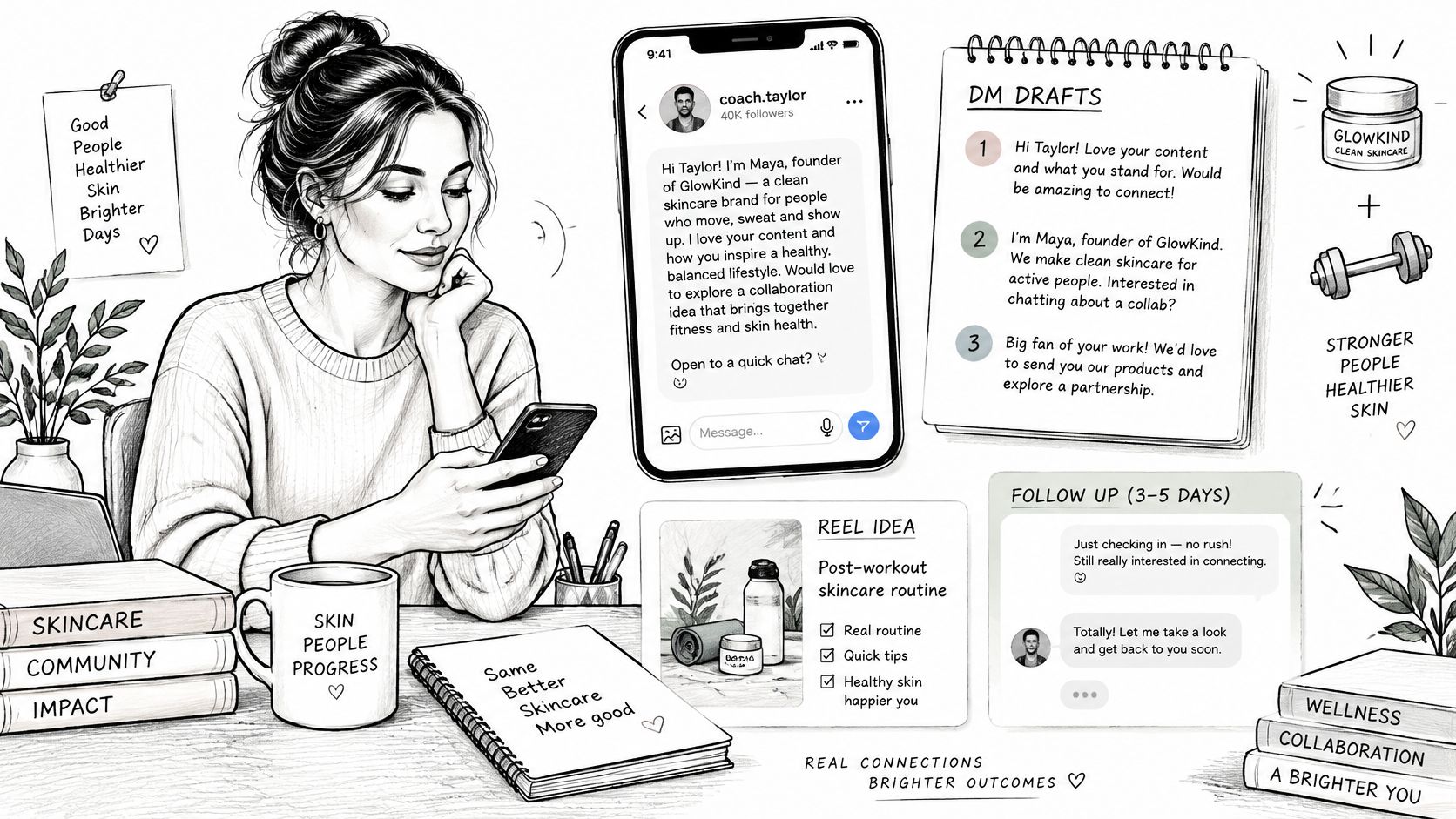
Template A for the first email
Subject: Maya, your post-workout routine Reel
Hi Maya,
Your recent gym-bag Reel made the transition from training to skincare feel practical, especially the rinse-before-moisturizing step.
I'm Alex, partnerships lead at GlowKind. We'd like to commission a Reel showing your post-workout routine, with product plus a creator fee, a proposed 30-day organic reposting license, and no whitelisting.
We'd use an ad disclosure in the video and caption. Open to reviewing the budget and short brief?
If this isn't relevant, reply no and I won't follow up.
Alex Partnerships, GlowKind
Template B for a follow-up
Subject: Re: Maya, your post-workout routine Reel
Hi Maya,
Following up on GlowKind's paid post-workout skincare Reel proposal. The offer is product plus a creator fee, with publication during our agreed launch window and the organic usage proposed below.
Our partnership lead will draft the ad disclosure for your review before production. Would you like the budget and brief?
If you'd rather not receive partnership inquiries from us, reply no and I'll close your record.
Alex
Template C for an Instagram DM
Hi Maya, Alex from GlowKind here. Your gym-bag Reel's rinse-before-moisturizing tip fits a paid post-workout skincare campaign we're planning.
What's the best partnership email for a short brief? No worries if it's not a fit.
These are scenarios, not messages to send unchanged. Replace the content reference with something the creator published, and replace the proposed rights with the rights your campaign needs. Whitelisting, or running ads through a creator's identity, requires a separate explicit agreement, not an assumption hidden inside permission to repost.
For more variations, Mailbeam's partnership outreach templates with verification tips can help you check the message and recipient before sending. Keep the email specific even when your underlying structure is reusable.
Use the video as an additional reference while drafting your outreach.
Delete the parts that create work
Cut follower compliments, vague admiration, and the brand's founding story. Remove the PDF deck from the opening email, repeated reminders, and questions that require the creator to assemble a media kit before knowing whether you have a paid offer.
I'd rather send a short, accurate proposal than a polished introduction with no commercial substance. The creator should be able to identify the ask, understand the compensation model, and decide whether to continue.
One specific post, one ask, one way to say no.
Before sending, complete only these personalization fields:
- Post URL: The exact asset you're referencing.
- Existing format: The format they already produce well.
- Audience purchase reason: Why their followers would consider this product.
Put Disclosure and Opt-Out in the First Brief
Only 37% of influencers used the word ad in a content analysis of 150 sponsored Instagram posts, while the standardized paid-partnership disclosure appeared in 24%, according to the University of South Florida thesis. Don't assume a creator's normal labeling habit matches your campaign's requirements.
Put the proposed disclosure language in the first brief, before the creator agrees. For a Reel, specify the spoken disclosure, readable on-screen label, and caption placement you want, then identify who checks them before publication. A vague instruction to disclose appropriately leaves an avoidable approval dispute.
Make transparency part of the creative agreement
The same thesis explains the U.S. Federal Trade Commission requirement to disclose financial or material connections with brands. Treat the label as a legal and reputational issue, not a styling detail the editor can remove to make the opening frame cleaner.
Your approval process should answer practical questions:
- Language: What clear sponsorship wording will viewers encounter?
- Placement: Where will viewers see or hear it while consuming the endorsement?
- Ownership: Who drafts the wording, and who approves the finished execution?
- Evidence: Who saves the agreement, approved asset, and live-post record?
Don't promise that transparency will either improve or hurt every campaign's performance. HypeAuditor's disclosure benchmark examines disclosed and undisclosed sponsored Instagram content across creator tiers, making tier and format useful variables to consider rather than treating all sponsored posts as interchangeable.
Measure saves, link clicks, and conversions, not only likes. If you compare disclosure approaches, keep every version compliant and avoid changing the creator, creative concept, and disclosure treatment simultaneously. Otherwise, you won't know what caused the difference.
Approval principle: Never ask a creator to make a partnership look independent.
Keep permission and provenance attached
A public email address isn't automatic consent for every marketing purpose. SponsorRadar's Instagram email-finder guidance distinguishes appropriate business contact from indiscriminate use of publicly available addresses. Match the inquiry to the mailbox's stated purpose, and don't repurpose a press or management contact for unrelated sales sequences.
Record the source location, collection date, contact purpose, lawful-basis assessment, and suppression status. For cross-border campaigns, use a documented GDPR email marketing workflow and get jurisdiction-specific advice where needed.
Our users agree to use data only for lawful purposes, comply with applicable anti-spam laws including CAN-SPAM and GDPR, honor opt-out requests, and never use data for harassment or stalking. They also agree not to resell or redistribute raw data.
After publication, check the live post against the approved brief and retain the commercial record. Close the brief with a plain clause:
Disclosure: Ad, spoken and on-screen in the Reel and clear in the caption; approval by our partnership lead before posting; reply no to stop further outreach.
Scale the List After the First Batch Works
Scale from the tracker, not from enthusiasm about an export. Start with a manageable batch of qualified creators that your team can research, contact, and support through production. Keep the source consistent enough to learn whether the audience selection worked.
Don't increase volume while basic delivery problems remain unresolved. More addresses won't fix a misleading subject line, an irrelevant source audience, or an offer whose usage requirements exceed its budget.
Use explicit hold and scale decisions
Separate interest from commercial progress. A healthy inbox can still produce a weak campaign if creators repeatedly decline the fee or stop replying when they see the rights clause.
| Decision | What you're seeing | Action |
|---|---|---|
| Hold | Bounces or unclear delivery | Validate the contact channel and sending process |
| Revise | Replies, but little qualified interest | Change targeting or the offer |
| Renegotiate | Interest stalls around rights or payment | Separate production, organic usage, and paid usage |
| Repair | Accepted deals don't reach publication | Review ownership, approvals, and production timing |
| Scale | Sustainable completed-post cost and compliant live assets | Expand the same source before adding another |
Choose a cost per completed post you'd willingly pay again. Include creator fees, product, shipping, and the operational effort you need to manage the work. A cheap contact list doesn't make an expensive collaboration profitable.
Expand a defined audience
For the next file, choose a specific public audience: followers, following, a hashtag, commenters, or likers connected to your buyer's interests. Keep the source field in the export so you can attribute eventual collaborations to the original audience.
HarvestMyData extracts real, publicly listed emails and phone numbers from Instagram business and creator profiles, checking profiles individually beyond the bio without requiring your Instagram login. Our follower-scraping prices include $3 for 1,000 users, $12 for 10,000, $49 for 100,000, and $99 for 250,000. Those are profile-processing quantities, not guaranteed email counts or qualified creators.
Our average public-email yield is about 10%, with substantial differences by niche. Treat that as a service-level planning assumption to verify against your own batch, not an independent influencer-outreach benchmark. Then measure the additional losses between an email found, an appropriate business address, a qualified creator, and a completed collaboration.
Once creators commit, separate production coordination from prospecting. A social media scheduler from iHatePosting can be considered for the brand-owned publishing workflow, while your partnership tracker remains the record of creator obligations, approvals, and rights.
This week, finish a test batch before adding another source. Expand only when the completed work is worth buying again and your team can maintain the same qualification and approval standards.
HarvestMyData turns defined public Instagram audiences into structured CSV or Excel files with profile information and publicly listed contact details. Visit HarvestMyData to build a focused prospecting file, then qualify the creators and test your outreach before scaling.
We built HarvestMyData to handle all of this for you.
No proxies, no code, no account needed.