Instagram Followers List Order: What It Shows and Hides

The most popular advice about Instagram followers list order promises more than the evidence supports: look at the top names to find your newest followers, strongest fans, or recent profile visitors. Those are different questions, and a row number can't reliably answer any of them.
For founders, agencies, and sales teams, the useful distinction is between a personalized display and an activity record. An exported list can preserve the accounts and public details visible during collection. It can't turn hidden ranking decisions into verified follow dates, profile visits, or buying intent.
Table of Contents
- Common Assumptions About Follower List Order - Separate Available Features From Assumed Capabilities
- Confirm the Surface Before the Signal - Signals That May Affect List Order - Why a Plausible Story Isn't an Audit Trail
- A Coworker Comparison - Search and Visibility Change the Question
- What Changes Between Two Follower Exports - Repeated Observations Still Need Scope Limits
- Keep Timing Evidence Separate - Record an Observation Window Honestly
- Replace Rank With Decision Criteria - Make Every Qualification Explainable
Why Your Followers List Is Not a Timeline
Instagram doesn't publish a fixed, complete rule that puts follower or following lists into chronological order. Treating the default display as newest-first is therefore an assumption, not a dependable method for dating a relationship.
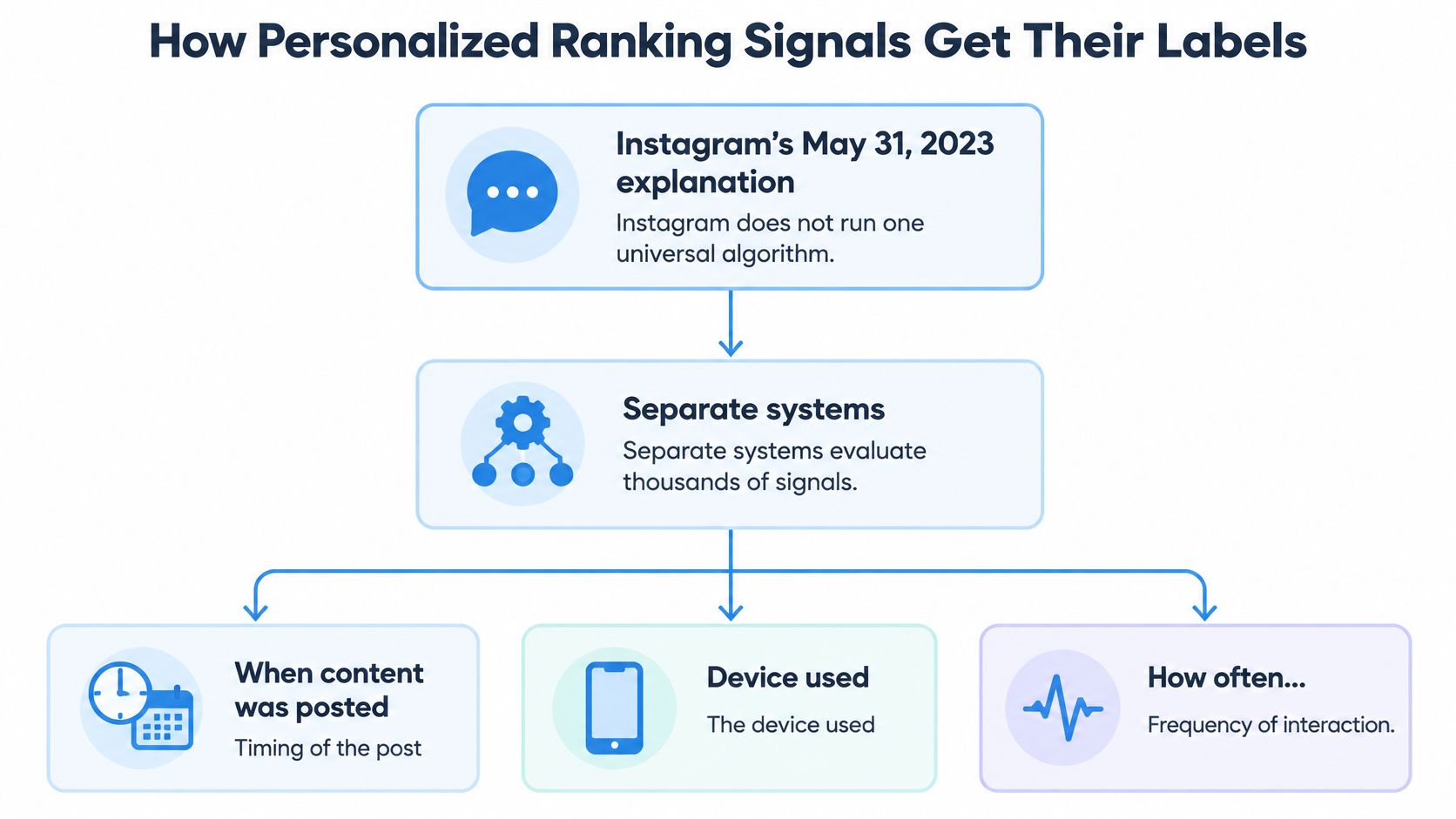
In its May 31, 2023 explanation, Instagram's ranking announcement explicitly describes separate ranking systems rather than one universal algorithm. It documents signals for surfaces such as Feed and Stories, but it doesn't publish a follower-list formula. That distinction matters: evidence that Instagram personalizes content isn't evidence that any particular interaction controls a follower's row.
Common Assumptions About Follower List Order
| Assumption | What the Evidence Shows | Verdict |
|---|---|---|
| The newest follower always appears first | Default display is algorithmic, not a fixed newest-first sequence | Not reliable |
| Top accounts are your most engaged followers | Ranking may reflect interaction signals, but no weights are published | Plausible, unconfirmed |
| Top accounts recently viewed your profile | No documented link between profile visits and list position | Not supported |
| Position reflects commercial value or popularity | Position is personalized to the viewer and context | Not supported |
The table separates an unsupported conclusion from a plausible explanation. Engagement could help explain why an account appears prominently, but that doesn't establish that the list measures engagement accurately or fully. A commercial interpretation requires an even larger leap: appearing early says nothing verified about budget, business fit, or willingness to respond.
Personalization also changes what a comparison means. Different viewers can encounter different orders for the same account set, so there isn't necessarily a single underlying rank waiting to be uncovered.
Practical rule: Preserve list position as contextual metadata, not as a timestamp or a popularity score.
Separate Available Features From Assumed Capabilities
Before building a workflow around an Instagram tool, identify what it lets you collect or manage. FoPost's option to browse supported Instagram features is useful for checking feature scope, rather than assuming that an integration exposes hidden follow dates or ranking inputs.
A spreadsheet doesn't remove this limitation. Exporting a displayed sequence makes it easier to examine, but it doesn't make that sequence chronological. Keep the extraction time attached to the file, and leave unsupported interpretations out of the column names.
How Personalized Ranking Signals Get Their Labels
The strongest analysis starts by asking which surface a documented signal belongs to. A signal confirmed for Feed isn't automatically confirmed for follower lists, even if the explanation sounds convincing.
Meta's Instagram ranking transparency material describes personalized prediction systems and the use of thousands of signals, with examples including posting time, device or access method, and interaction frequency. For Feed, the documented predicted actions include spending several seconds on a post, commenting, liking, resharing, and tapping the profile photo. Those predictions explain content ranking, not a published equation for ordering followers.
This diagram illustrates the separation between systems and inputs, rather than a follower-list recipe.
Confirm the Surface Before the Signal
Use confirmed only when the platform connects a signal to the specific surface under discussion. Likes and comments are documented ranking inputs in content contexts. Their precise effect on follower-list placement remains unconfirmed.
Use plausible for a mechanism consistent with documented personalization but not established for follower rows. Use unknown when the claimed connection lacks a documented basis. An exact percentage assigned to a follower-list signal shouldn't receive even a tentative numerical label.
Signals That May Affect List Order
| Signal | Where it is documented | Label |
|---|---|---|
| Likes and comments | Named in general ranking explanations, not as follower-list weights | Plausible |
| Time spent on a post | Feed predicts spending several seconds on a post | Plausible |
| Story replies, viewing history, and closeness | Stories ranking explanations, not a follower-list formula | Plausible |
| Recent follows used to infer interests | Interest inference, not row order | Plausible |
| Profile visits | Third-party claims; no documented link to list position | Unknown |
| Direct messages | Third-party claims about follower-list ordering | Unknown |
| Mutual connections | Third-party claims about follower-list ordering | Unknown |
| Exact percentage weights | Instagram publishes none for follower-list position | Not supported |
Think of a restaurant host who recognizes regular customers. Seating decisions might reflect familiarity rather than call-in order, but watching the seating chart wouldn't reveal the host's complete decision process. Likewise, a familiar account near the top of a list doesn't disclose which interaction, if any, put it there.
Say an account replies to a brand's Story and later appears prominently in the follower list. The reply is an observable event if the brand retains it. The claim that the reply caused the placement is a separate hypothesis, and the claim that the account subsequently visited the profile is another unsupported step.
The accompanying video offers additional context for evaluating ordering claims.
Why a Plausible Story Isn't an Audit Trail
The Lilach Bullock explainer on Instagram follower ordering discusses the interaction and personalization explanations commonly attached to list order. Such explanations are useful hypotheses, but they don't establish access to private events.
Can the top of a follower list reveal who recently viewed, searched for, or interacted with your profile? No. Position alone doesn't identify an event, its actor, or its time.
This also limits causal testing. If a person likes a post and then moves upward, other activity or display conditions may have changed during the same interval. Record the like and the movement separately; don't combine them into a claim that you've discovered the ranking rule.
Why Two Viewers Do Not Share One Order
A follower-list observation needs a viewer attached to it. Without that context, a team can accidentally combine different displays and describe the result as a single ranking.
Your own followers list and someone else's followers list aren't interchangeable research environments. The logged-in viewer matters, while followers and following identify different relationships: accounts following the target versus accounts the target follows. A comparison that mixes those list types doesn't measure the same audience.
A Coworker Comparison
Say a hypothetical agency has coworkers Maya and Leo inspect the same public account. Maya sees a prospect near the beginning; Leo sees that prospect much farther down. Neither observation establishes which position is the account's true rank.
Averaging those positions wouldn't solve the problem. It would create a new metric without a defined interpretation, while obscuring the fact that the observations came from different viewers.
Before comparing files, attach:
- Target account: The profile whose audience you inspected.
- Viewer context: The logged-in username, or the collection method if no customer login was involved.
- List type: Followers or following, stated explicitly.
- Collection time: When the observation or export occurred.
- Access conditions: Any restrictions, loading problems, or incomplete collection.
Search and Visibility Change the Question
Searching for a username inside a list helps locate that account. It doesn't supply a follow date or turn the search result into a relevance score. Record it as a lookup, not as evidence of where the account ordinarily appeared.
Access also needs its own field. If a private account or another visibility restriction prevents inspection, a missing name isn't enough to establish an unfollow. The collection may lack the access needed to observe the relationship.
Compare like with like: the same target, list type, collection method, and access conditions.
For a team, that means naming the viewer before interpreting the order. For an automated export, it means documenting the collection context rather than assuming the file reproduces what every Instagram user sees.
Reading Two Snapshots Side by Side
Say a small brand saves a follower export at the start of a campaign and another after the campaign ends. The analyst should match accounts by username, not by spreadsheet row, because row position is the variable being questioned.
Keep the original files unchanged, then create a comparison sheet. Normalize username formatting, remove duplicate records, and mark whether each username appears in the earlier file, the later file, or both. Treat usernames as practical matching keys, while recognizing that renamed accounts may need manual reconciliation.
What Changes Between Two Follower Exports
| Observed Change | What It Can Suggest | What It Cannot Prove |
|---|---|---|
| New account appears in the export | The account entered this viewer's list view | The exact follow date or reason for following |
| Account disappears from the export | Unfollow, deactivation, or a visibility change | Why it left or whether it viewed the profile |
| Account moves up or down the list | Ranking inputs or display conditions changed for this viewer | That it was followed or viewed more recently, or gained a universal rank |
| Bio, category, or website changed | The public profile was edited between snapshots | Any private engagement or activity |
| Two exports taken at different times | List order may differ between pulls | A universal or permanent ranking |
The wording matters. Newly observed is more defensible than new follower when collection completeness or visibility isn't established. Similarly, absent from the later export describes the evidence more accurately than unfollowed.
For collection preparation and file handling, use our Instagram data export guide. Keep raw captures separate from cleaned comparison sheets so another analyst can retrace your matching decisions.
Repeated Observations Still Need Scope Limits
A 2025 analysis by [Instracker](https://instracker.io/article/following-on-instagram-order-explained) examined more than 25,000 Instagram following-list observations across 500 accounts over six months. Its repeated-observation design provides context for studying changing displays, rather than relying on an isolated pull.
The scope matters: these were following-list observations, not follower-list observations. That sample cannot be converted into a probability that a follower near the top joined recently, and observation volume alone doesn't reveal hidden ranking inputs.
To assess campaign results, pair audience changes with records of the campaign itself. Data Hunters Agency's guide to how to build Instagram engagement offers a separate reference for engagement work, which shouldn't be confused with decoding list position.
Save the extraction timestamp, collection context, and full username list with each capture. Also retain any completeness warnings, because a partial export can otherwise look like a sudden audience change.
Finding Recent Follows Without Using Row Position
To investigate recency, look for a record that carries timing information. A follower notification is more useful for that purpose than an account's placement in the list, although the notification's displayed timing may still be less precise than an exact event timestamp.
Start in Instagram's activity notifications and look for started-following notices. Preserve relevant notices while they're available, and don't assume your activity screen is a complete historical archive.
Keep Timing Evidence Separate
- Capture the notice. Save a screenshot showing the username, the notice, and whatever timing Instagram displays. Record when you captured it separately from the event timing.
- Distinguish requests from followers. For a private account, a pending follow request records a request, not an accepted follower relationship.
- Add the collection context. Attach the target account, viewer or method, and whether you inspected followers or following.
- Leave unsupported dates blank. If all you have is a row position, label the evidence as position only.
A notification and an export answer different questions. The notification can support a timing observation about a named event; the export can help establish whether the account was present when the list was collected. Neither should replace the other.
Record an Observation Window Honestly
If an account is absent from an earlier complete capture and present in a later comparable capture, you have a window of first observation. You don't automatically have the exact follow time, and you still need to consider access changes or account renaming.
Our discussion of RecentFollow.com and free alternatives can help frame tool evaluation around the evidence a service actually returns. Ask whether a result includes an event timestamp, an extraction timestamp, or only a displayed sequence.
For content-led analysis, PostNitro's follower growth insights for carousel creators offer a complementary planning resource. Connect growth observations to dated publishing records, but don't assign an individual follower to a carousel merely because the account appeared afterward.
Decide From Verified Facts Not List Position
The costliest mistake isn't misidentifying the newest follower. It's allowing an unexplained row order to decide whom your team contacts, qualifies, or ignores.
For prospecting, build a scoring rule from fields that relate to the business question. A suitable bio, relevant category, functioning business website, and directly recorded engagement provide interpretable evidence. A high row doesn't establish purchasing authority, interest in your offer, or permission to contact someone.
Replace Rank With Decision Criteria
Consider a hypothetical software agency looking for independent fitness coaches. An account whose bio clearly describes a coaching business deserves closer review than an unrelated account near the top of the export. The reason is audience fit, not an inferred relationship with Instagram's ranking system.
Use these checks before handing a list to sales or a client:
- Date the capture. Preserve the extraction timestamp so the file has a clear observation date.
- Record the environment. Note the viewer or collection method, list type, and relevant device or access context.
- Repeat consistently. Schedule a later capture using comparable conditions, rather than changing methods without documentation.
- Review public fields. Compare bio, category, and website, and retain the values used in your decision.
- Label certainty. Separate observed facts, reasonable inferences, and unknowns.
- Score against the objective. Prioritize business fit and engagement you have measured.
Make Every Qualification Explainable
A useful prospect record should let a colleague answer why the account was selected without reopening Instagram. Write a concrete reason such as public bio identifies a local coaching business, rather than top follower or likely profile visitor.
Our Instagram audience analysis guide supports that broader shift from collecting names to evaluating relevant attributes. Keep audience membership, contact availability, and commercial qualification as separate fields, because none automatically establishes the others.
Decision rule: Use a row change to prompt a question, not to supply the answer.
When evidence conflicts, retain the uncertainty instead of forcing a conclusion. A public profile edit can justify rechecking a prospect; an unexplained movement in a list cannot justify claiming that the person is newly interested.
That discipline makes the resulting audience analysis more useful. Your team can explain its selections, repeat the comparison, and distinguish actual changes from assumptions about a display.
HarvestMyData extracts public Instagram audiences and publicly listed contact details into structured CSV and Excel files for sales, marketing, and research. Visit HarvestMyData to build an audience dataset you can evaluate by profile fit and observable attributes, rather than treating follower-list position as a hidden activity log.
We built HarvestMyData to handle all of this for you.
No proxies, no code, no account needed.