Web Scraping vs API: The 2026 Decision Framework

Your integration returns clean records, authentication works, and the dashboard is nearly ready. Then someone checks a source page and asks why the dataset is missing a field that's plainly visible in the browser. The API doesn't return it. Scraping looks straightforward, until you have to decide who will keep it working.
Table of Contents
- Define the job before choosing the transport
- Read the gaps as engineering assignments
- Put the failure modes on different clocks
- Build, runtime, and maintenance are separate ledgers
- Audience research and price intelligence - Archives and operational dashboards
- Budget for the page dependency
- Turn the decision into an acceptance record
The Moment You Realize the Choice Is Not Obvious
That missing field changes the engineering question. You're no longer choosing a convenient way to download data. You're deciding which dependencies your team can afford to own.
An official endpoint might supply the identifiers and categories your analytics pipeline needs while leaving out the public context your sales team wants. A scraper might collect that context, but a successful test doesn't establish that it can deliver complete records on schedule.
Web scraping vs API is a choice between contract strength and accessible surface area. A strong contract makes behavior easier to plan around. A broad accessible surface gives you more possibilities, but your team must establish what those possibilities cost to use responsibly.
Define the job before choosing the transport
Start with the output, not the implementation. Write down the required fields, their meaning, the acceptable age of a record, and what downstream users should see when collection fails.
A dashboard that can display a stale-data warning has a different failure budget from an automated workflow that acts immediately on a changed value. An exploratory audience report can tolerate a different collection schedule from a partner-data feed.
- Required coverage: Separate essential fields from useful enrichment. Do not build a second collection system for information nobody uses.
- Failure consequences: Identify whether missing records delay a report, mislead a salesperson, or trigger an incorrect action.
- Operational ownership: Name the person or team responsible for recovery before the first production run.
Practical rule: Choose the smallest collection surface that satisfies the business requirement, then test what happens when it stops behaving as expected.
Both methods deserve consideration. The expensive mistake is committing before anyone has defined a usable record or assigned responsibility for delivering it.
What Scraping and APIs Really Expose
Web scraping reads pages built for people and converts them into records. An API exposes structured endpoints built for software. The difference is the contract you integrate against: a provider commits to a schema, while a page commits to nothing beyond rendering in a browser.
That asymmetry decides where your engineering effort goes.
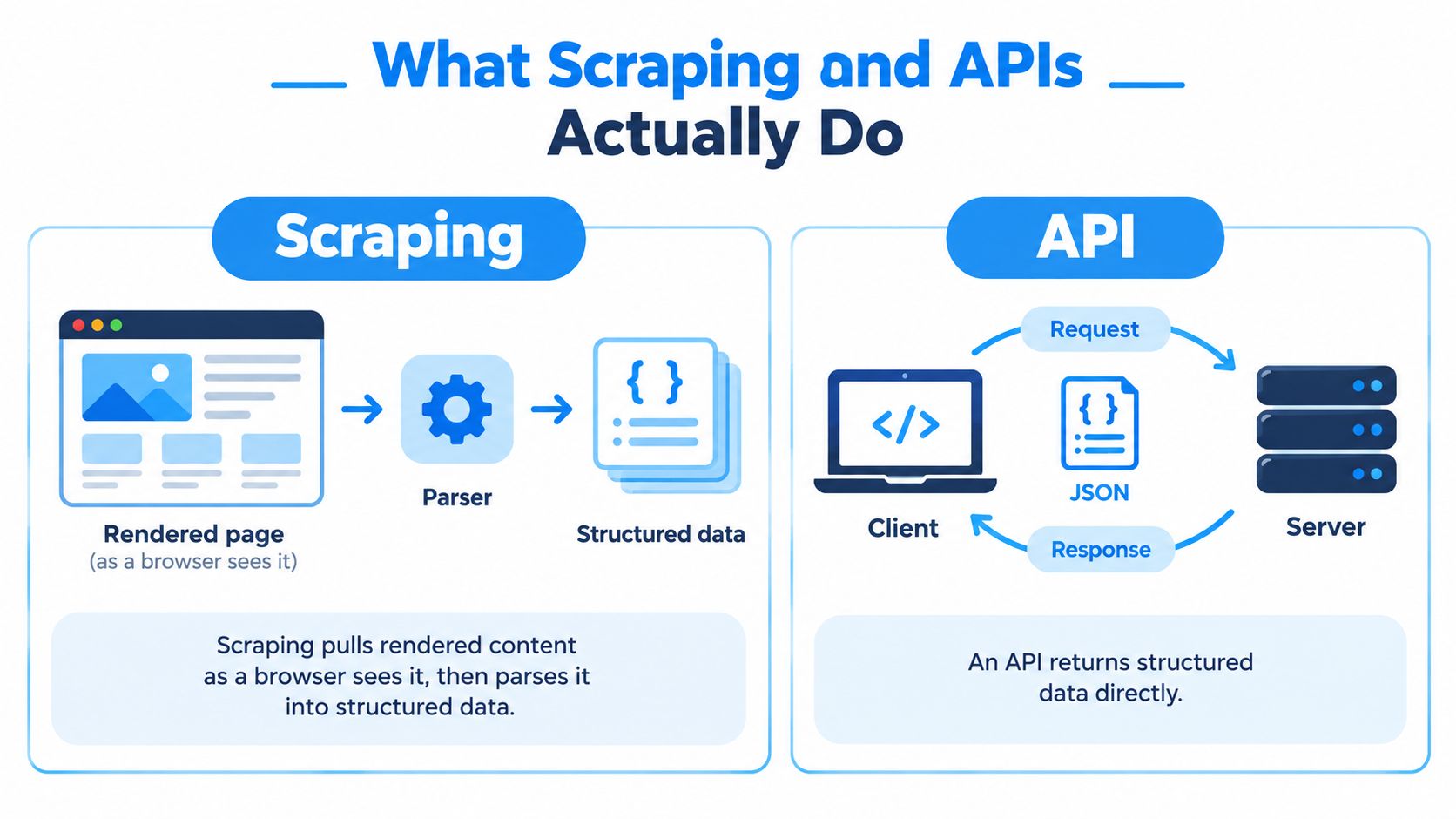
A scraping pipeline fetches the page, waits out rendering, locates the relevant content, and validates each value against evidence of where on the page it came from. Selectors and regular expressions do the locating, but the operational weight sits elsewhere: concurrency engineering to sustain throughput without tripping rate limits, retry logic that distinguishes a missing field from a failed fetch, and anti-bot defenses that change without notice. Most comparisons treat this work as a footnote. In production it is the cost driver.
An API integration inverts the trade. You build requests from the provider's documented parameters and credentials, interpret a defined response, and map its fields into your own schema. The provider controls what exists on the endpoint. You still own verifying that those fields mean what downstream users assume they mean.
Scope deserves its own design decision on either path. The peer-reviewed research on website link extraction collected 46,366 URLs across 78 websites and found that a crawl depth of three captured most relevant network data in that study. The finding describes their research setting rather than a universal crawl-depth rule, but it shows how quickly an unbounded discovery step can outgrow the actual job.
Three boundaries keep either transport honest. A discovery boundary fixes which pages belong in the job before you follow every available link. An extraction boundary determines which content becomes a record and which gets ignored. A validation boundary rejects ambiguous output instead of coercing it into a plausible value.
For broader planning, Fetchin's web data collection guide is a useful companion resource, and a practical guide to extracting data from the web can help translate a field list into a working extraction flow.
Consumers of the final dataset should never need to know which transport produced a record. They should always be able to trace where it came from.
Comparing the Two Methods Side by Side
A useful comparison separates provider commitments from collector responsibilities. Neither method wins every criterion, and an API's existence doesn't establish that its commercial terms or capacity fit your project.
Scraping vs API at a Glance
| Criterion | Web Scraping | API |
|---|---|---|
| Cost | Evaluate collection infrastructure and engineering work, not just the absence of an endpoint fee. | Evaluate access charges alongside the integration work the interface removes. |
| Reliability | Your team must detect page changes and distinguish missing content from failed extraction. | Defined responses offer a clearer basis for validation, subject to the provider's actual commitments. |
| Speed | Rendering and page behavior influence how quickly usable records arrive. | Structured responses simplify processing, but quotas can constrain delivery. |
| Maintenance | Extraction logic depends on the presentation staying interpretable. | Integration depends on endpoint behavior, schema compatibility, and access terms. |
| Legal posture | Review the source's rules, collection method, data category, and intended use. | Review the permission granted by the API terms, including downstream restrictions. |
| Accessible data | Can reach public page content absent from an endpoint, where collection is permitted. | Limited to fields and operations the provider exposes to your access level. |
| Capacity planning | Establish a sustainable operating envelope through controlled testing. | Use documented limits as planning inputs, without assuming they are an uptime guarantee. |
Read the gaps as engineering assignments
A comparison cell isn't just a pro or con. It tells you where work belongs. If the provider doesn't define a response schema, you need to define and enforce an extraction schema yourself.
Consider a product-price field. The engineering requirement isn't merely to return text containing a currency symbol. It's to distinguish the intended price from nearby values and preserve enough context to interpret it correctly.
Likewise, a documented API field isn't automatically suitable for every analysis. Your team must verify its meaning, availability, and relationship to the business event you're measuring.
An API can give you a clear interface without giving you the data you need. A scraper can give you the data you need without giving you a dependable interface.
Treat legal review as a separate acceptance criterion, not a tie-breaker after implementation. Public visibility shouldn't substitute for permission analysis, and API authentication shouldn't substitute for reviewing permitted uses.
The comparison becomes actionable when every apparent advantage has an owner, an acceptance test, and a consequence if it fails.
Reliability as the Deciding Factor
A scheduler can finish green while the consumer still gets stale prices, dropped variants, or duplicates created during recovery. Frame the choice as contract strength versus accessible surface area: an API usually gives a stronger contract over a narrower field set, while scraping exposes more of the page and leaves more of the contract in your hands.
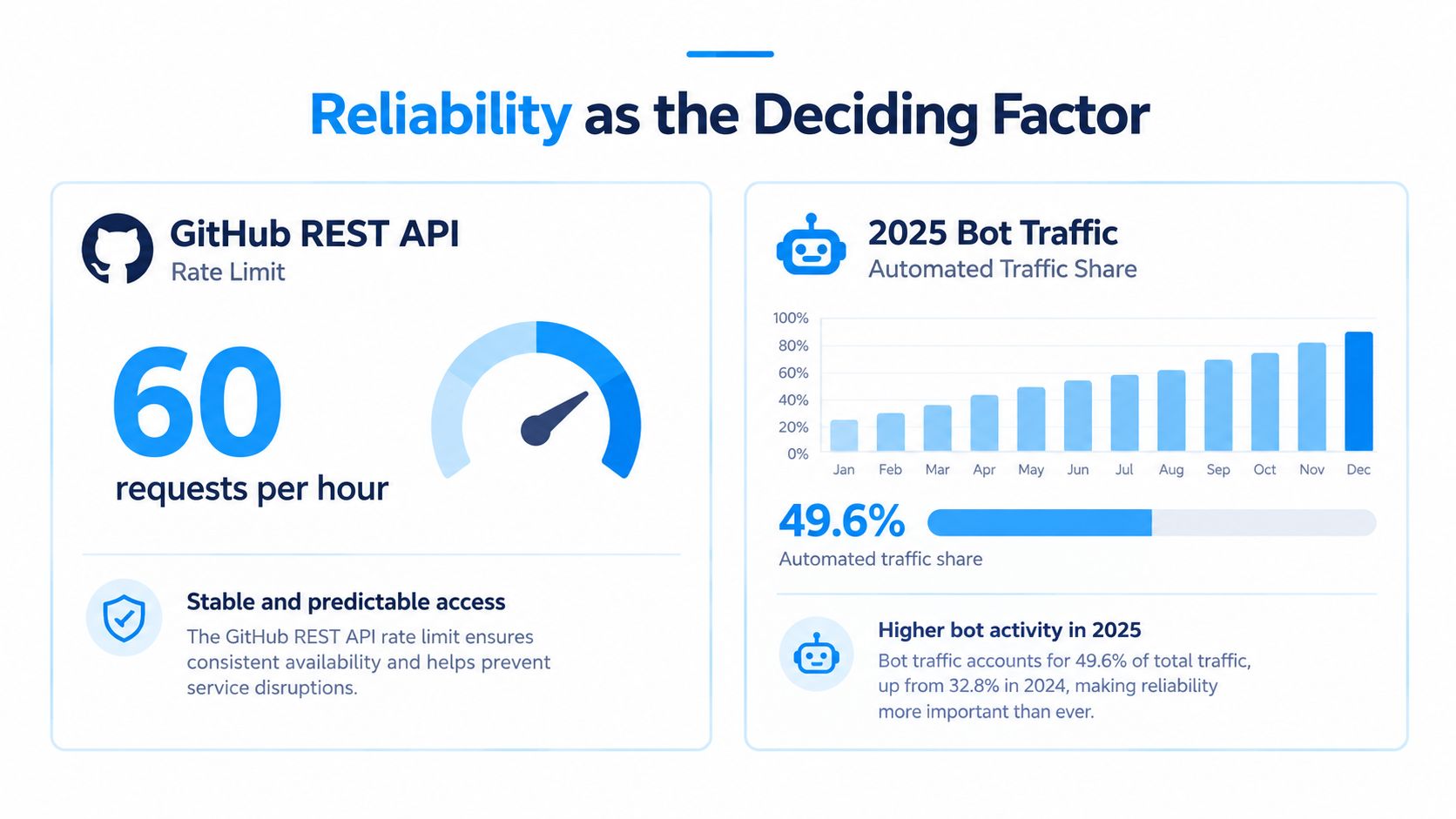
GitHub's REST rate-limit documentation specifies 5,000 authenticated requests per hour, 60 unauthenticated requests per hour, and a 100-request concurrency ceiling, with limit violations potentially returning HTTP 403 or 429. Hourly allowance and simultaneous-request capacity are different constraints, so a client must respect both.
A 2025 empirical study of university website traffic analyzed approximately 3.9 million external requests across 36 websites and found that more than 40% of observed accesses came from just 20 bots. Read that as a pacing and load-management warning for that sample, not as a global bot-traffic share.
Put the failure modes on different clocks
API failures are often explicit: quota headers run down, 403 or 429 responses appear, pagination changes, or fields are deprecated. Scraper failures are quieter. The page still renders and the selector still matches, while the wrong node is promoted, a consent state changes the record set, or anti-bot pressure turns a clean run into partial output.
That is where scraping carries its operational tax: concurrency engineering, bounded retries, session and proxy handling, refusal classification, and reprocessing after partial saves. For API clients, use token-bucket limiting, exponential backoff, retry-after handling, pagination checkpoints, and conditional requests or webhooks where supported; API rate limit headers explained is a useful implementation reference. For scraping, set source-specific pacing and pause or escalate when access controls interrupt collection instead of treating every refusal as transient.
Judge output, not request counts: validated records per minute, retry ratio, duplicate rate, required-field completeness at fixed concurrency, and freshness at handoff. A scraper can still be the dependable path when permitted public pages expose what an API withholds, but that needs a measured pilot rather than a hunch.
Connect collection health to real-time data processing: downstream consumers need an explicit freshness signal, not only a green job status.
What Each Approach Costs in Practice
An API sends you an invoice. A scraper sends you a pager. The invoice is easy to price; the pager is not, and that asymmetry is why cost comparisons between the two methods go wrong before they start.
The honest unit of cost is a usable record delivered under your operating requirements. Build your model from measured inputs, because there is no defensible universal price range for sources with different access conditions, rendering requirements, and recovery workloads.
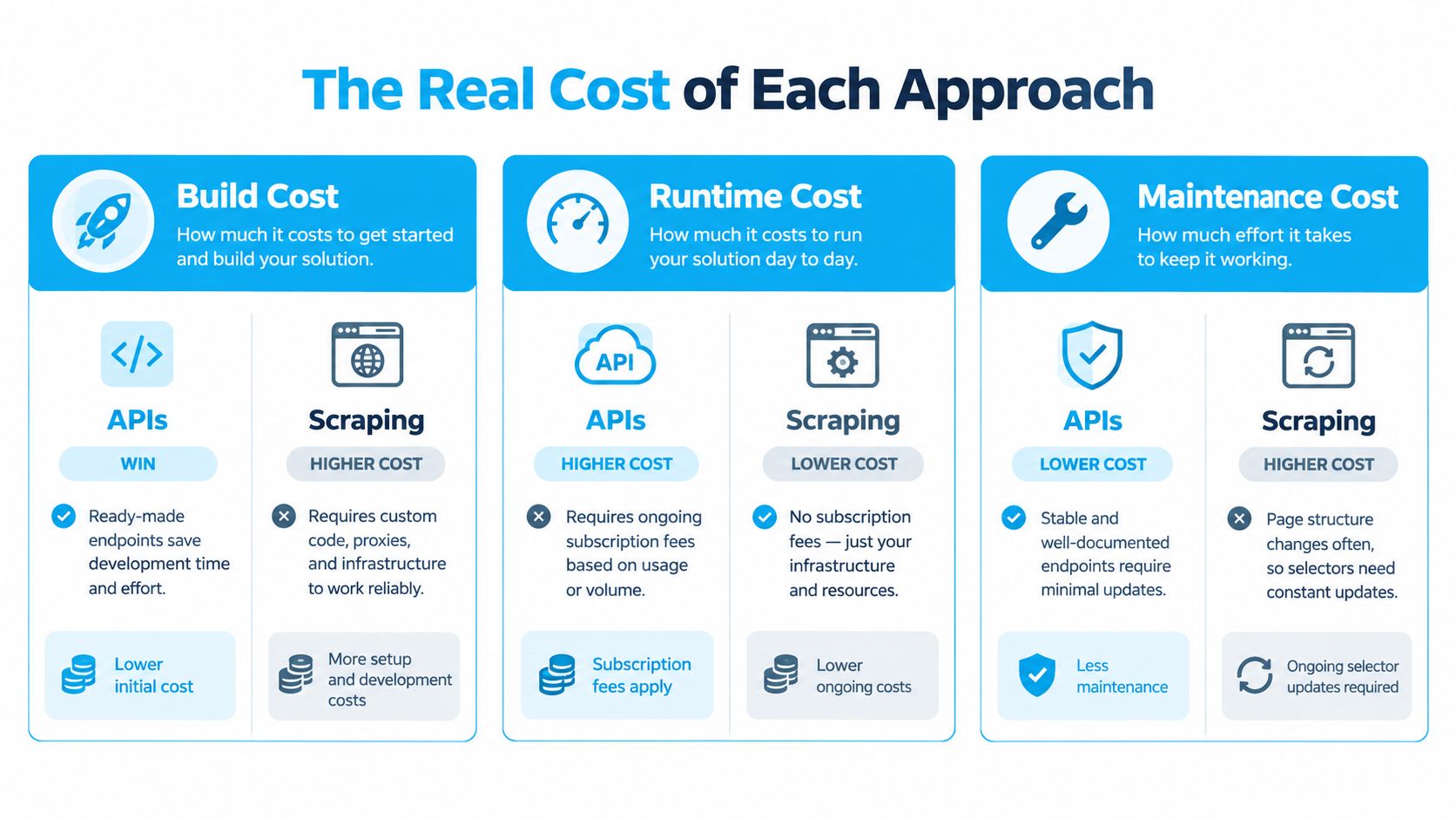
Build, runtime, and maintenance are separate ledgers
| Cost bucket | API integration | Scraping pipeline |
|---|---|---|
| Build | Authentication, field mapping, pagination, error handling | Page interpretation, rendering decisions, extraction tests on real pages |
| Runtime | Request volume, paid tiers, compute | Compute, bandwidth, rendering infrastructure, proxies, paid access where applicable |
| Maintenance | Version changes, schema drift, contract updates | Selector repairs, access interruptions, reprocessing, downstream repairs |
The scraping maintenance column deserves extra scrutiny. Hours disappear into work that never appears on a hosting bill: tuning worker pools, investigating failed jobs, responding when access controls interrupt collection, and cleaning downstream datasets after a partial run. Log each of these as attributed line items tied to the source that caused them. A single bucket labeled "engineering" in your ledger means the scraper is being subsidized invisibly.
Budget test: If your estimate assumes the extraction code will never need attention, you've priced a demonstration, not a production service.
Run both approaches through the same ledger. Attribute incidents, engineering hours, and discarded output to the collection method responsible for them.
A paid API can be economically preferable when it removes recurring work your team would otherwise perform. Scraping can remain economical when the target is manageable, the required fields are valuable, and the measured maintenance burden fits available capacity.
Neither outcome can be claimed in advance. Set a review point after launch and compare measured operating cost against the assumptions that justified the build.
Choosing by Use Case
The collection method should follow the job's constraints. These scenarios are decision examples, not claims about particular companies or measured results.
Audience research and price intelligence
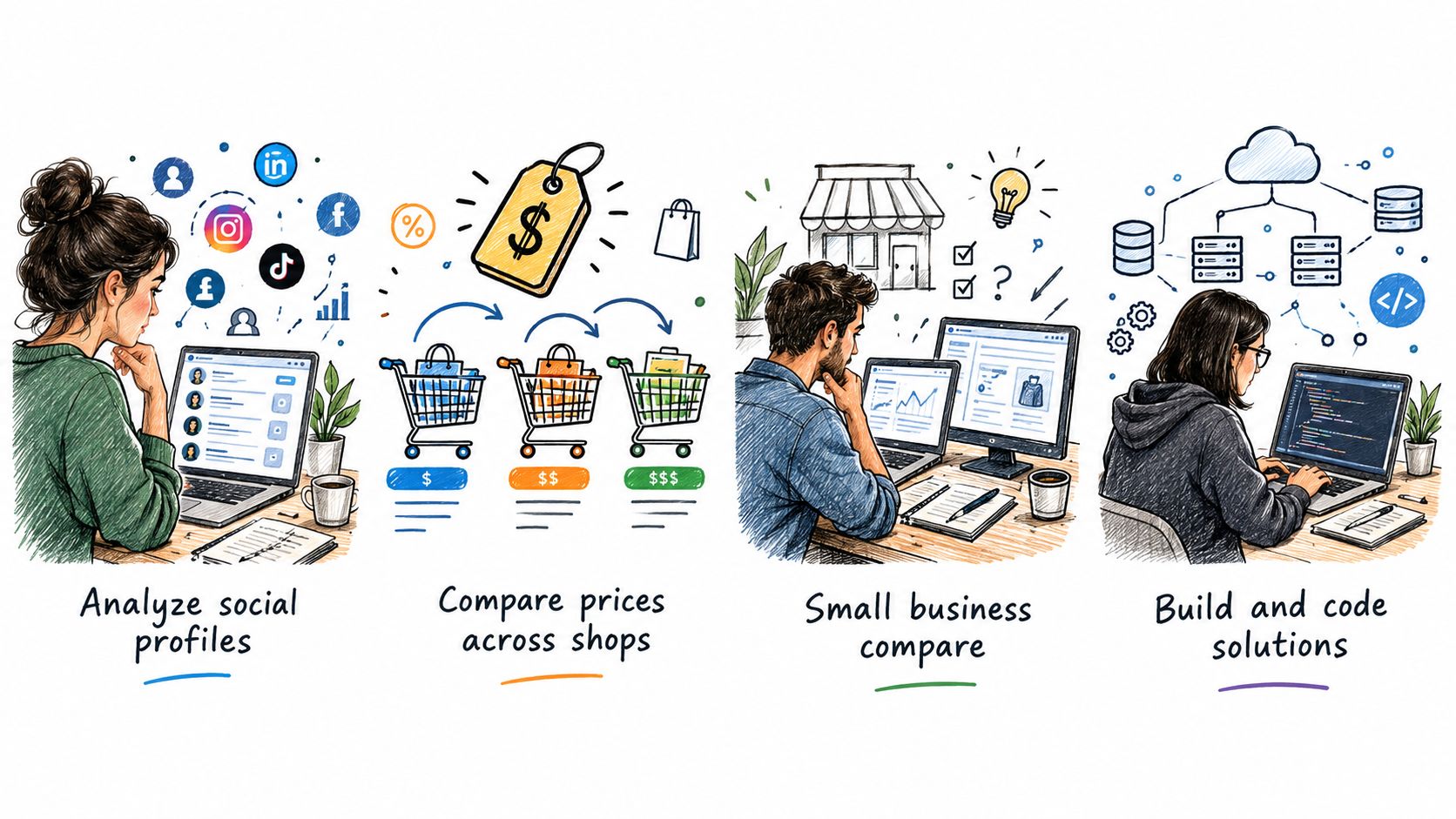
Audience research from public social profiles: Prefer a permitted scraping or hybrid workflow when essential public profile context is absent from the available API. Keep the research question narrow and collect only the fields needed to answer it. If the intended use involves personal information or outreach, require a separate usage review before delivery.
The API loses this particular comparison only if its available fields can't answer the question. It may still be the better source for identifiers or other supported attributes.
Price intelligence across e-commerce sites: Choose permitted scraping when the job is specifically to observe prices displayed on public pages and no suitable feed exists. Define what counts as the relevant price before implementing extraction. A result without its associated product, variant, currency, and observation context shouldn't pass validation.
Archives and operational dashboards
For a historical archive job with no supporting API, scraping is the practical candidate if the relevant material remains publicly accessible and collection is permitted. Preserve source references and extraction status so researchers can distinguish unavailable material from collection failure. No method can recover content that the source no longer exposes.
For operational dashboards fed by partner data, prefer the partner's API when it supplies the required fields under workable terms. Ask for documented field meanings and an escalation path. Scraping the partner's user interface would add an avoidable dependency if a suitable integration already exists.
Classify your own project before selecting a tool:
- Data shape: Do you need standard records, displayed context, or both?
- Freshness: When does a record become too old to use?
- Coverage: Which missing fields would invalidate the job?
- Permission: Has someone approved the collection method and downstream purpose?
- Recovery: Can you replay a failed collection without corrupting the dataset?
The winner is conditional. Change the field requirements or permission model, and the sensible choice may change with them.
When Scraping Is the Right Answer
A pricing team needs reseller stock status that exists only on public listing pages. The vendor's API covers catalog fields but never exposes inventory, and no licensed feed fills the gap. That is the shape of a scraping-first job: the required data lives on the accessible surface, and no available contract covers it.
Treat API-first as a procurement and engineering check rather than doctrine. Reject the API only against a written requirement: a field the job depends on is missing, capacity cannot support the workload, no relevant endpoint exists, or the commercial terms fail. If none of those hold, sign the contract.
When scraping does qualify, write a short exception memo before building anything. It should record why the alternative fails and what the team accepts by collecting from pages.
| Approval condition | What the team accepts |
|---|---|
| Public scope | Collection stays on approved public material, without expanding into authenticated areas just because the tooling allows it |
| Source respect | Site rules and robots directives reviewed, requests paced conservatively, collection halted before it imposes inappropriate load |
| Usage ownership | A named owner for privacy review, GDPR-conscious handling where it applies, retention limits, and downstream use |
| Operational readiness | Validation tests, an alert path, a safe stop condition, and accountability when markup changes |
Collecting a field successfully is not the same as establishing that you should collect it, retain it, or use it for outreach.
Budget for the page dependency
The memo should also price the operational tax directly. Queues, retry and backoff logic, session handling, and anti-bot defenses consume the engineering hours that an API contract would have absorbed. Scraping earns the primary role when the page-only data is valuable enough to fund that work indefinitely.
A hybrid design earns its complexity when each method contributes different information. Keep the API-backed record as the stable core and attach permitted page-derived context as separately labelled enrichment. Record provenance for every enriched field, define which source wins when values conflict, and never let an empty extraction overwrite a known value.
That boundary keeps the scraper small. You operate a narrow subsystem for what the endpoint cannot provide instead of rebuilding the API from markup.
A Practical Decision Framework and Closing Checklist
Choose the collection method with the strongest usable contract, not merely the strongest documentation. A contract that omits an essential field isn't sufficient; a broad page surface without manageable operating conditions isn't sufficient either.
For an additional perspective during evaluation, WebscrapingHQ's reliability and cost comparison can serve as a discussion resource. Use your own pilot results to make the final decision.
Turn the decision into an acceptance record
Document the chosen approach alongside the evidence that supports it:
- Coverage accepted: Required fields have verified meanings and usable output.
- Delivery accepted: Collection meets the agreed freshness and completeness requirements.
- Recovery accepted: Interrupted jobs can resume without losing or duplicating accepted data.
- Ownership accepted: Someone is accountable for operating costs, incidents, and permissions.
Keep the legal review attached to the project. A website scraping legal overview can help frame questions for qualified counsel, but it can't replace advice about your specific source and use.
Reopen the decision when silent breakage, rising maintenance hours, or legal ambiguity appears. Don't keep repairing a collection method solely because it was the original choice.
The question to ask before starting is: What's the least operationally expensive, permitted way to deliver the exact records this workflow needs? Answer it with a field specification, a controlled test, and an operating ledger. That gives the team a decision it can defend and revise.
HarvestMyData offers cloud-based extraction of publicly listed Instagram contact information into structured CSV and Excel files for sales, marketing, and research workflows. If that's your collection job, visit HarvestMyData to evaluate a managed option alongside building and maintaining your own scraping or API integration.
We built HarvestMyData to handle all of this for you.
No proxies, no code, no account needed.