Social Media Data Extraction Guide for 2026

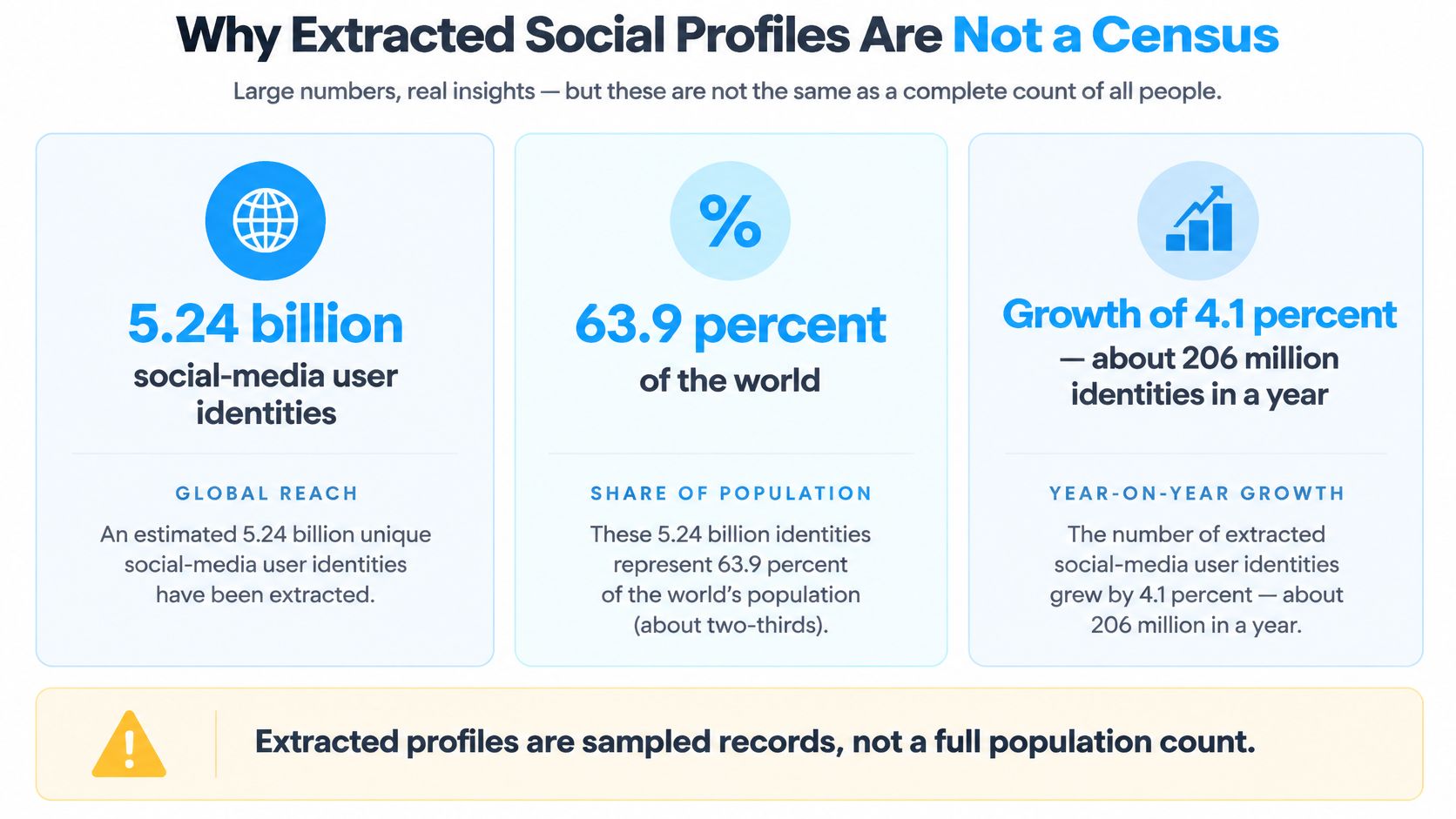
5.24 billion social-media user identities worldwide doesn't mean 5.24 billion distinct people. DataReportal's Digital 2025 overview explicitly cautions that identities aren't necessarily unique individuals. That's the right starting point for social media data extraction: you're collecting observable records from a particular source, not downloading a verified population.
Table of Contents
- Define what a row represents
- Official interfaces have defined boundaries - Relationship lists answer different questions
- A retailer's followers versus its following list - A campaign hashtag versus a product post
- Give the operator an auditable job specification - Keep operational safety separate from permission
- Measure against the intended use - Qualification isn't an extraction field
- Make reuse a documented decision - Apply responsibility beyond collection
- Keep the first order bounded
Why Extracted Social Profiles Are Not a Census
Say a skincare brand wants a shortlist of independent retailers for a wholesale launch. Collecting profiles connected to a beauty distributor can produce a useful starting file, but it won't identify every relevant retailer, establish who owns each account, or prove that anyone wants a sales email.
Social media data extraction turns a defined audience or collection of public content into sortable records. Depending on the collection path, a row might contain a username, display name, bio, follower count, post count, category, website, and contact details the profile chose to publish. A column's presence in the export doesn't mean every profile can supply its value.
Think of a public noticeboard. You can copy the cards people pinned there without opening their private mail, but the cards may be outdated, duplicated, incomplete, or irrelevant to your purpose. Copying them doesn't establish permission for every subsequent use.
Define what a row represents
For the skincare brand, a defensible row represents a profile observed through a named audience at a recorded time. It doesn't automatically represent a unique business, a current decision-maker, or a qualified lead.
Keep these questions separate:
- Visibility: Was the field publicly accessible through the collection path?
- Platform permission: Did the platform permit that method, object scope, and purpose?
- Lawful reuse: Can your business justify storing, analyzing, or contacting the person associated with it?
A useful file preserves those distinctions instead of flattening them into a contact list. It also leaves uncertainty visible: an apparent shop account might belong to a creator, a shared brand account, or an inactive business.
Practical rule: Describe the population you actually observed, not the market you hoped to reach.
Start by choosing a source from the comparison below. A tool brand can't fix an audience definition that answers the wrong question.
Sources You Can Actually Pull From
Social data sources, gates, and what they miss
| Source | Typical records | Access gate | Completeness trap | Best use |
|---|---|---|---|---|
| Instagram Graph API | Fields the authorized app user can access | Standard Access, endpoint permissions, rate limits | Complete unrelated follower, following, commenter, and liker audiences aren't guaranteed | Owned-account reporting |
| Hashtag public content | Public posts for a hashtag | App Review and business verification | Public posts don't grant profile-level contact-export permission | Campaign and sentiment research |
| Follower list | Public profiles following an account | Public availability plus platform rules | Samples, inactive accounts, and duplicate identities | Audience composition and overlap |
| Following list | Public profiles an account follows | Public availability plus platform rules | Account-owner selection, potentially skewed toward businesses and creators | Lookalike prospecting |
| Comments and likers | Profiles engaging with a public post | Public availability plus platform rules | Bias toward that post's active audience | Engagement-based research |
| Manual profile review | Hand-copied public fields | Reviewer time and permitted access | Reviewer inconsistency and limited scale | Spot checks against a file |
Choose a row before designing the pipeline. These paths aren't interchangeable, even when their exports share the same column names.
Official interfaces have defined boundaries
The Instagram Platform overview limits Standard Access to data associated with users who authorized the application, with restricted public endpoints for other objects, endpoint-specific permissions, authentication, and rate limits. An API token isn't a universal audience-download key.
Treat unsupported fields and inaccessible users as expected non-availability, not invitations to retry indefinitely. Store field provenance and a bounded retry policy. A successful response proves that a request succeeded, not that the audience is exhaustive.
Meta's Instagram Public Content Access documentation requires App Review and business verification, with documented purposes including hashtag campaign discovery, sentiment analysis, contest entrants, and aggregated or de-identified audience analysis. Those permissions don't automatically authorize turning authors into an identifiable contact export.
Relationship lists answer different questions
Followers describe an account's subscriber audience. Following describes the account owner's choices, which can make it useful for discovering suppliers, peers, and creators, but not for estimating consumer demand.
Comments and likes provide evidence of engagement with particular content. Don't promote that evidence into purchase intent without another qualification step. For teams separating engagement from commercial relevance, buying signal prospecting with SignalVan offers a useful adjacent framework for deciding what should count as a signal.
Manual review belongs at the validation stage. Use it to inspect whether categories, websites, and published contacts match the exported fields, not as an untracked substitute for a repeatable collection process.
An API-approved sample can be defensible yet unsuitable for prospecting. A freshly collected audience can be current yet difficult to reproduce.
The practical web scraping versus API comparison is therefore about scope, maintenance, and permitted use, not which method returns rows fastest.
Audience Seeds That Change the File
A skincare brand can run several extraction jobs during the same launch week and receive files with very different commercial value. The collector hasn't necessarily changed. The seed and the decision have.
A retailer's followers versus its following list
For consumer-audience research, the brand starts with a retailer's followers. The resulting file may include shoppers, personal accounts, inactive profiles, and unrelated promotional accounts. Keep the source relationship and account-status indicators, but don't treat sparse contact fields as proof that collection failed.
For a wholesale partnership shortlist, the brand instead examines accounts the retailer follows. Suppliers, creators, and peer shops become potential candidates because the retailer selected them, not because they're representative of the broader market.
The useful columns change with that decision:
- Consumer-audience review: Username, source relationship, collection timestamp, and only the profile descriptors needed for classification.
- Partnership discovery: Category, website, bio, and a published business contact where available.
- Candidate verification: A review status and a short reason for inclusion or exclusion.
A website and a clear retail category can matter more than follower count when the task is finding stockists. Conversely, a full bio doesn't establish that a shop is active or accepts wholesale approaches.
A campaign hashtag versus a product post
For campaign analysis, the brand starts with a hashtag. Posts are the primary records; people are associated records. Preserve the hashtag, media identifier, publication timestamp where available, and retrieval timestamp so the team can explain how it selected content.
Set a fixed post cap before collecting. If the purpose is entrant discovery, resolve the contest rules and legal basis before building an identifiable participant file. Don't let an open-ended crawl redefine the campaign's boundaries.
For product-message testing, commenters and likers on a particular post form a more engaged slice. They reflect reactions to that creative, product, and posting context, not the whole skincare market. Keep comment text only when interpreting the text is necessary for the decision.
A large seed account isn't a success metric. Judge the file by the relevance of the profiles it returns and the evidence supporting their inclusion.
When combining follower, following, and engagement jobs, collapse matching profiles into a master profile row while preserving their source relationships separately. Otherwise, a creator appearing through several paths inflates the reported audience and may receive duplicate outreach.
How to Run an Extraction Job
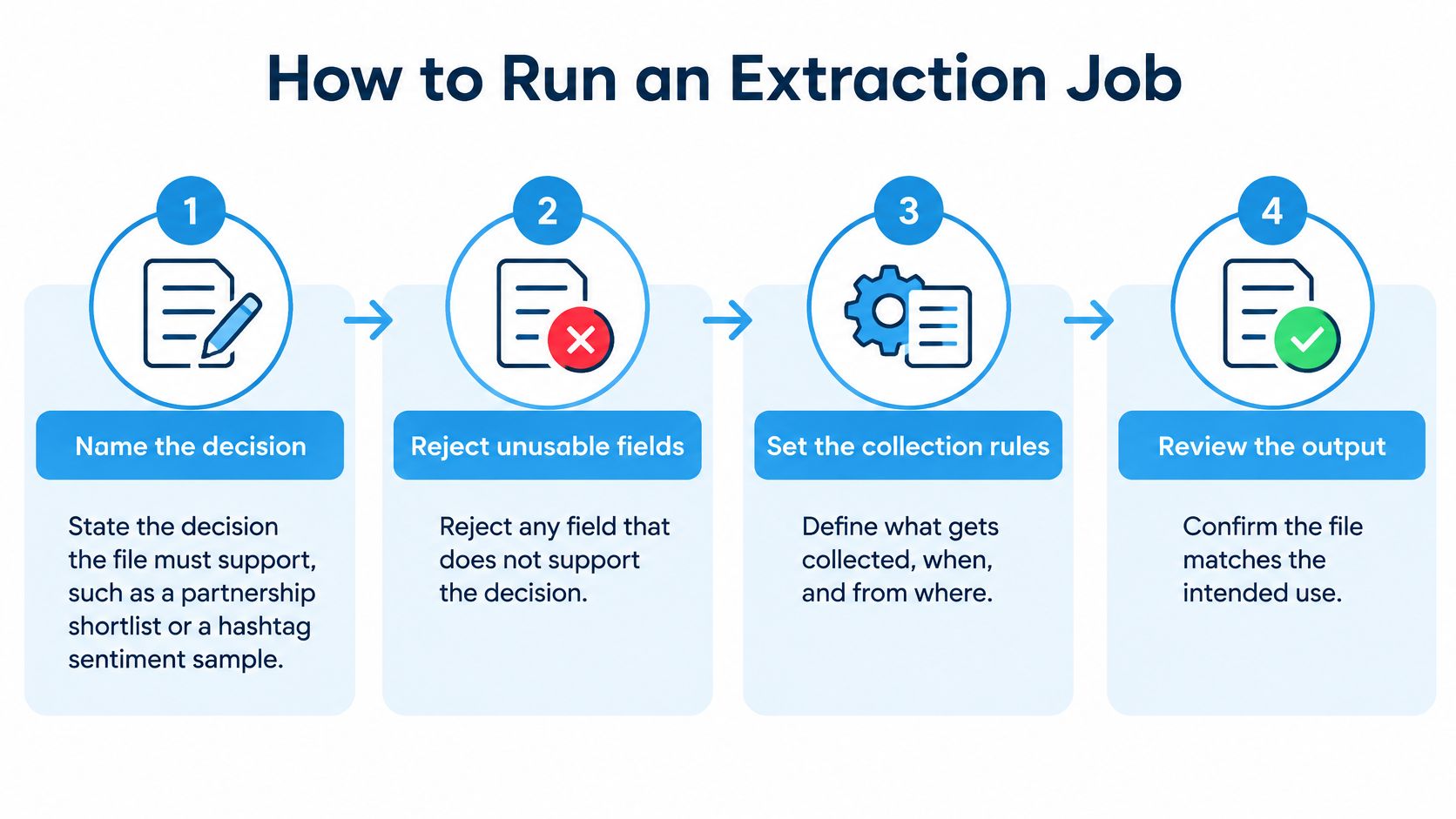
An operator should be able to execute the job without guessing what counts as finished. Write the decision, access conditions, stop rules, and output contract before collection begins.
Give the operator an auditable job specification
- Name the decision. State whether the file supports a partnership shortlist, campaign analysis, or another defined task. Add
job_purposeand an allowed-field list. Reject fields that won't affect that decision.
- Choose the source and exact seed. Record the public username, hashtag, or post reference without substituting a similar account during collection. Leave
source_typeandseed_valuein the job manifest.
- Record authorization before collection. Distinguish official API permissions, approved public-content access, and another public-profile collection path. Store
authorization_state; public visibility mustn't be recorded as an API grant.
- Collect with explicit stop conditions. Save the query, retrieval timestamp, collector version, and API version where applicable. Stop at the agreed page or profile cap, permission boundary, or exhausted pagination. Record
termination_reasonso a capped job isn't mistaken for a complete audience.
- Deduplicate before enrichment. Remove repeated media and profile records across pages. Use platform identifiers where available, preserve a merge log, and retain the source relationships rather than discarding useful overlap information.
- Separate observed and derived fields. Keep published profile details apart from inferred country or assigned categories. Include
derivation_methodfor enriched values, and don't present a guess as something the profile owner published.
- Explain blanks. Use companion status fields for not published, not permitted, inaccessible, and collection error. When the cause can't be established, record unknown rather than inventing certainty.
- Export a usable file. Produce UTF-8 CSV or Excel with a consistent profile-row structure, explicit column names, and provenance fields. Treat phone numbers as text so spreadsheet software doesn't alter their formatting.
- Close the job with a manifest. Record duplicate rate, rejected objects, returned profiles, and completion against the configured cap. Keep audience completeness separate from job completion; finishing the requested work doesn't prove full population coverage.
Keep operational safety separate from permission
For a parallel professional-network workflow, Flowkon's guide to reduce restriction risks during LinkedIn research is useful operational reading. Restriction avoidance, however, isn't evidence that collection or downstream use is authorized.
Don't switch collection paths after a permission failure. Pause, revise the job specification, and approve the change before continuing.
Handoff standard: Deliver the file with its manifest, not as an unexplained spreadsheet attachment.
The output is a dated snapshot for a defined decision, not a CRM of record. Keep it out of production outreach until it passes the fitness checks.
How to Judge Whether a Dataset Is Fit
A fresh audience file can be more current and less reproducible than an access-controlled research sample. An approved API sample can be easier to defend and still omit the profiles a prospecting team needs.
The published analysis of platform data access describes platforms moving toward stricter, more commercialized access, including Instagram's shift toward business-oriented APIs. An old integration isn't a quality-control method. Test what the current access path returns.
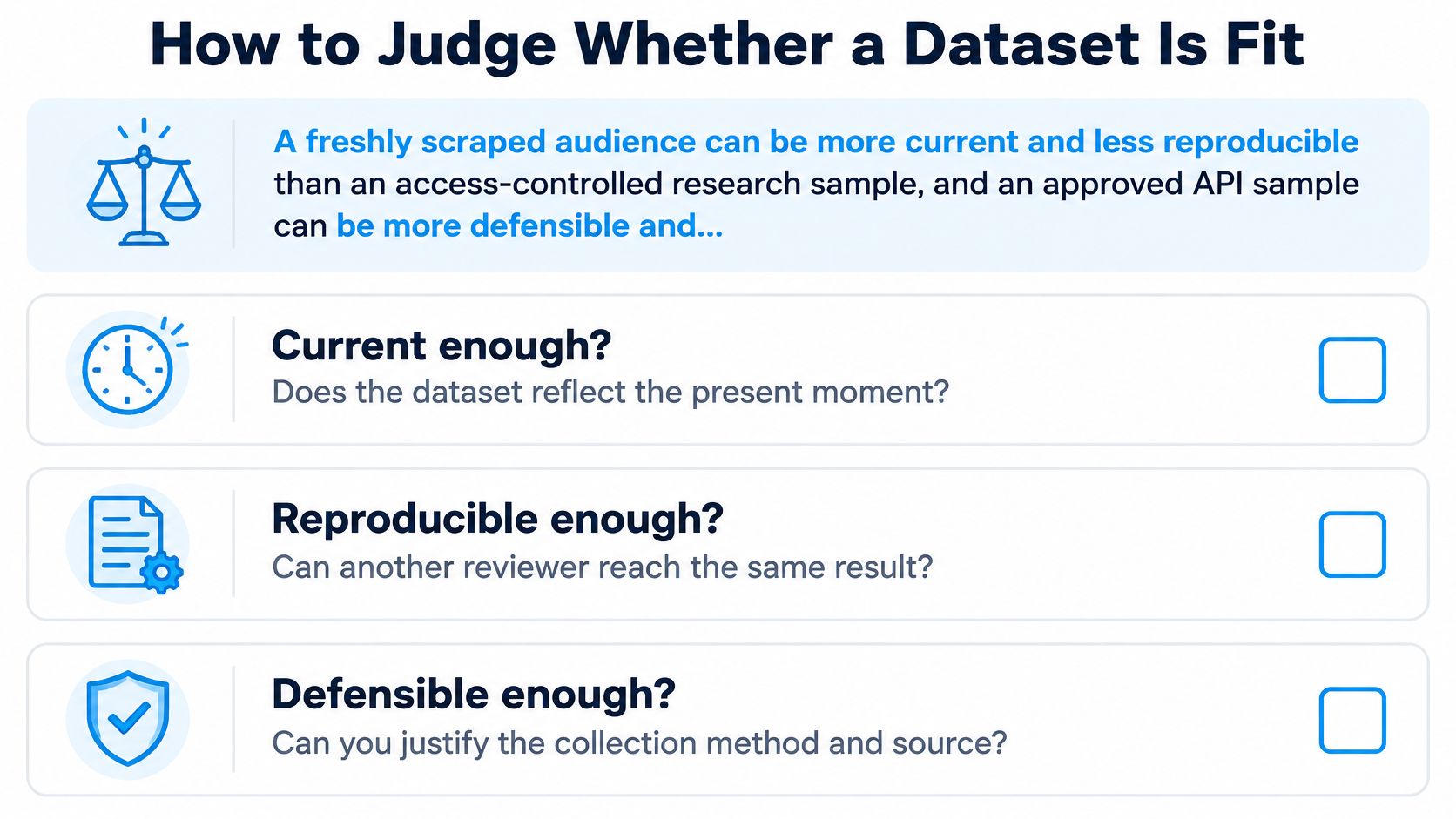
Dataset fitness checks before anyone emails the list
| Check | What to record | Fail signal |
|---|---|---|
| Freshness | Collection timestamp per row | Undated rows treated as current |
| Blank reason | Missing, not permitted, inaccessible, or collection error | Empty email automatically counted as a failed scrape |
| Identity | Username and stable profile identifier where available | Matching profiles counted separately across audiences |
| Handle drift | Previous username beside the current one | Comparisons break after renames |
| Contact check | Email syntax and domain status | An address is marked deliverable from appearance alone |
| Segment yield | Email and phone availability by source and niche | A universal average applied to every audience |
Measure against the intended use
For a partnership shortlist, relevance and verifiable business identity may matter more than broad coverage. For longitudinal research, consistent inclusion rules and retained identifiers become critical. A research archive can support repeated analysis without being appropriate for fresh commercial outreach.
Report profiles requested, profiles returned, emails found, and phones found separately. Contact yield should use returned profiles as its stated denominator; collection coverage needs its own measure. Otherwise, a team can't distinguish low contact availability from incomplete retrieval.
Segment the results by source and account type. Business-oriented accounts and personal profiles shouldn't be evaluated as though they publish the same fields, and following-list yield shouldn't be used to forecast a broad follower job.
Qualification isn't an extraction field
Syntax validation catches malformed addresses. Domain checks add evidence, but neither establishes consent, mailbox ownership, or guaranteed delivery. Keep contact validation status separate from commercial qualification.
Lead Printer's explanation of how to define a qualified B2B lead helps distinguish an available contact from a prospect that meets business criteria. For spreadsheet-level controls, use the data-quality checklist to make acceptance rules repeatable.
Pass rule: If you can't explain why a field is blank, don't load the file into a sequencer. Resolve the status, exclude the affected records, or restrict the output to analysis.
When Public Profiles Need a Lawful Basis
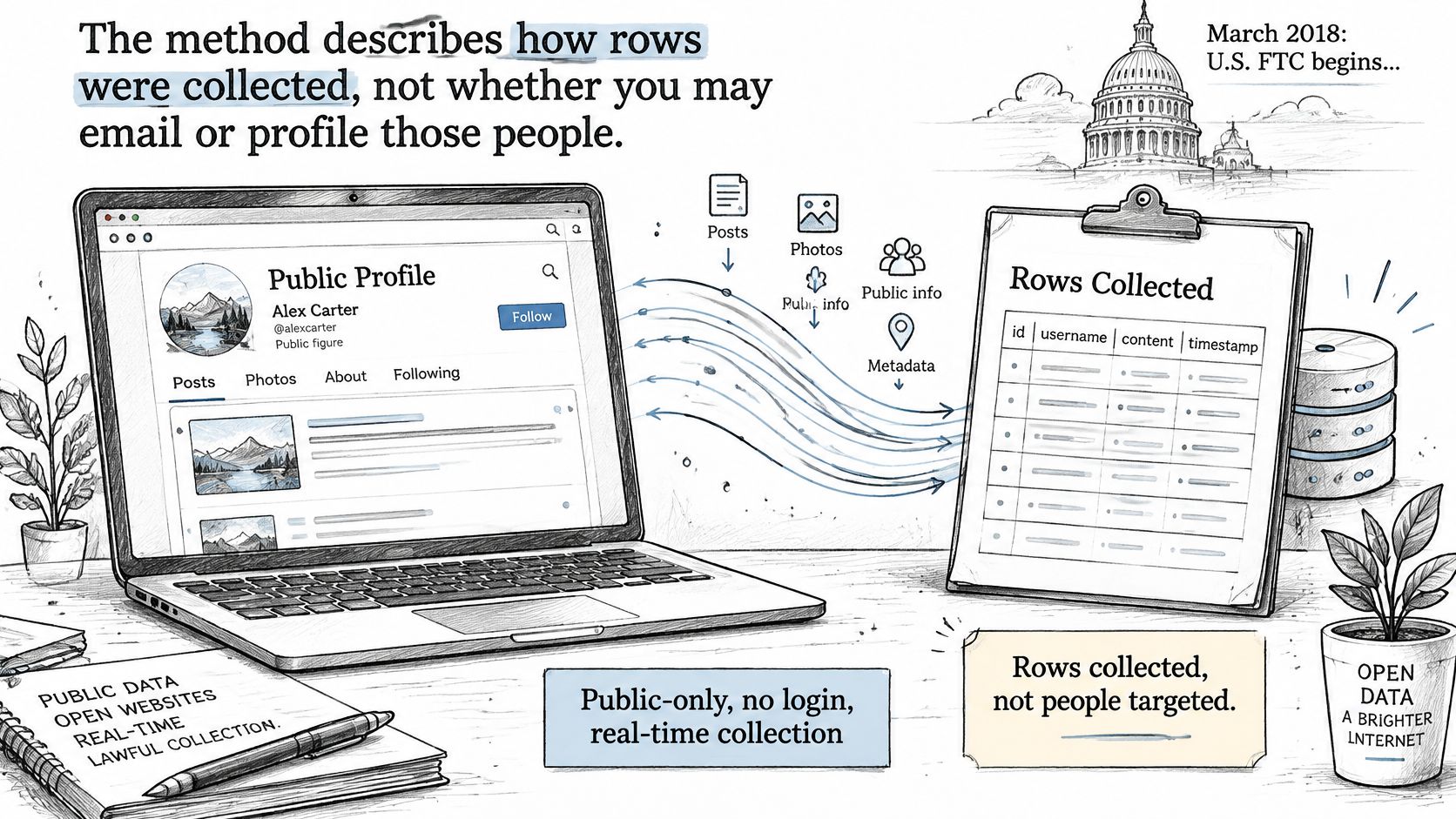
No login, public-only, and real-time describe collection mechanics, not permission to email or profile people. A published business email can still identify an individual and require data-protection controls.
CNBC's reporting on the Facebook privacy settlement describes the FTC investigation beginning in March 2018 after reports involving information associated with as many as 87 million users, followed by a $5 billion settlement in July 2019. The relevant lesson isn't that every extraction job resembles that case. It's that collection, disclosure, and downstream governance are separate responsibilities.
Make reuse a documented decision
The Stevens & Bolton explanation of privacy regulators' joint scraping statement makes clear that publicly accessible personal information remains subject to data-protection law. High-volume collection also makes transparency, erasure, and control over social-network information harder.
Before outreach, apply these decisions:
- Separate contact types. Distinguish business contact details from personal details. Exclude unnecessary personal contacts rather than assuming publication makes them fair game.
- Document the lawful basis. Assess legitimate interests or another applicable basis for the specific processing. Don't assume B2B activity automatically qualifies, and don't substitute API approval for a legal assessment.
- Prepare required disclosures. State the source, purpose, and relevant privacy information where required.
- Implement suppression and deletion. Make requests traceable across working files, CRM imports, and outreach tools. Prevent deleted contacts from returning through a fresh import.
- Exclude sensitive attributes. Don't infer health, religion, political views, or other sensitive characteristics from bios and engagement.
- Set retention limits. Assign an owner and a review or deletion condition. Retaining an export indefinitely shouldn't be the default.
Apply responsibility beyond collection
Our collection boundary excludes private accounts and protected content. Our terms also require lawful use, compliance with applicable requirements including CAN-SPAM and GDPR, honored opt-outs, no harassment or stalking, and no resale or redistribution of raw data. Those restrictions are customer obligations, not claims that public collection resolves every legal issue.
Use the guide to web-scraping legality to frame a jurisdiction-specific review, and get qualified advice where the intended use is uncertain.
Aggregated research and sequenced outreach require different files. If the business decision only needs campaign themes or audience categories, don't retain identifiable contacts merely because they were available.
Start With a Public Audience You Can Defend
Refuse a recycled database with no collection date. Don't attach a personal Instagram session to a scraper, and don't push every exported column into outreach because importing it is easy.
For a defined public audience that passes the lawful-use assessment, a pay-per-job collector that doesn't use your account avoids exposing that account to the collection workflow. It doesn't remove your responsibility for the resulting data.
Keep the first order bounded
HarvestMyData extracts publicly listed contact information without accessing private accounts or protected content. You never log into Instagram through our service, and we don't touch your account. Results arrive as CSV and Excel by email, usually within an hour, or through the Telegram bot.
Followers job pricing
| Users | Price |
|---|---|
| 1,000 | $3 |
| 5,000 | $6 |
| 10,000 | $12 |
| 25,000 | $18 |
| 50,000 | $25 |
| 100,000 | $49 |
| 150,000 | $69 |
| 200,000 | $89 |
| 250,000 | $99 |
Choose the smallest scope that can answer the decision. A carefully selected following audience or tightly defined hashtag can be a better starting point than a broad follower export; the followers tiers above shouldn't be read as hashtag pricing.
Before ordering again or sending anything:
- Inspect provenance: Confirm what collection details the delivery contains and retain your job specification alongside it.
- Resolve uncertainty: Review timestamps, unexplained blanks, and source-specific contact yield.
- Authorize the handoff: Approve only the fields and records needed for the intended use.
If the checks fail, remove unnecessary identifiers and retain only appropriate aggregated findings. Don't turn an uncertain export into an outreach database.
HarvestMyData converts defined public Instagram audiences into structured CSV and Excel files without using your Instagram login. Visit HarvestMyData to review the sample output and scope a bounded first job, then validate the file before using it for research or outreach.
We built HarvestMyData to handle all of this for you.
No proxies, no code, no account needed.