How to Scrape Instagram Followers Safely in 2026

The popular advice is to choose a scraper, enter an account, and download its followers. That's a collection task, not a prospecting workflow. If you want to scrape Instagram followers without wasting your sales team's time, start with the decisions that determine whether anyone can use the export.
A visible profile isn't permission to collect it in bulk, and a captured email isn't permission to contact its owner. Treat the job as a production line with explicit acceptance criteria, not a download button followed by a CRM import.
Table of Contents
- Build a production line, not a spreadsheet
- Audience Sources and Where They Fit - Make the specification a purchasing contract
- Track the stages, not just the status
- Keep observations separate from judgments - Test the segment before scaling
- Establish responsibility before releasing records
The Real Way to Scrape Instagram Followers
Public visibility and authorized access are different things. Meta's Instagram platform overview describes controlled access, including limited access to public information not created by the app user. What someone can view inside Instagram doesn't automatically correspond to data an application may retrieve through supported endpoints.
That distinction changes how you buy extraction services. Don't start by asking how many rows a provider can deliver. Ask which source it uses, what access authorizes the collection, which fields it returns, and what happens when the requested audience isn't fully available.
Build a production line, not a spreadsheet
Use collection, normalization, validation, and compliance review as separate stages. Each needs an owner and a pass-or-fail checkpoint.
- Collection: Retrieve the specified audience through an authorized mechanism and preserve field provenance. A file from the wrong audience fails even if every cell is populated.
- Normalization: Turn inconsistent identifiers and repeated profiles into a stable dataset. Preserve original values so someone can investigate a disputed match.
- Validation: Assess contact quality and commercial relevance. Finding an address and establishing a useful prospect are different outcomes.
- Compliance review: Approve the intended processing and outreach before releasing records to sales.
The process should look like connected checkpoints rather than an uninterrupted trip from payment to delivery.
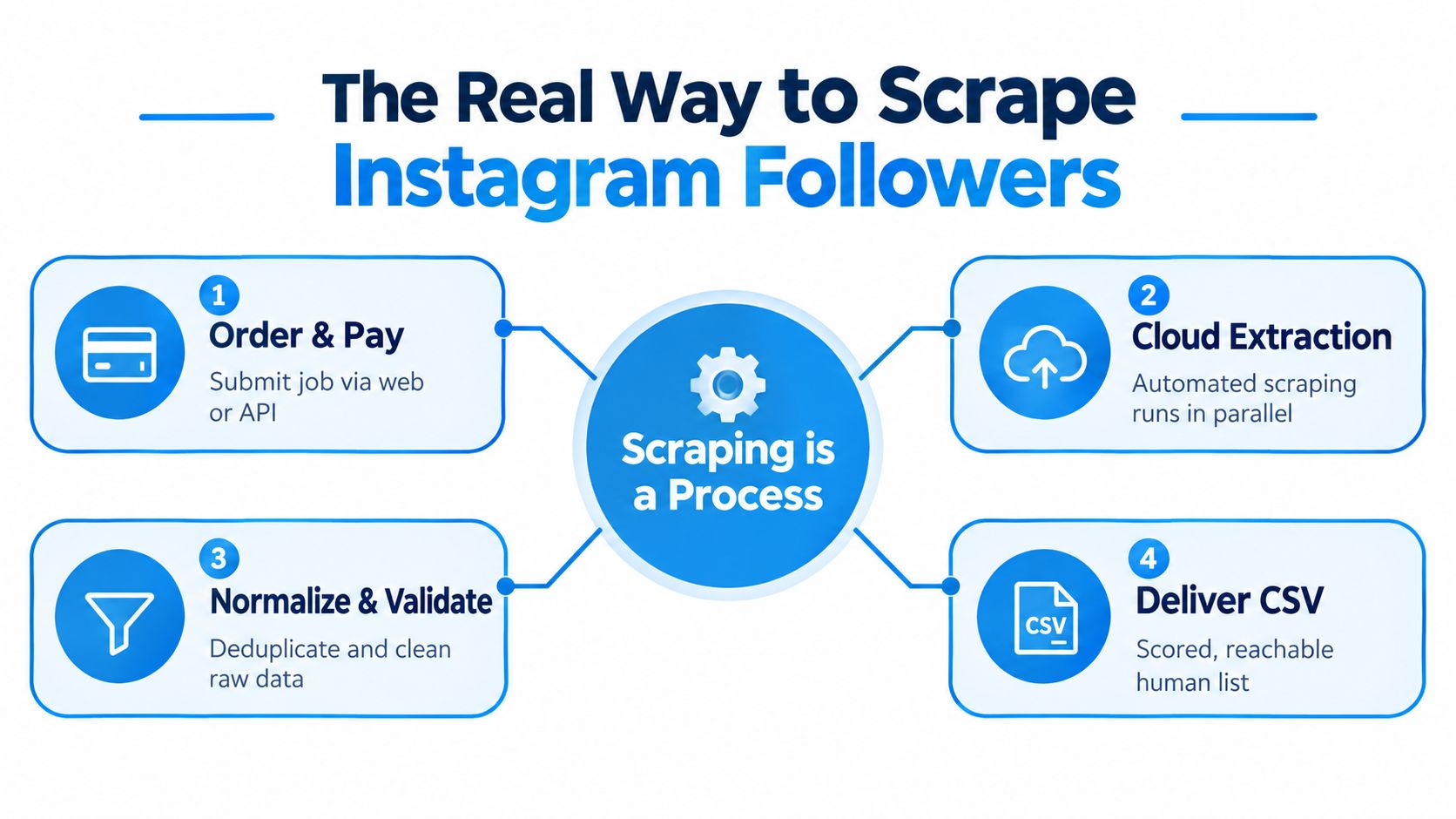
A pay-per-job cloud service is one option for collection. A supported API or permissioned dataset may fit better when its available fields match the job. Choose the access mechanism first, then compare convenience, output format, and cost.
A delivered CSV proves that a collection job produced a file. It doesn't prove that the file contains suitable prospects.
My recommendation is to keep raw exports away from your CRM. Put them in a restricted staging area, where the next stages can reject records without creating sales tasks, triggering sequences, or overwriting existing customer information.
Define the Job Before You Run It
An audience specification should describe who you want to find, not merely which account you want to scrape. For an e-commerce campaign, a brand's followers might support audience research, but they aren't automatically store owners or purchasing decision-makers.
Write the commercial hypothesis before selecting the source. For example, an agency selling creative services might look for profiles that identify themselves as operating brands, then qualify those businesses against its service offering. Following a relevant account is a discovery signal, not evidence of buying intent.
Audience Sources and Where They Fit
The table below gives planning recommendations, not coverage guarantees. Actual availability depends on the authorized collection method and the selected target.
| Source | Best For | Typical Size | Watch-Out |
|---|---|---|---|
| Followers | Audience research around a relevant brand or creator | Target-dependent | Interest in an account doesn't establish business relevance |
| Following | Exploring an account's professional ecosystem | Bounded by the target's list | A followed account isn't necessarily a supplier or partner |
| Hashtags | Discovering profiles associated with a topic | Scope-dependent | Topic participation can be broad or commercially irrelevant |
| Commenters | Reviewing people participating in specific discussions | Post-dependent | A comment may express criticism rather than interest |
| Likers | Exploring engagement around selected content | Post-dependent | A like provides little context for qualification |
Keep audience sources separate during the pilot. If you combine followers, commenters, and hashtag discoveries immediately, you won't know which source produced the useful records.
Make the specification a purchasing contract
Define the field list with the person who will use the export. A research analyst may need usernames, display names, bios, follower counts, categories, and websites. An SDR also needs contact provenance and a qualification decision, not just an email column.
Use a compact job specification:
- Audience boundary: Name the target account or content set, audience relationship, exclusions, and intended use.
- Collection limit: Set a budget-controlled cap and define whether billing follows requested, fetched, or exported records.
- Required fields: Separate essential columns from optional enrichment. State how missing values should appear.
- Acceptance conditions: Specify deduplication, output format, provenance requirements, and handling of partial jobs.
Country enrichment is worth considering only when geography changes eligibility or routing. Ask whether the location is observed or inferred, what evidence supports it, and how uncertain results are labeled. Don't pay for a location column merely because it's available.
Contact verification deserves the same scrutiny. Ask what the check establishes and what it leaves unresolved. If a provider offers a price calculator, compare its current quote against the exact specification, including add-ons and incomplete-job terms. Optimize for accepted prospects, not the cheapest raw row.
Running the Extraction in Cloud
Cloud processing removes the need to run collection locally, but it does not make the export trustworthy by default. Treat the job as the first stage of a production line: collection generates records, while normalization, validation, and compliance review determine whether those records can support a campaign. A high fetched count means little if parsing fails or the delivery goes to the wrong place.
Before payment, compare the order summary with the job specification. Confirm the target, audience type, requested fields, delivery destination, and authorization to collect. Keep this check tied to the actual order, not a generic service description.
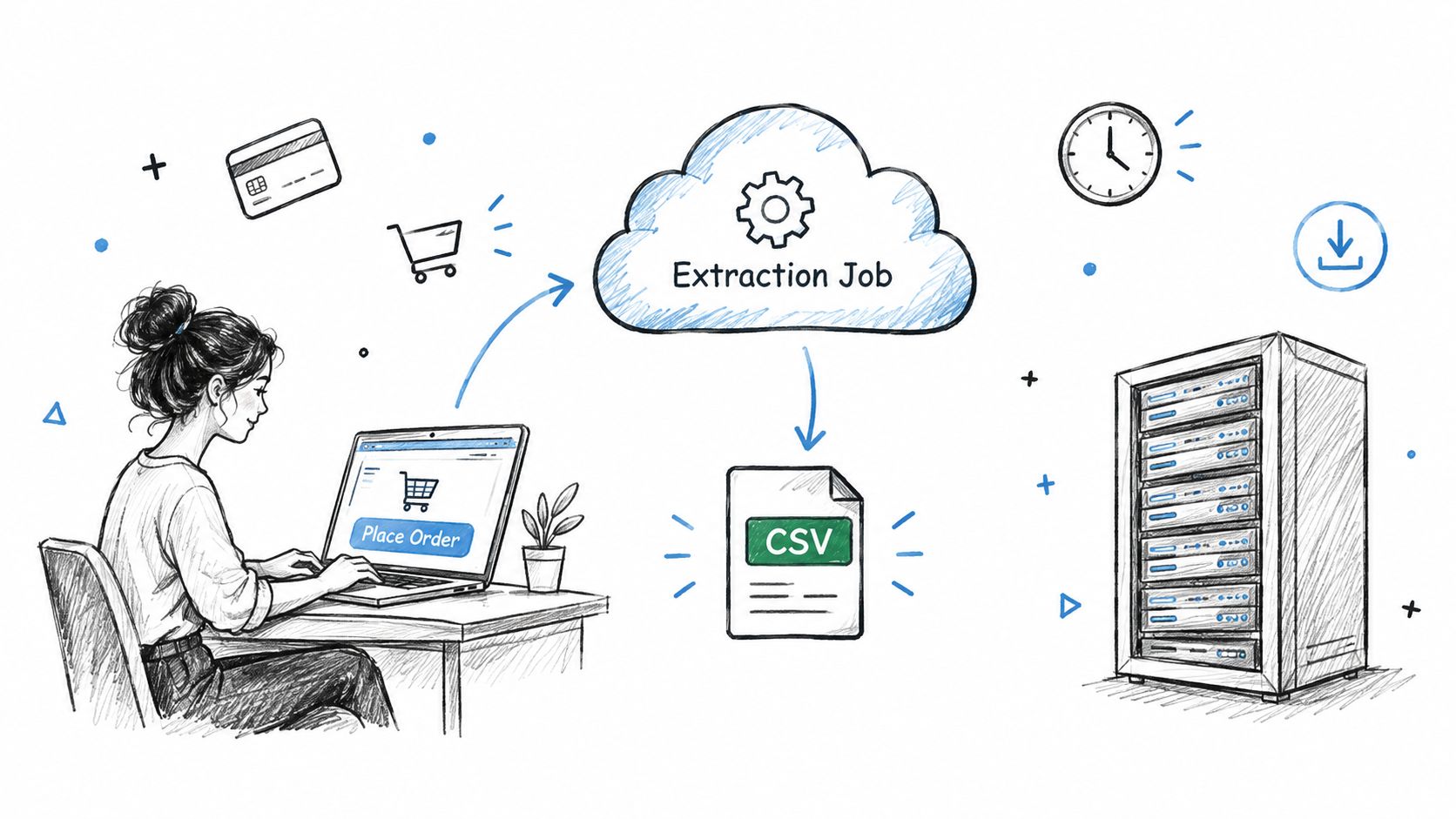
Use the service's web interface or documented Telegram workflow, such as @harvestmydata_bot. Confirm the available card or crypto payment route, then save the order identifier with the job specification. If the file will arrive in a shared inbox or chat, check who has access before submitting.
A traceable order record links the purchase, target, and delivered export. That connection helps operators distinguish a retry from a revised target or an earlier file. For tool selection, use this Instagram scraper comparison to structure your evaluation. Ask each candidate to demonstrate the fields and controls your job requires, and review a sample export rather than relying on a feature list.
Track the stages, not just the status
A status page may show users fetched, emails found, and percent complete. Those figures describe collection, not usable output. Ask for separate counts of parsed, validated, rejected, and exported records. Otherwise, a rising fetched count can hide a parsing failure that leaves the campaign with fewer usable prospects than expected.
Cloud jobs are described as having a short turnaround, with pay-per-job delivery typically around an hour. Treat that as a working estimate, not a fixed deadline. The operational discussion of Instagram extraction reinforces the need to assess access stability and workload-specific performance instead of assuming consistent throughput. Use the walkthrough to check the ordering sequence against your specification.
When the export arrives, inspect it before importing. Confirm that every required column is present, and distinguish missing values from extraction failures. Check UTF-8 handling, readable names, intact bios, and consistent column boundaries. Then reconcile the exported count with the job's final counters and request an explanation for any discrepancy.
Quarantine a mismatched file. Asking sales reps to repair an extraction defect while prospecting turns a collection problem into wasted selling time.
Normalizing and Validating the File
A follower export is not a usable prospect list until each record can be traced, classified, and screened. Treat normalization, validation, and compliance review as production stages, not cleanup afterthoughts. Errors here can shrink the campaign's viable audience or leave sales reps guessing about the evidence behind a contact.
Keep the raw export unchanged. Create a working copy and log each transformation, so every cleaned record can be traced to its original values.
Start with identity fields. Normalize usernames and canonical profile URLs, then deduplicate on both. Preserve the original username and URL in separate columns. Never merge profiles just because their display names look alike. When combining records from multiple audiences, use a defined profile identifier and retain each audience relationship as provenance. That keeps one prospect from appearing several times without losing how the profile was found.
Contact data needs its own evidence trail. Label where each address came from: bio, linked website, contact button, or page metadata. Store the source URL and collection date when available. An address published on a linked website is not automatically the Instagram profile owner's address, and publication alone does not establish role fit. Assign confidence according to the evidence you have, not the address's usefulness to your campaign.
Use the cleaning flow as a staging checklist, not as proof that every surviving record is reachable.
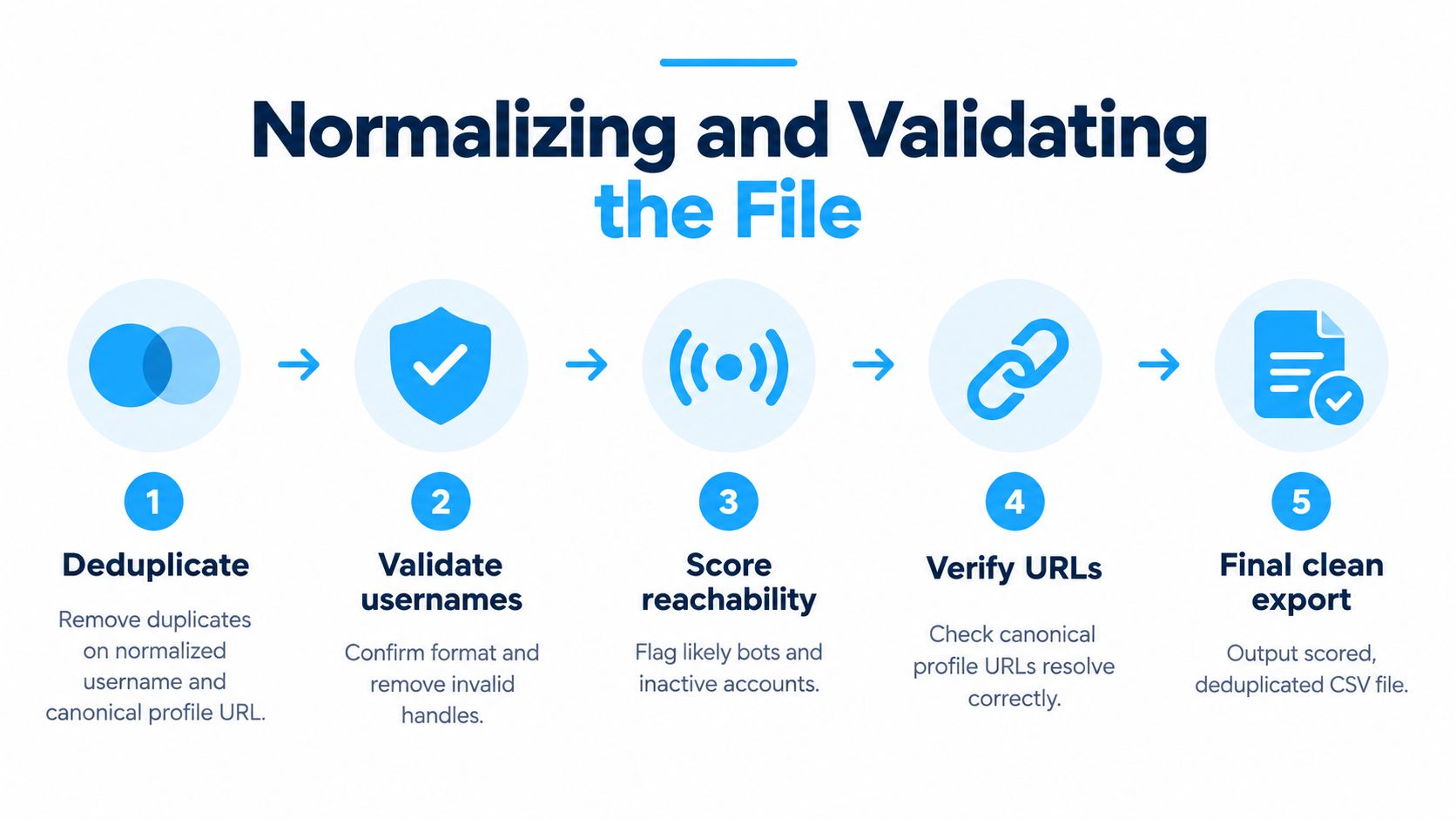
For repeatable cleanup controls, use this guide to fixing data hygiene gaps. The Instagram data-quality guide can help you document acceptance rules for your exports.
Validation should reject unsuitable records deliberately. Remove malformed addresses, role inboxes that do not fit the campaign, disposable inboxes, duplicates, and contacts with known marketing objections from the outreach candidate file. Record a reason for every rejection. That distinction helps operators separate extraction defects from legitimate exclusions.
Report two measures separately:
- Valid-contact yield: Valid contacts divided by profiles fetched. Define “valid” before calculating it.
- Check-pass rate: Contacts passing syntax, domain, and suppression checks divided by contacts evaluated.
A check-pass rate is not a deliverability guarantee. These checks do not establish inbox placement, address ownership, commercial relevance, or permission to send.
Before CRM import
- Identity: Normalize identifiers and preserve the raw values.
- Evidence: Record contact sources and confidence labels.
- Suppression: Document why each excluded record was rejected.
- Handoff: Assign approved records an owner and qualification status.
A clean file earns its place in the workflow because the team can explain what each record represents. That audit trail also makes disagreements fixable without rerunning the extraction.
Quality Beats Volume in Follower Lists
A large follower export is not a sales asset until it survives four production stages: collection, normalization, validation, and compliance review. Each stage can waste campaign budget. Start with a focused commercial hypothesis, then expand only the audience segments that produce qualified candidates.
Authenticity needs its own review. A study of fake-user identification covering **65,326 Instagram accounts** treats account authenticity as a classification problem. Use that as a reason to inspect your own dataset, not to apply a universal fake-account rate to every audience.
The target is a smaller, curated candidate list.

Keep observations separate from judgments
Store the profile's observed category separately from your commercial assessment. A category, website, or bio is evidence. The conclusion that a profile fits an e-commerce campaign is your judgment, and the distinction matters when a sales rep challenges a lead.
Track activity risk, authenticity risk, and business relevance in separate fields. A single quality score hides why a record passed or failed. A quiet profile can be genuine; a polished business profile can still have no relevance to your offer.
Unknown means unknown. Missing activity evidence does not establish inactivity, and a suspicious signal does not prove fraud.
Test the segment before scaling
Run a 1,000-profile pilot with a random manual audit of 100 records as an operating recommendation, not a guarantee of representativeness. Measure false-positive and missing-contact rates. Keep marketing data current and honor objections, following the European Commission's guidance on processing grounds.
The audit should capture:
- False positives: Profiles your rules accept but a reviewer rejects as unsuitable.
- Missing contacts: Relevant profiles where permitted manual inspection finds contact evidence the export missed.
- Category yield: Contact availability and check-pass results for business, creator, personal, suspicious, and unknown profiles.
Inspect difficult records too, but report those findings separately from the random sample. Mixing them distorts the baseline because reviewers deliberately focus on questionable cases.
If enrichment becomes the bottleneck, the GTM guide to Clay providers can help you compare provider options. Enrich profiles that already meet your qualification rules. Spending more to rescue an unfocused audience is a poor use of budget.
Buy more rows only after you can explain why the accepted rows deserve a sales rep's attention.
Compliance Gates Before Outreach
A technically validated contact isn't necessarily approved for outreach. Platform permission and privacy-law compliance are separate gates, and someone must sign off on both.
Under the platform gate, request evidence of the collection mechanism and its authorization. The discussion of Instagram's scraping terms explains that automated collection restrictions can apply even to publicly visible information. Don't accept the absence of a customer login as proof that the provider has permission.
Establish responsibility before releasing records
Reject collection designs that depend on stolen sessions, CAPTCHA bypass, or rotating identities to evade restrictions. Where supported API access doesn't cover the requested audience, narrow the job or choose another permissioned source rather than treating evasion as routine infrastructure.
Privacy review addresses a different question: whether your organization may process and use the collected information for its stated purpose. CNIL's web-scraping safeguards emphasize freely accessible information, reasonable expectations, and measures that reduce effects on individuals' rights. Legitimate interest requires an assessment, not a checkbox attached to a public profile.
Prepare a job-level record:
- Responsibility: Identify controller and processor roles according to what each party decides and does.
- Purpose and scope: Document the source, fields, volume, collection date, intended use, and lawful basis.
- Lifecycle controls: Set retention limits, restrict access, and define deletion and suppression procedures.
- Transparency and outreach: Prepare appropriate notices and review the rules governing the chosen marketing channel.
For designing how preferences reach your sales systems, use Fypion Marketing's consent management for B2B outreach as a supporting resource. Bring the actual workflow, not just the exported file, to your legal reviewer; this website-scraping legality guide can help frame the questions.
Keep objections synchronized across staging files, enrichment tools, and the CRM. Deleting a contact from one spreadsheet while leaving it eligible elsewhere doesn't solve the operational problem. Hold outreach until the responsible reviewer approves the intended use.
A Repeatable Scraping Workflow
Standardize the handoffs, not merely the extraction settings. Every campaign should produce a job specification, a preserved raw export, a transformation record, a quality assessment, and an outreach approval.
Save these checkpoints
- Scope the audience. Choose the source against a commercial hypothesis. Check that the requested relationship is available through an authorized mechanism.
- Submit and monitor. Retain the order identifier and watch collection counters. Reconcile the delivered file with the specification.
- Normalize and validate. Apply identity, provenance, and contact rules. Keep rejected records out of the sales queue.
- Review the pilot. Compare qualification outcomes across categories. Expand only the segments that justify further collection.
- Approve and release. Confirm documented responsibility, processing grounds, retention, and suppression before outreach.
The levers that matter are audience choice, contact evidence, profile relevance, and job-level accountability. Keep those visible in the handoff instead of burying them in an operator's notes.
Assign someone to approve every transition. When a checkpoint fails, return the job to the stage that owns the defect. Don't make the SDR diagnose collection errors or make the extraction provider decide your lawful marketing purpose.
HarvestMyData offers pay-per-job cloud extraction of publicly listed Instagram contact information into structured CSV and Excel files. Visit HarvestMyData with a defined audience, field list, and pilot plan, then put the export through your validation and compliance gates before outreach.
We built HarvestMyData to handle all of this for you.
No proxies, no code, no account needed.