Real Estate Agent Lead Generation: An Instagram Playbook
Most real estate lead generation advice keeps agents stuck in the same crowded lanes: buy portal leads, ask for referrals, post listings on social, repeat. Those channels can work, but they also create dependency. You wait for a platform to send demand, or for your network to remember you at the right moment.
That's a weak system if you want a pipeline you can control. A better approach is to treat Instagram as a live intent database. People reveal where they live, what they do, what they're renovating, who they follow, and often how to contact them. For agents willing to work with public audience data instead of rented lead platforms, that creates a very different kind of edge.
Table of Contents
- Why the standard playbook breaks down - Instagram is underused as a prospecting layer
- Start with following lists, not just hashtags - Use hashtags carefully - A simple prospecting map for buyer and seller intent - What to avoid
- What good scraping actually pulls - Why this works better than recycled lead lists - The cleanest workflow - What ethical use looks like
- Generic outreach versus useful outreach - Personalization signals that matter - Speed matters more than most agents think - A practical first-touch structure - What not to say
- A workable 30-day cadence - Build around source-based segmentation - What automation should handle
- The KPIs that matter - Compare against paid media honestly - Compliance keeps the channel usable
Beyond Zillow Referrals and Paid Ads
A lot of agents still act like there are only three serious options for real estate agent lead generation: referrals, Zillow, and paid ads. That's outdated thinking. Those channels aren't useless, but they're shared, expensive, or inconsistent, and often all three at once.
The budget data makes that obvious. A 2026 survey found that 63.7% of realtors spend less than $1,000 per month on marketing and lead generation according to Real Estate Bees lead generation statistics. That tells you most agents don't have room for waste. They need channels that are targeted, controllable, and less dependent on bidding wars.
Why the standard playbook breaks down
Referrals convert well, but they don't scale on command. You can strengthen your sphere, stay top of mind, and still have slow months.
Portal leads solve that by offering volume, but volume isn't the same as ownership. You compete on response speed, and many leads are also talking to other agents. Paid social has the same basic problem. If your targeting drifts or your creative gets stale, your economics slide fast.
A more durable system starts with a different question: where are high-intent local people already gathering online before they ever fill out a home search form?
Instagram is underused as a prospecting layer
Most agents use Instagram as a brand channel. They post listings, market updates, and closing photos. That's fine for visibility, but it misses the deeper opportunity. Instagram is also a searchable map of local audiences.
You can identify people connected to mortgage brokers, builders, relocation-focused accounts, local interior designers, and neighborhood businesses. Those audiences often contain future buyers, move-up buyers, investors, sellers preparing homes, and service professionals with real estate-adjacent intent.
Practical rule: Stop relying only on platforms that sell the same lead to multiple agents. Build a proprietary list from public audience signals instead.
If you want a broader view of the classic channels before shifting into this approach, Saleswise has a useful roundup of real estate agent lead generation strategies. The gap is that most guides stop at the usual channels. They don't show how to build a local outbound list from Instagram audiences.
That's where the economics start to improve. Instead of renting attention, you identify it early and reach out directly.
Identifying Hyper-Local Lead Sources on Instagram
The biggest mistake agents make with Instagram prospecting is targeting too broadly. “People interested in real estate” is not a target. It's a vague category that produces weak lists and generic outreach.
The better move is to work from micro-markets and audience adjacency. Start with accounts that already aggregate the exact people you want to reach in your city or zip-code cluster.
Start with following lists, not just hashtags
Recent trend data says scraping the following lists of targeted accounts can outperform hashtag scraping by 2x in email yield, with 25% versus 12% averages, based on PNC's lead generation strategy article. For agents, that matters because following behavior often signals stronger local relevance than a broad hashtag does.
A hashtag like #dreamhome can attract anyone. A following list for a local mortgage broker, custom builder, or relocation consultant is usually tighter.
Here are audience buckets worth prioritizing:
- Local mortgage brokers and lenders. Their followers often include first-time buyers, refinance prospects, and people actively learning financing.
- Home builders and remodelers. These audiences can surface both future buyers and owners preparing to sell after upgrades.
- Interior designers and stagers. Followers often include affluent homeowners and people already investing in their homes.
- Neighborhood media accounts. Local dining, events, and community pages can expose residents with strong geographic fit.
- Relocation and employer-adjacent accounts. HR consultants, local recruiting firms, and newcomer guides often sit close to move-driven demand.
Use hashtags carefully
Hashtags still matter, just not as your only source. They work best when they describe a concrete local situation, not a broad aspiration.
Examples include city-specific moving, investing, or first-time buyer tags. Also look for niche community tags tied to new developments, condo buildings, waterfront districts, school zones, or lifestyle clusters. If you work luxury, pull from accounts and hashtags that reflect that world. If you work downsizing or 55+ transitions, target those communities directly rather than hoping broad homebuyer terms will surface them.
The strongest Instagram audiences usually sit one layer away from the transaction, not directly inside a “buy a house” hashtag.
A simple prospecting map for buyer and seller intent
| Audience type | Likely signal | Better fit |
|---|---|---|
| Mortgage broker followers | Financing curiosity | Buyers |
| Builder and renovation audiences | Upgrade behavior | Sellers and move-up buyers |
| Interior design accounts | Home investment mindset | Sellers |
| Relocation-focused pages | Moving intent | Buyers |
| Investor niche accounts | Market activity | Investors |
The easiest way to think about this is upstream versus downstream. Zillow catches people after they've already entered a lead marketplace. Instagram audience targeting lets you catch them earlier, before every other agent is in the same queue.
If you need help spotting local audience clusters before you scrape, this guide on finding local business emails on Instagram is useful because it shows how to think in terms of local account ecosystems rather than random profile collection.
What to avoid
Three targeting choices usually underperform:
- Massive celebrity or national accounts. The audience is too broad.
- Generic real estate hashtags. Intent is diluted.
- Tiny inactive local pages. Even if the audience is relevant, the data pool is too thin.
A better target is often a mid-sized local account with a clear niche and a real community around it. That gives you a list with enough volume to work and enough specificity to personalize.
Building Your Outreach List with Data Scraping
Once you know which audiences matter, the next step is building a list from public profile data. At this stage, most articles become vague. They'll tell you to “engage on Instagram” or “build relationships” without explaining how to extract a workable prospecting list from an audience you didn't personally build.
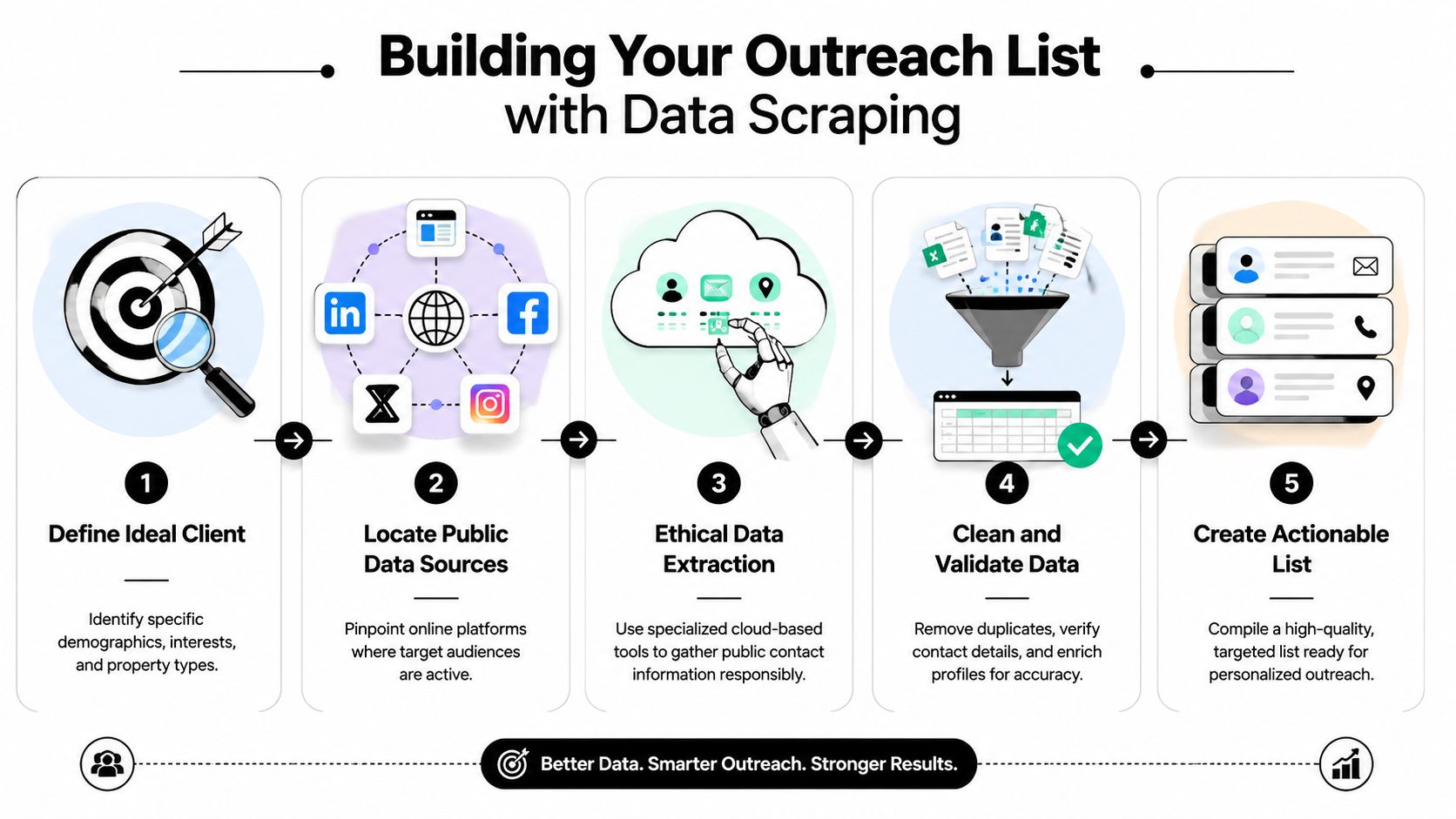
The practical method is cloud-based instagram email scraping from public followers, following lists, and hashtags. Not single-profile lookups. Not browser-extension guesswork. Not manual copy-paste. The goal is to turn a relevant audience into a clean CSV you can segment and work.
What good scraping actually pulls
The value isn't just the email. The useful output is enriched profile context:
- Public email addresses when listed
- Full names when available
- Bio text for personalization clues
- Category or niche indicators
- Website URLs
- Follower context that helps you sort creators, businesses, and consumers
That context is what makes outreach sound informed instead of cold. A seller-facing note to someone who follows a local staging company should read differently from a buyer-facing note to someone following a mortgage advisor.
Why this works better than recycled lead lists
Most purchased lists decay fast. People change roles, switch inboxes, or never wanted outreach in the first place. Public social data is different because it reflects current behavior. If someone follows three local mortgage brokers, a relocation concierge, and a new condo development page, that cluster tells you far more than an old database ever will.
The technical side matters too. According to the gap data cited in NAR's article on lead generation ideas, compliant Instagram scraping can yield 15% to 30% public emails in real estate niches and process 1,000 profiles every two minutes. That's why this method is viable for agents who want a repeatable, non-ad-based pipeline.
The cleanest workflow
A practical workflow looks like this:
- Choose one audience source
Start with a local broker, builder, designer, or relocation account.
- Extract public profile data at audience level
Pull followers, following, or hashtag participants.
- Filter the output
Remove obvious spam, irrelevant geographies, and duplicate profiles.
- Segment the list
Split likely buyers, sellers, investors, and local business owners.
- Send the list into your CRM or outreach stack
Don't leave it sitting in a spreadsheet.
If the list isn't segmented before outreach, you'll write generic messages. Generic messages are what make cold outbound feel broken.
A lot of agents also underestimate the value of comparing different audience sources before committing to one. This overview of an Instagram follower tracking workflow is useful for that. It helps frame audience collection as an ongoing testing process rather than a one-time scrape.
What ethical use looks like
Stick to publicly listed contact information and business-relevant outreach. Don't treat scraped data like a license to blast everyone with the same script. The point is precision, not volume for its own sake.
That distinction matters. Good instagram email scraping supports better targeting and cleaner messaging. Bad scraping just creates a bigger pile of ignored emails.
Crafting Outreach That Actually Converts
Most agents don't have a lead problem. They have a messaging problem.
They finally get a decent list, then send some version of: “Hi, are you looking to buy or sell real estate in the area?” That message tells the prospect you know nothing about them, nothing about their context, and nothing about why they should respond.
Generic outreach versus useful outreach
Here's the weak version:
Hi Sarah, I'm a local real estate agent. If you're looking to buy or sell, let me know. I'd love to help.
That message is easy to ignore because it asks for attention before earning it.
A better version uses the data you already collected:
Hi Sarah, I noticed you follow a local mortgage team and a downtown condo page, and your bio mentions you recently moved back to the area. I help buyers compare condo options in that part of the city without getting pushed into portal lead funnels. If you're still exploring neighborhoods, I can send a short breakdown of what buyers usually miss between those buildings.
That works better because it feels observed, local, and specific. It also offers something small and useful instead of jumping straight to a call.
Personalization signals that matter
You don't need to write a custom essay for every lead. You need one or two credible signals:
- Who they follow
- What their bio says
- What category they appear to fit
- Whether their website suggests investor, business owner, or resident
- Whether the original audience source implies buyer or seller intent
Niche selection proves helpful. If you're targeting high-relevance audiences, your personalization options are built into the list. For examples of which audiences tend to produce stronger public email availability, this breakdown of Instagram niches with high email rates is worth reviewing.
Speed matters more than most agents think
Even strong outreach loses value if your response handling is slow. Research cited by AgentZap's real estate lead statistics says that contacting a new lead within 5 minutes leads to a 21x higher conversion rate than contacting them after 30 minutes, and 5-minute responders see a 391% higher conversion overall.
That applies to inbound leads, but the operational lesson carries over to outbound too. When someone replies, your system needs to react immediately. If your inbox is a mess and your CRM isn't connected, you'll waste the small window where curiosity is highest.
A practical first-touch structure
Use a three-part message:
- Relevant observation
Mention the audience signal. Keep it light and factual.
- Specific value
Offer a local insight, shortlist, estimate, or comparison.
- Low-friction CTA
Ask a simple question or offer to send something brief.
Later in the process, video can help sharpen your messaging style and follow-up tone:
What not to say
Avoid these patterns:
- Fake familiarity. People can tell.
- Long autobiographies. They don't care yet.
- “Just checking in” follow-ups. Add value or stay silent.
- Over-qualification on first touch. Don't interrogate people before they engage.
Send messages that prove you know why this person is on your list. That alone separates you from most agent outreach.
Nurturing Leads with Automated Workflows
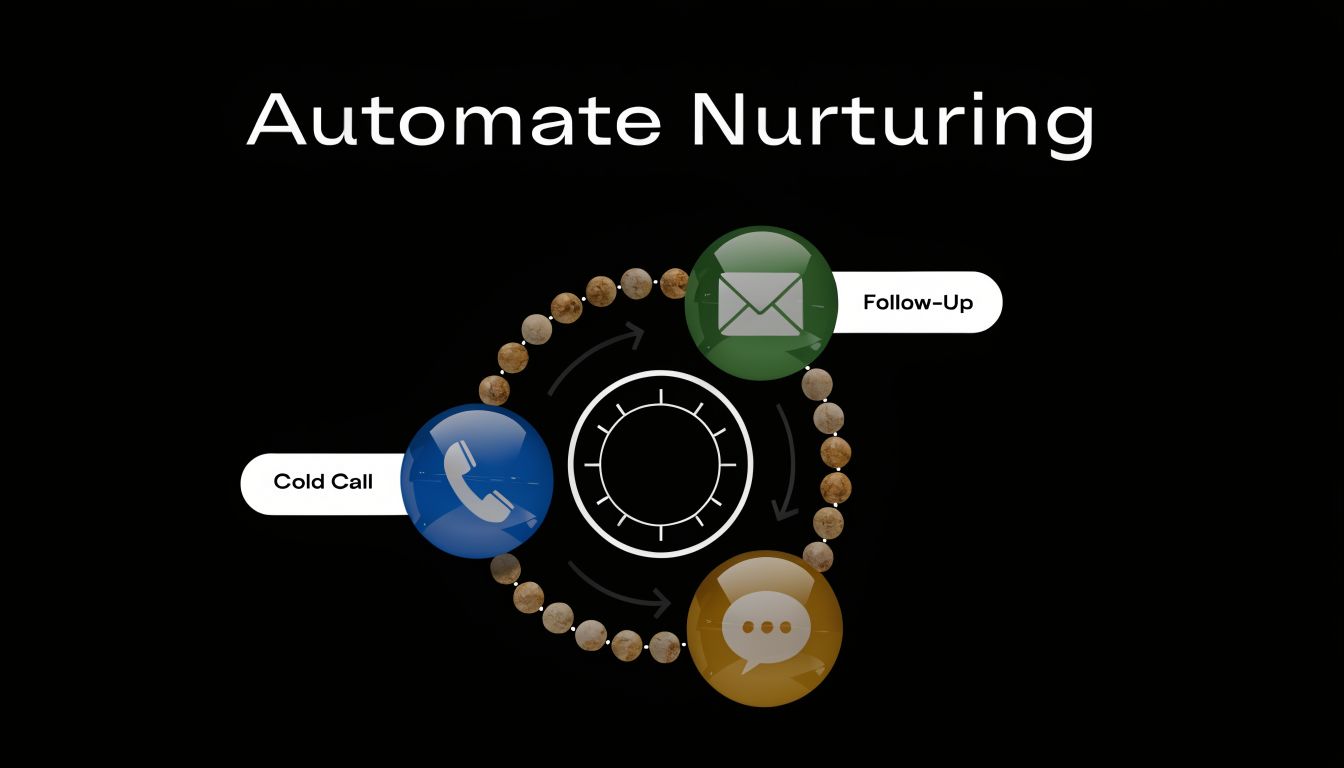
A scraped list is not a pipeline. It's raw material. The pipeline appears when your follow-up runs without depending on memory.
Many agents lose money at this stage. They send one email, maybe one text, then move on. Real Trends data cited by SaveMyLeads' real estate lead generation statistics says leads contacted 6 or more times convert at a 70% higher rate. Persistence matters, but only if it's organized.
A workable 30-day cadence
You don't need a giant enterprise stack. A CRM plus simple automation is enough if the logic is sound.
Days 1 through 7
Start with the personalized first email. If there's no reply, follow with a short second touch that reframes the value. This should not be a bump email. It should introduce a different angle, such as a neighborhood comparison, seller prep insight, or investor lens.
Then add a manual or semi-automated text if that channel fits your process and compliance standards. The text should be shorter and more direct than the email.
Days 8 through 20
Shift from direct ask to useful content. Send one market-relevant asset, one niche-specific note, and one personal follow-up.
Good examples include:
- Buyer-focused note with a shortlist of neighborhoods or building types
- Seller-focused note with prep observations based on local positioning
- Investor-focused note with a compact angle on rental or resale pockets
Automation provides the most help. The CRM should trigger tasks, assign stages, and tag leads by audience source so you can see which Instagram segments progress.
Days 21 through 30
Use a clean closing sequence. Not “I guess you're not interested.” More like:
- Relevance check asking whether timing is later
- Value offer such as a custom shortlist or local pricing snapshot
- Permission-based close that lets them opt out or stay on a useful update list
Build around source-based segmentation
Not every scraped lead deserves the same cadence. Someone pulled from a luxury builder following list should not enter the same sequence as someone pulled from a first-time buyer mortgage audience.
A simple segmentation table helps:
| Source audience | Likely intent | Best nurture angle |
|---|---|---|
| Mortgage broker followers | Buying soon | Financing-friendly guidance |
| Interior design audiences | Home prep or move-up | Seller positioning |
| Investor accounts | Deal analysis | Opportunity spotting |
| Relocation pages | Area research | Neighborhood education |
Field note: Most follow-up fails because the sequence is too repetitive, not because the lead was bad.
If you want more ideas on how to structure automated messaging once a lead enters your CRM, ListingBooster.ai's email marketing insights are a helpful reference for balancing automation with personalization.
What automation should handle
Let software handle the boring parts:
- Lead routing
- Tagging by source
- Task reminders
- Email sequencing
- Reply detection
- Stage movement
Let humans handle judgment. That includes rewriting messages for high-value prospects, deciding when to call, and spotting when a seller signal is stronger than the original list source suggested.
Measuring Success and Ensuring Compliance
If you can't measure this channel against paid media, you won't know whether it deserves more attention. The cleanest way to evaluate instagram email scraping for real estate agent lead generation is to track it like a performance marketer, not like a social media manager.
The KPIs that matter
Start with a small scorecard:
- Cost per lead
Total data acquisition and outreach cost divided by valid leads created.
- Reply rate
Replies divided by messages sent.
- Qualified conversation rate
Leads that turn into real buying, selling, or investing conversations.
- Appointment set rate
Appointments booked divided by leads contacted.
- Source-to-opportunity rate
Which audience type creates the best conversations.
A lot of agents stop at opens or clicks. That's too shallow. A local mortgage-following audience and an interior-design-following audience may behave very differently. You need source-level visibility.
Compare against paid media honestly
Paid search gives you a benchmark. According to Opendoor's overview of real estate lead sources, real estate PPC averages a cost-per-click of $1.55. That doesn't tell you your own cost per closing, but it gives you a baseline for what bought traffic costs before conversion work even begins.
If your scraped audience workflow produces lower-cost qualified conversations than your paid channels, that's a strong signal to keep investing. If it doesn't, tighten the audience, improve the message, or drop that segment.
Compliance keeps the channel usable
This method depends on restraint. Use publicly listed contact details. Keep outreach relevant to the person's business or likely interest. Identify yourself clearly. Include a way to opt out. Keep your data handling organized and avoid dumping everyone into a never-ending drip.
Compliance isn't a side note. It's what separates targeted prospecting from sloppy blasting.
The safest mindset is simple:
Treat every contact like a real person whose context you partially understand, not as a row in a spreadsheet.
If you do that, your outreach gets better and your risk drops at the same time.
If you want to turn Instagram audiences into clean, enriched outreach lists without dealing with software, proxies, or account logins, HarvestMyData is built for that workflow. It lets you scrape public followers, following lists, and hashtags in the cloud, then export the contact data you need for targeted real estate outreach.
We built HarvestMyData to handle all of this for you.
No proxies, no code, no account needed.