Lead Generation for Small Business That Books Calls

The most popular advice about lead generation for small business is to add more channels. Post more, run ads, collect contacts, and keep the funnel full. That's poor advice when the owner already has unanswered inquiries and no protected time to follow up. Start with the conversations your team can handle, then choose how to generate them.
Table of Contents
- Channel popularity doesn't establish value - Separate the acquisition problem from the handoff
- Channel Fit by Budget and Follow-Up - Make the economic decision before choosing tools
- Define the test before the pull - Inspect the sample by hand
- Keep the record small enough to maintain - Review the handoff, not just the campaign
- Assess what arrives with each source - Match the source to the work
- Check relevance and permission separately - Make suppression part of daily operations
- Prepare the first job - Set the limits before launching
Why More Leads Still Fail Small Businesses
The inbox has new contacts. The calendar doesn't have new sales conversations. By the end of the week, the owner has answered urgent customer questions, delivered paid work, and lost track of which campaign produced anything worth pursuing.
That's not necessarily an acquisition problem. It's a mismatch between lead volume, qualification, and follow-up capacity. Buying more contacts before fixing that mismatch gives someone more records to sort, not a clearer path to revenue.
Channel popularity doesn't establish value
A 2024 small-business marketing summary from PostcardMania reported Facebook advertising use at 69.2%, compared with 61.7% for direct mail, while reported revenue per lead was $41.60 for digital and $253.54 for direct mail; it also cited social media response rates below 1% in most categories.
Those figures don't establish that direct mail will outperform digital for your business. Industries, customer types, and attribution methods can differ. They do establish why channel adoption, response rate, and revenue per lead shouldn't be treated as interchangeable measures.
A contact can be inexpensive to acquire and expensive to qualify. Someone still has to inspect the business, establish relevance, handle replies, and decide whether a meeting makes sense.
Working definition: A useful lead is a relevant prospect your team can qualify and move toward a clear next step.
Separate the acquisition problem from the handoff
Before changing channels, identify where prospects stop moving:
- No relevant inquiries: Revisit the audience and offer.
- Relevant inquiries without meetings: Inspect response ownership, qualification, and booking.
- Meetings without suitable opportunities: Tighten the definition of a qualified conversation.
- Opportunities without revenue: Review the sales process before expanding acquisition.
For service businesses, call handling belongs in that diagnosis. Recepta.ai's resource on how to build a contractor pipeline with Recepta.ai is relevant when the practical challenge includes turning inquiries into scheduled work.
The operating target is booked, qualified conversations, not a larger export. Choose channels your team can maintain, test a narrowly defined audience, and judge the results after follow-up is complete.
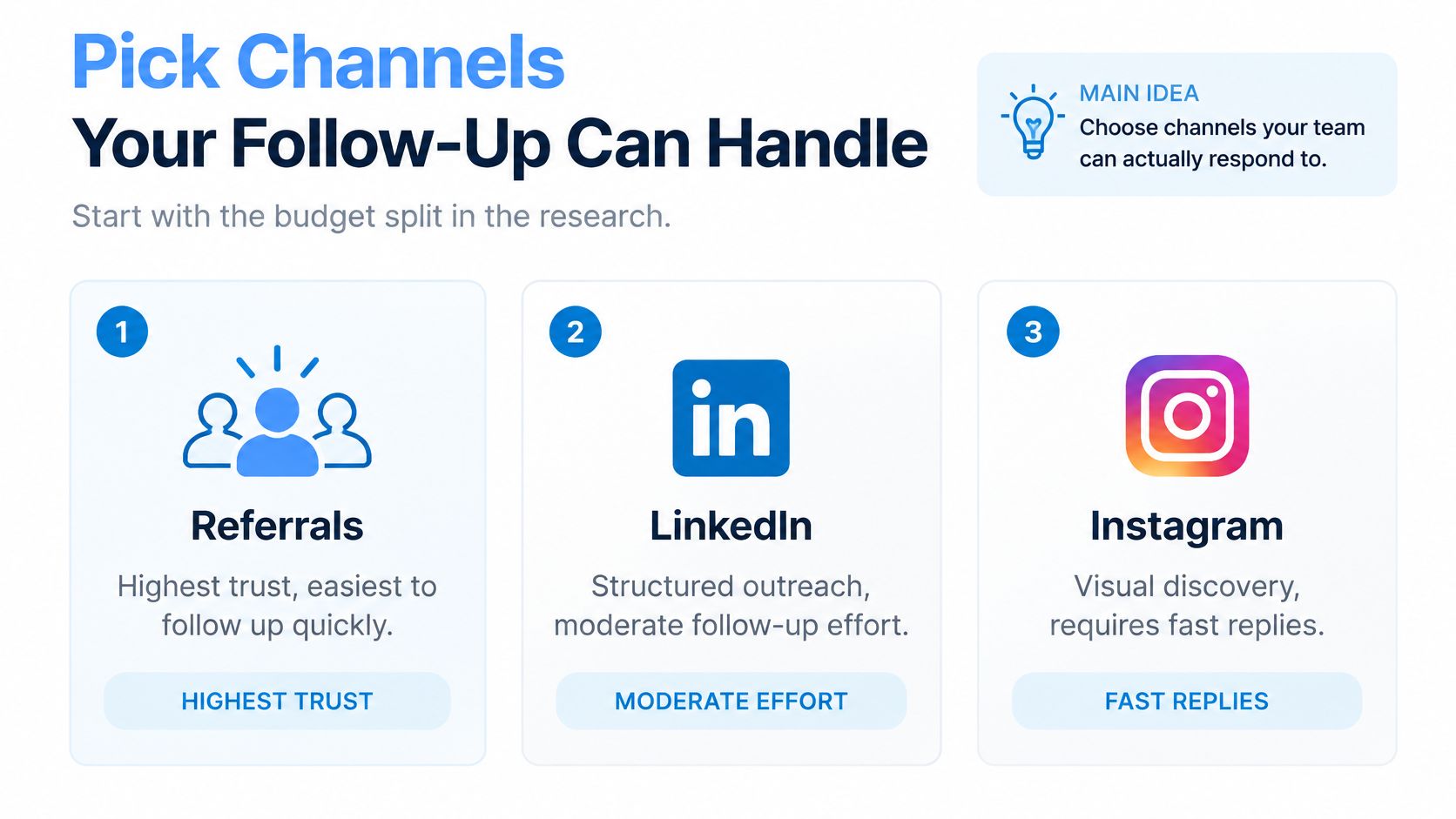
Pick Channels Your Follow-Up Can Handle
Referrals deserve attention before you buy more reach. In LocaliQ's small-business marketing trends report, 83% of businesses identified customer referrals as their best acquisition source, versus 46% identifying digital marketing or online advertising as a top source; digital was a top source for 37% of businesses spending $1,000 or less monthly, compared with 71% spending $10,000 or more.
That's a budget distinction, not proof that spending more causes better results. A cash-constrained owner shouldn't copy the channel mix of a business with dedicated campaign management and sales coverage.
The practical comparison starts with who will answer, not where you can advertise.
Channel Fit by Budget and Follow-Up
| Channel | Fits first when | Follow-up load | Metric to watch |
|---|---|---|---|
| Referral asks | Satisfied customers understand whom you help | Personal introductions and direct replies | Qualified conversations per ask |
| Local search | Buyers seek your service within a defined area | Calls, forms, and appointment requests | Cost per qualified local inquiry |
| Partnerships | Complementary businesses serve the same buyer | Relationship maintenance and handoffs | Partner-sourced qualified conversations |
| Social prospecting | You can identify a specific business audience | Research, validation, outreach, and replies | Cost per qualified conversation |
| Paid ads | The offer and inquiry handling already work | Campaign oversight plus incoming responses | Acquisition cost and contribution margin |
Make the economic decision before choosing tools
Start with your sales cycle. An urgent local service needs someone available to handle incoming inquiries, while a considered business purchase may require research and continued follow-up. Neither is a good fit for a channel that generates work nobody owns.
Write down the hours available for research, replies, qualification, and meetings. Don't allocate all available time to first contact, because interested prospects create additional work.
Use this calculation:
Cost per qualified conversation = campaign spending plus allocated labor cost, divided by qualified conversations.
Define qualification before launching. A useful definition might require the right geography, a relevant business need, an appropriate decision-maker, and agreement to discuss a plausible purchase.
Outbound or paid acquisition becomes economically rational when expected sales from those conversations can cover delivery costs, acquisition spending, and follow-up labor, with enough margin left to justify the work. Revenue alone isn't the decision.
Compare sales prospecting tools by workflow fit only after identifying which task needs help. This week, choose the channel whose replies you can personally handle without postponing existing customer work.
Build a Small Public Prospecting Test
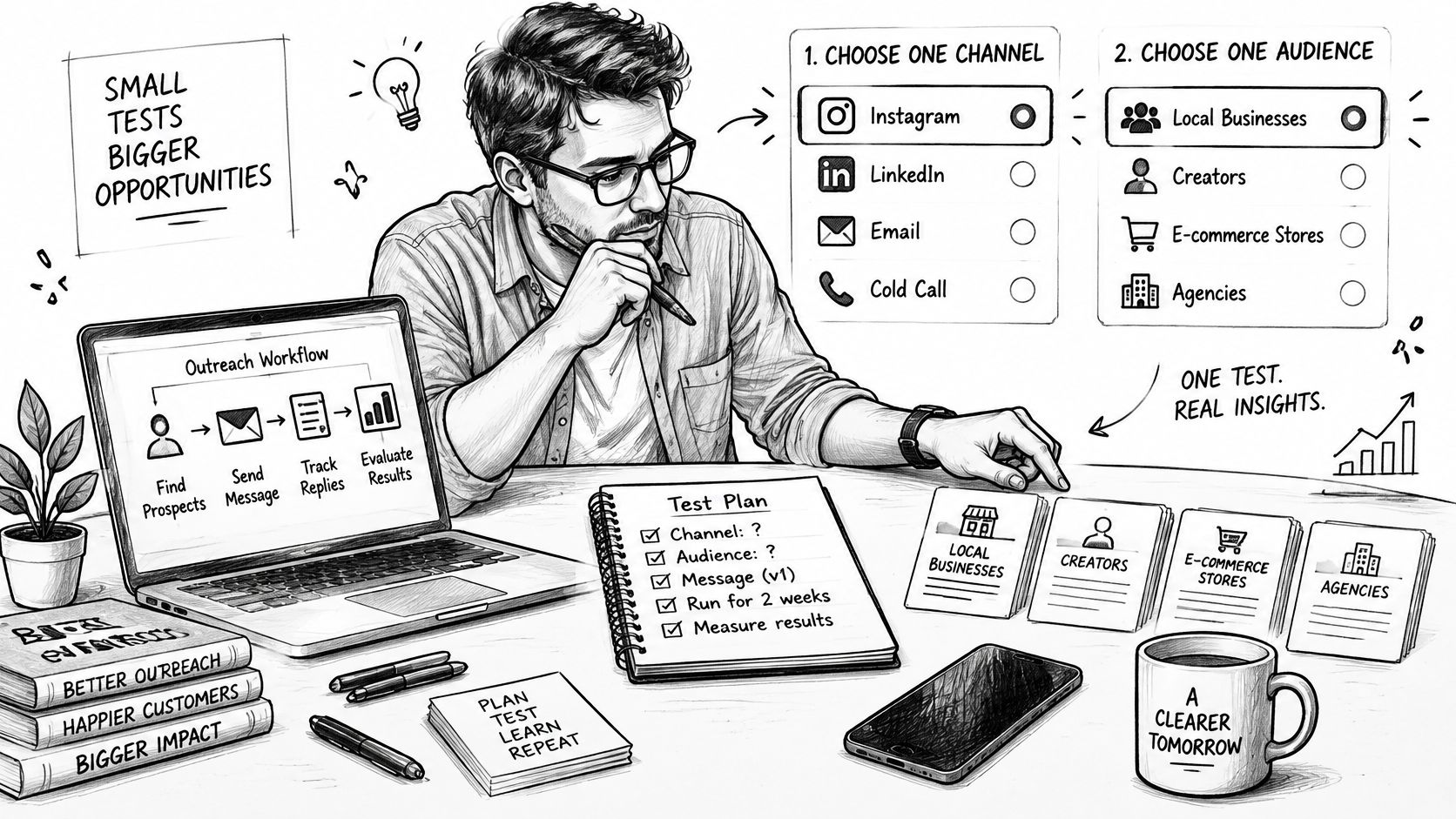
Consider a hypothetical founder selling product photography to independent retailers. A broad audience interested in photography would include peers, hobbyists, and potential buyers. Followers of a niche retail account might provide a more useful starting hypothesis, but they still need inspection.
Write the audience and offer down before collecting anything.
The planning task is to connect a visible audience with a plausible business need.
Define the test before the pull
Use a short test statement containing:
- Buyer: The business type, buyer role, and geography you intend to reach.
- Audience: A relevant account's followers, a following list, a niche hashtag, or engagement with a specific post.
- Offer: A concrete service connected to something the buyer does.
- Success threshold: The booked conversations that would justify the spending and time.
- Stop condition: The point at which weak relevance or replies require a pause.
For the photography example, the hypothesis could be that retailers actively presenting products on Instagram need help creating consistent commercial images. That's an assumption to test, not a fact established by their presence on the platform.
Set the initial collection cap according to how much validation you can finish. A cloud extraction service can turn a public audience into a CSV or Excel file without requiring the customer to log into Instagram, but file delivery isn't the end of the work.
Inspect the sample by hand
Check whether each candidate is a retailer. Confirm the service area from available business information rather than guessing from a name or language. Remove photographers, unrelated creators, inactive businesses, and other obvious mismatches.
Keep the source account, hashtag, or post reference and collection date with the record. Note why the business fits, so the person writing outreach doesn't have to repeat the research.
Use this video alongside the written test plan, without treating extraction as permission to contact everyone.
Only move appropriate, legally reviewed candidates into a callable or emailable sample. The opening message should connect the offer to the business, not merely announce that you found its profile.
Stop before increasing volume if the sample is poorly matched. If relevant prospects don't respond, review the offer, message, and contact channel before collecting another audience. Change a clear variable, rather than changing everything and losing the ability to interpret the result.
Track Conversations Instead of Raw Contacts
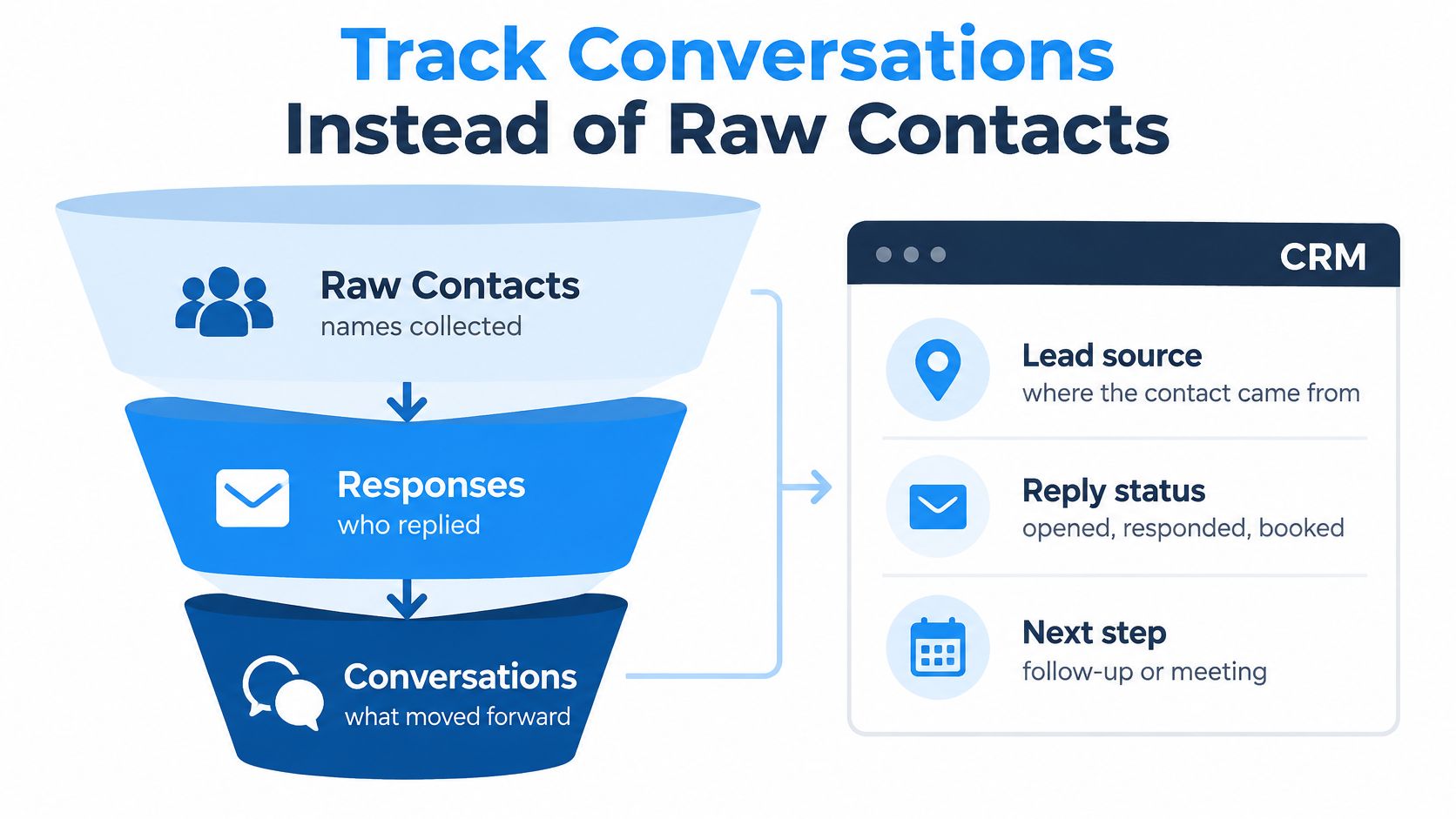
A downloaded file proves that records were collected. It doesn't prove that anyone was contacted, qualified, or booked.
The operational question is whether another person could open your records and understand what should happen next. If the answer depends on the owner remembering an Instagram message, the process is too fragile.
Keep the record small enough to maintain
A Fit Small Business compilation of CRM research reported that only 26% of small and midsize businesses had a CRM in their technology stack; among CRM users, 86% said it helped them achieve business goals and 61% reported improved retention, while 51% of small businesses adopting a CRM reported increased lead-conversion rates.
These are survey-based findings, not a guarantee that buying software improves sales. Treat them as support for structured management, not a reason to install a complicated system.
A spreadsheet can support an early test if someone maintains it consistently. Keep these fields visible:
- Source and niche: Where the prospect came from and why it fits.
- Contact history: First-touch date, latest reply, and responsible person.
- Status: Unreviewed, approved, contacted, replied, qualified, booked, or closed.
- Next action: What happens next and when.
- Outcome: Meeting result, opportunity value, and actual revenue when available.
The funnel below separates collection from meaningful progress.
Review the handoff, not just the campaign
Measure the interval between an inquiry and a human response. Check overdue next actions and conversations that ended without a decision. Those records show whether the team needs better targeting or needs to finish work already started.
During the weekly review, compare contacts touched, qualified conversations booked, meetings held, and resulting opportunities or revenue. Separate booked meetings from attended meetings so cancellations don't inflate your assessment.
Use campaign-level results while samples are small. For comparable audience jobs, you can also normalize revenue per thousand profiles, but don't confuse open pipeline with money received.
A small list that produces suitable meetings is more useful than a large file nobody has worked.
Include existing relationships in the review. When a service business has a lawful reason to resume contact, a resource on how to reconnect with past service customers offers a relevant alternative to acquiring entirely new contacts.
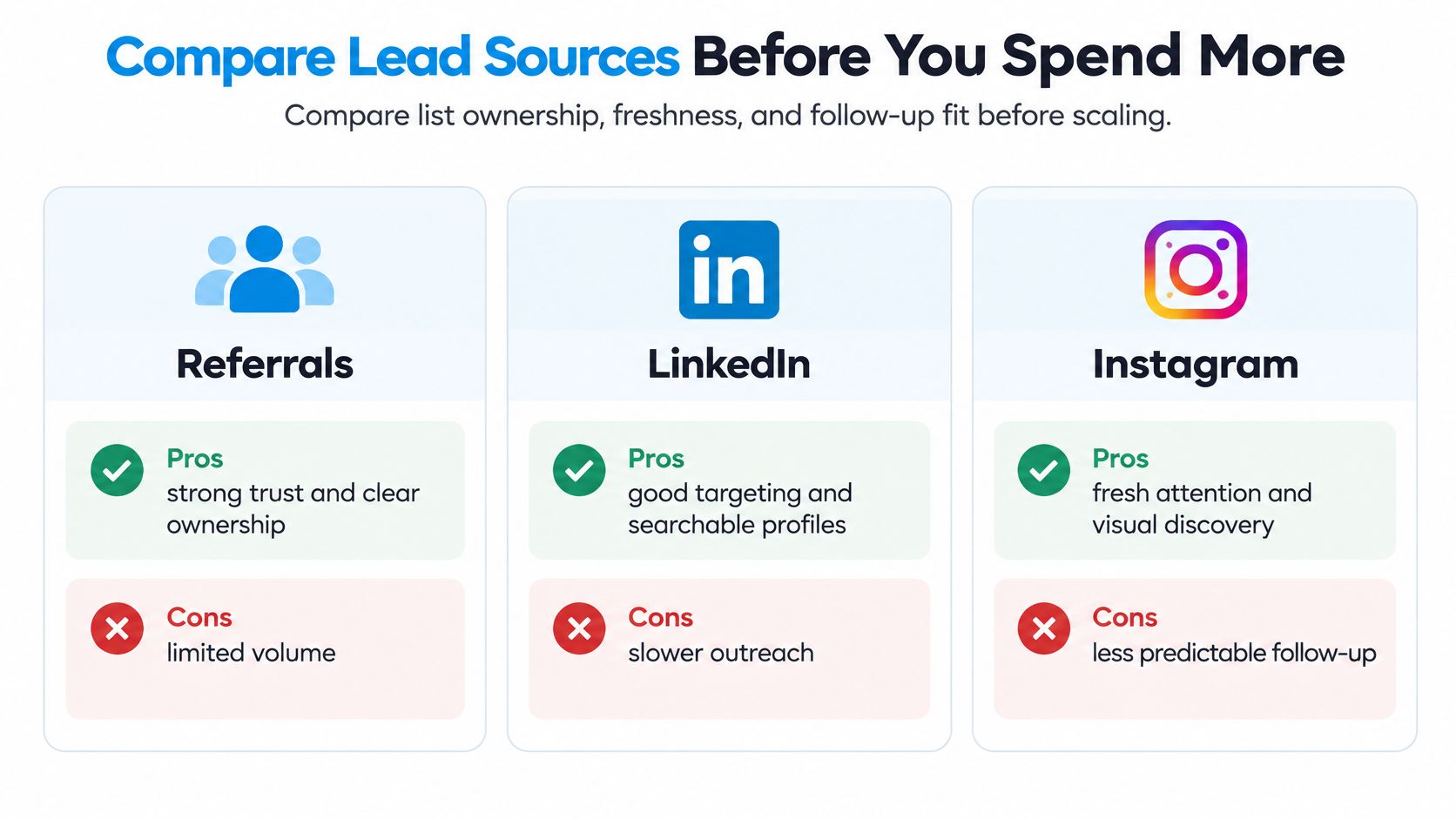
Compare Lead Sources Before You Spend More
Source selection changes what your team must verify. A partner introduction may arrive with useful context but incomplete records. A form submission provides a direct inquiry, but the person may still be outside your service area.
Compare relationship control, freshness, and handoff quality, not just the apparent price of a name.
Assess what arrives with each source
| Source | Relationship and control | Freshness check | Handoff requirement |
|---|---|---|---|
| Referrals and partnerships | Existing relationship provides context | Confirm the introduction is current | Record the need and introducing party |
| Local search and forms | Prospect initiates the inquiry | Review submission time and details | Route it to an accountable owner |
| Paid ads | You rent access to attention | Check campaign and inquiry dates | Preserve campaign attribution |
| Public Instagram audiences | You build a prospecting dataset | Inspect current business relevance | Validate contacts and import clean fields |
An introduction isn't a purchased list. Likewise, exporting public profile data doesn't give you ownership of the people represented in it or permission to market to them.
This comparison provides a quick visual prompt, but your own follow-up requirements should decide the choice.
Match the source to the work
For paid acquisition, review the campaign setup before committing more spending. SimpleLab Digital's guide to pay per click for small businesses is relevant when evaluating that route. Keep the definition of a lead consistent with your cost-per-lead calculation, then examine downstream qualification separately.
Public Instagram audiences fit a different task: identifying businesses or creators that already publish commercial contact details.
HarvestMyData extracts publicly listed emails and available phone numbers from followers, following lists, hashtags, commenters, and likers. We enrich records with username, name, bio, follower count, category, and website, then provide UTF-8 CSV or Excel output without requiring an Instagram login or subscription.
Our average public-email yield is approximately 10%, with higher rates in business-focused niches. Email yield isn't a conversion rate. It measures contact availability, not buyer fit, permission, interest, or purchasing intent.
Choose the source that leaves your team with the least unresolved work before a legitimate conversation. Don't assemble every available source just because you can import them into the same spreadsheet.
Run Outreach You Can Defend Later
Public contact information is a candidate for review, not blanket permission to send marketing. A visible address may belong to a shared inbox, a former employee, or a team that handles customer support rather than supplier proposals.
The OCIE SBDC small-business survey found that nearly 20% of surveyed businesses didn't engage in marketing. For an owner building the process from scratch, a short, documented workflow is a more manageable starting point than simultaneous campaigns across several channels.
Check relevance and permission separately
Apply this checklist before releasing a reviewed batch:
- Legal applicability: Identify the sender's and recipient's jurisdictions, channel requirements, and any consent or other legal basis needed. Get qualified advice where the rules are unclear.
- Public-source provenance: Retain the source reference and collection timestamp. Don't assume publication establishes consent.
- Business relevance: Confirm that the offer relates to the recipient's role and business activity.
- Contact quality: Check whether the address appears current, appropriate, and usable for the intended purpose.
- Deduplication: Remove repeated records across audiences and campaigns.
- Suppression: Exclude opted-out contacts and others marked do not contact.
- Accountability: Assign someone to handle objections, correction requests, and removal requests.
Use the GDPR email marketing guide as a starting point for identifying questions to resolve, not as a substitute for jurisdiction-specific legal advice.
Make suppression part of daily operations
Use the same CRM statuses that govern outreach to prevent inappropriate repeat contact. An opt-out recorded in a separate inbox won't help if someone later imports the address into another campaign without checking it.
Before scaling: Review whether the team can explain where each contact came from, why the offer is relevant, and why the outreach is permitted.
Keep only the information needed for the work and apply an appropriate retention policy. Review ambiguous records rather than treating missing information as approval.
A technically deliverable email can still be the wrong contact. Resolve that distinction before increasing the send volume.
Run One Audience and Book the Next Calls
A larger export does not create more sales capacity. Choose one audience you can assess and follow up with, then judge the test by qualified conversations per hour of staff time, not by the number of rows collected.
For example, a service for independent retailers is easier to test when you define the location, business activity, and person who makes buying decisions. Before collecting profiles, agree on what makes a prospect relevant and what would rule one out. Keep the first audience narrow enough for the team to review and contact appropriately.
Prepare the first job
Record five decisions before ordering:
- Audience boundary: The account, following list, or hashtag to test.
- Commercial reason: Why these businesses might need the offer.
- Review owner: Who checks the sample before outreach.
- Response owner: Who handles interest and schedules suitable calls.
- Decision point: What results would justify repeating, revising, or stopping.
Collecting more profiles than you can review creates work, not pipeline. Contact only an approved sample, and leave unused records out of campaigns until someone has checked them.
HarvestMyData extracts publicly listed emails from Instagram business and creator profiles, with phone numbers when available. Customers can choose an order from 1,000 to 250,000 profiles. Pricing starts at $3 for 1,000 profiles, and larger jobs cost less per profile. Results arrive by email as CSV and Excel files within 1 hour. Each order also has a live status page showing profiles fetched, emails found, and completion progress.
Use the processing time to finish the review and assign someone to handle replies. A file arriving quickly does not mean the team is ready to contact every person in it.
Set the limits before launching
Use collected data only for lawful purposes. Follow applicable CAN-SPAM and GDPR requirements, do not use data for harassment or stalking, do not resell or redistribute raw data, and honor opt-out requests.
Run the approved sample and complete its follow-up before expanding. Track booked qualified conversations and revenue per thousand profiles, then compare those outcomes with the staff time required. Repeat only when relevance, sales results, and follow-up capacity support another run. Stop when the audience produces low-quality conversations or demands more work than the team can absorb.
HarvestMyData turns defined public Instagram audiences into structured CSV and Excel files for a controlled prospecting test. Visit HarvestMyData to choose an audience, then use a reviewed sample to assess whether it can produce qualified conversations.
We built HarvestMyData to handle all of this for you.
No proxies, no code, no account needed.