Free Trial Instagram Follower: How to Get and Use It

You've found an Instagram account whose audience looks like your ideal customer. Before paying for a large contact file, you want to know whether those followers include relevant businesses, whether their emails are usable, and whether you can lawfully contact them.
A search for “free trial Instagram follower” can also turn up offers to add followers to your own account. That's not the trial discussed here. This guide treats the trial as a sample data export, something you inspect before spending money or importing contacts into your CRM.
Table of Contents
- Match the relationship to your buyer
- Prepare and submit the request - Monitor delivery and preserve the evidence
- Clean the records before scoring them - Keep a compact quality scorecard
- Document the intended use - Limit access and prepare responsibly
- Price the contacts you can actually use
What the Free Instagram Follower Trial Includes
A trial should show you what lands in your spreadsheet. Our trial covers up to 1,000 accounts on request, allowing you to inspect a defined audience before ordering a larger file.
Instagram's commercial audience is substantial: approximately 90% of users follow at least one business account, according to Linearity's Instagram statistics. That doesn't mean every follower publishes contact details or matches your buyer profile.
What a free trial export contains
| Trial Element | What to Expect | Why It Matters |
|---|---|---|
| Trial size | Up to 1,000 accounts on request | Enough to test one audience before a full order |
| File format | UTF-8 CSV or Excel, with one row per profile | Opens directly in spreadsheets and supports CRM imports |
| Profile fields | Username, full name, bio, follower count, category, website URL, public email and public phone when published | Lets you filter before outreach |
| Public email coverage | Our stated coverage is 15-30% of profiles, not a guaranteed sample result | Plan for most rows having no email |
| Processing time | About 2 minutes per 1,000 accounts | Collection is quick, but processing time isn't a delivery deadline |
| Progress tracking | Live status page with users fetched, emails found and percent complete | Makes incomplete or stalled jobs visible |
Treat contact coverage as something to measure, not something to assume. A populated email field still needs validation, and a valid address still needs to belong to someone relevant to your offer.
Pick an Audience Source That Yields Contacts
Choose a source because its members resemble your buyers, not because its follower count looks impressive. A following list, a creator's followers and a hashtag audience represent different relationships. They shouldn't be treated as interchangeable pools of prospects.
Audience sources and their contact yield
| Audience Source | Contact Yield Pattern | Best Use |
|---|---|---|
| Following list | Usually higher email rates than followers | Finding accounts a relevant community already follows |
| Followers of mega accounts with over a million followers | Lower email rates because many followers are casual users | Broad audience research rather than direct outreach |
| Followers of accounts under ten thousand followers | Niche business audiences can offer stronger contact coverage | Targeted small-business prospecting |
| Followers of accounts with ten thousand to two hundred fifty thousand followers | Our useful target range for balancing relevance and volume | Lead-list projects with a defined buyer |
| Hashtag audience | Measure the share of relevant business profiles in the returned sample | Finding accounts by topic at a fixed post count |
Small creators deserve attention. 76% of Instagram influencers worldwide have fewer than 10,000 followers, according to Sprout Social's influencer marketing statistics. That supports looking beyond celebrity accounts, but it doesn't prove that a particular creator's followers will publish emails.
Match the relationship to your buyer
Say you sell booking software to independent fitness studios. Followers of a general fitness celebrity may include people looking for workout advice, not studio owners. Accounts followed by a specialist studio consultant may be more relevant because they include gyms, instructors and industry suppliers.
A hashtag can help when the topic is more useful than an account relationship. However, a post about opening a studio could come from an owner, a photographer or a customer. Review bios and websites before assigning buyer status.
Use these controls when choosing your sample:
- Test a single source. Mixing unrelated audiences makes it harder to identify why contacts are missing or irrelevant.
- Prefer following lists when the community is clear. Start with an account that follows the kinds of businesses you serve.
- Compare like with like. Use matched sample sizes and comparable geography, category and buyer criteria.
A small, relevant audience is more useful than a large audience you can't explain.
Run collection close to when you intend to use the file, and record its date. Account relationships and published details can change. For the distinction between a visible address and a guessed contact, use our guide to finding an email associated with Instagram.
How to Request Your Trial Step by Step
Prepare a short request before opening the order form: your target buyer, the source you want sampled and the fields you need to inspect. This prevents an easy mistake, collecting the right number of profiles from the wrong audience.
The request workflow is straightforward.
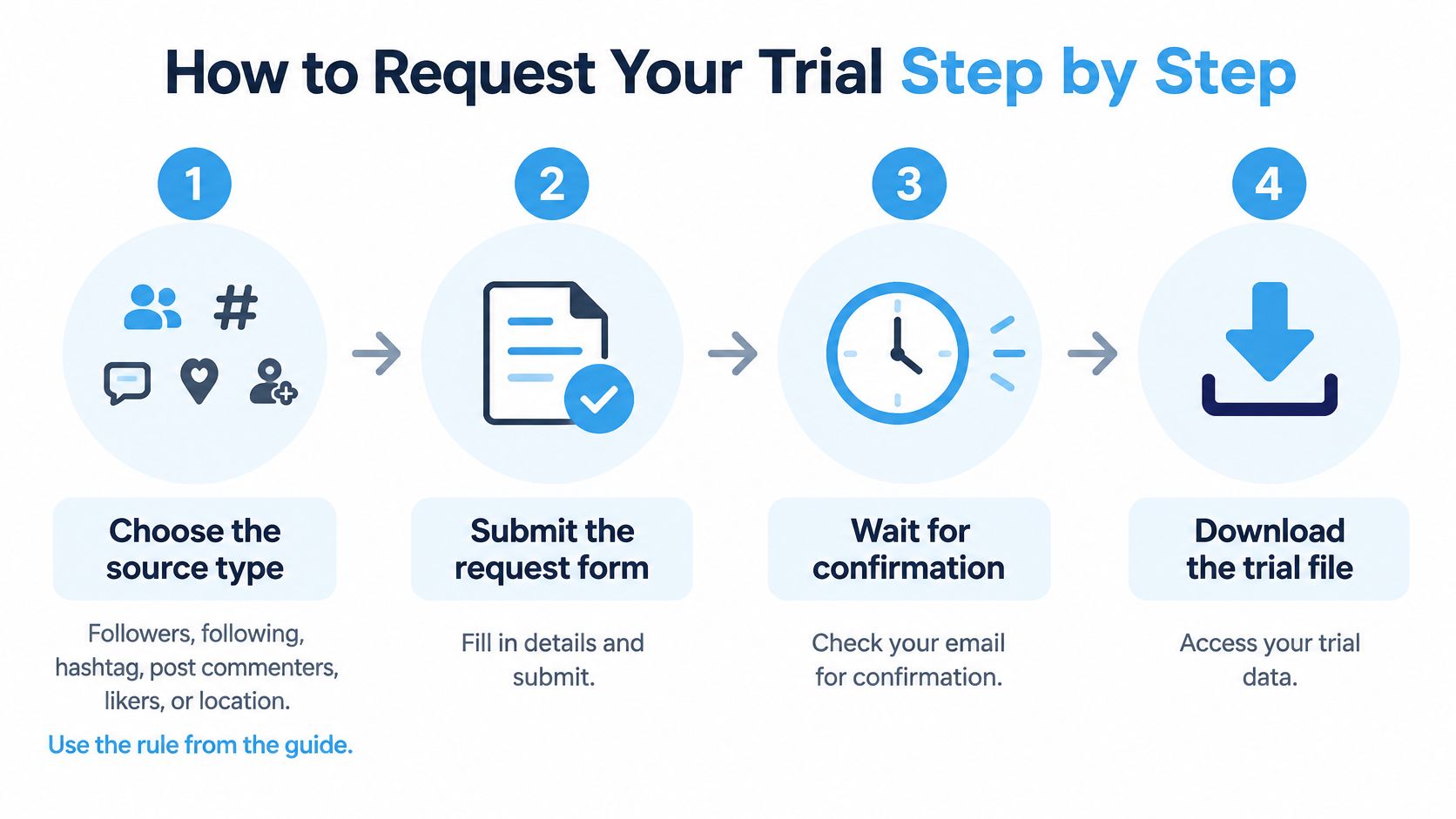
Prepare and submit the request
- Choose the source type. We support followers, following, hashtags, comments, likers and location. Choose the relationship that best represents your intended buyer. Selecting followers when you meant following changes the audience completely, even if the account username is correct.
- Enter the public username or profile link. Check the spelling and confirm that the account is public. For hashtag, post or location sources, confirm the relevant target in the request workflow rather than assuming a profile link identifies everything. Similar names, fan accounts and regional branches are common sources of confusion.
- Specify the sample and submit it. Request the trial through the web workflow or Telegram, keeping the audience narrow enough to evaluate meaningfully. Add your buyer criteria to your own notes, such as independent studios rather than fitness enthusiasts. A vague request makes the eventual file difficult to score.
You don't need an Instagram login, API key, proxies or software installation. We don't log in through your Instagram account or touch it during collection. Those are account-security characteristics, not a legal determination about collection or outreach.
Monitor delivery and preserve the evidence
- Watch the live status page. It shows users fetched, emails found and percent complete, with optional push notifications. Read these together: profiles processed can increase while emails found remains unchanged because some profiles don't publish an address. A flat email counter alone doesn't prove that the job has stalled.
- Receive and open the file. Delivery is through your email inbox or Telegram chat. Open CSV files in Excel or Google Sheets using UTF-8 encoding if names display incorrectly. Check that bios remain within their intended cells rather than splitting across columns.
- Keep the original untouched. Save the raw export, then create a working copy for filtering, validation and annotations. If you overwrite the original while cleaning, you can't reliably reconstruct which values arrived from collection and which your team changed.
Audit habit: Keep the request details, delivery file and cleanup notes together so another person can reproduce your decision.
Before calling the delivery complete, compare its rows with the requested scope and identify any reported failures. Check that the agreed columns are present and that collection timing is documented. If row-level timestamps aren't included, record the job's collection date separately rather than inventing timestamps.
Also distinguish missing values from missing work. A profile without a public email may be a legitimate completed record. An unprocessed profile is a delivery issue, and it belongs in a separate status category.
Check the Export for Duplicates and Bad Contacts
Evaluate the file in a fixed order so your cleanup doesn't inflate its apparent quality. Use the original export as evidence and keep every transformation in the working copy.
Clean the records before scoring them
- Normalize usernames and deduplicate. Trim spaces, remove a leading account symbol where appropriate, and compare consistently cased usernames. Record duplicate rows removed divided by delivered rows as the duplicate rate. Don't merge different usernames merely because their display names match.
- Validate published emails. Check address syntax and whether the domain is configured to receive email. Mark failures instead of guessing corrections. Our guide to validating email addresses explains the checks to separate.
- Calculate contact yield. Divide valid public emails by profiles processed. Report results for the whole sample, identifiable business or creator profiles, and each audience source. Label unknown account types rather than classifying them as businesses.
- Account for collection failures. Log failed fetches and private or deleted accounts separately. Keep attempted profiles and successfully processed profiles distinct so readers understand the denominator.
- Reconcile delivery. Compare delivered profile rows with the requested quantity, documenting any shortfall and its stated reason.
Keep a compact quality scorecard
| Check | Calculation or record |
|---|---|
| Duplicate rate | Duplicate rows removed ÷ delivered rows |
| Invalid-contact rate | Invalid emails ÷ emails checked |
| Contact yield | Valid public emails ÷ profiles processed |
| Delivery completeness | Delivered profile rows ÷ requested profiles |
| Buyer relevance | Relevant profiles ÷ profiles reviewed |
A syntactically valid email isn't proof of an active mailbox or permission to contact its owner. Never fill missing addresses by inferring private contacts from names or unrelated sources. If a segment performs poorly, investigate or exclude it rather than hiding it inside an overall average.
Campaign results come later: track deliverability, replies, qualified meetings, unsubscribes and complaints separately, ideally with a holdout group. If your campaign includes free products or paid endorsements, the FTC's Endorsement Guides require clear disclosure of material connections with the endorsement itself.
Compliance Limits to Clear Before Outreach
Public visibility isn't blanket permission to collect and reuse information. Instagram's Terms of Use prohibit automated access or collection without express permission, including when the collector isn't logged in. A technically successful trial therefore doesn't establish that the collection method is permitted.
Public business contact details also differ from private data or information obtained by bypassing access controls. Don't treat an accessible profile as authorization to obtain anything associated with its owner.
Use the compliance checklist as a set of questions to resolve, not a badge attached to the export.
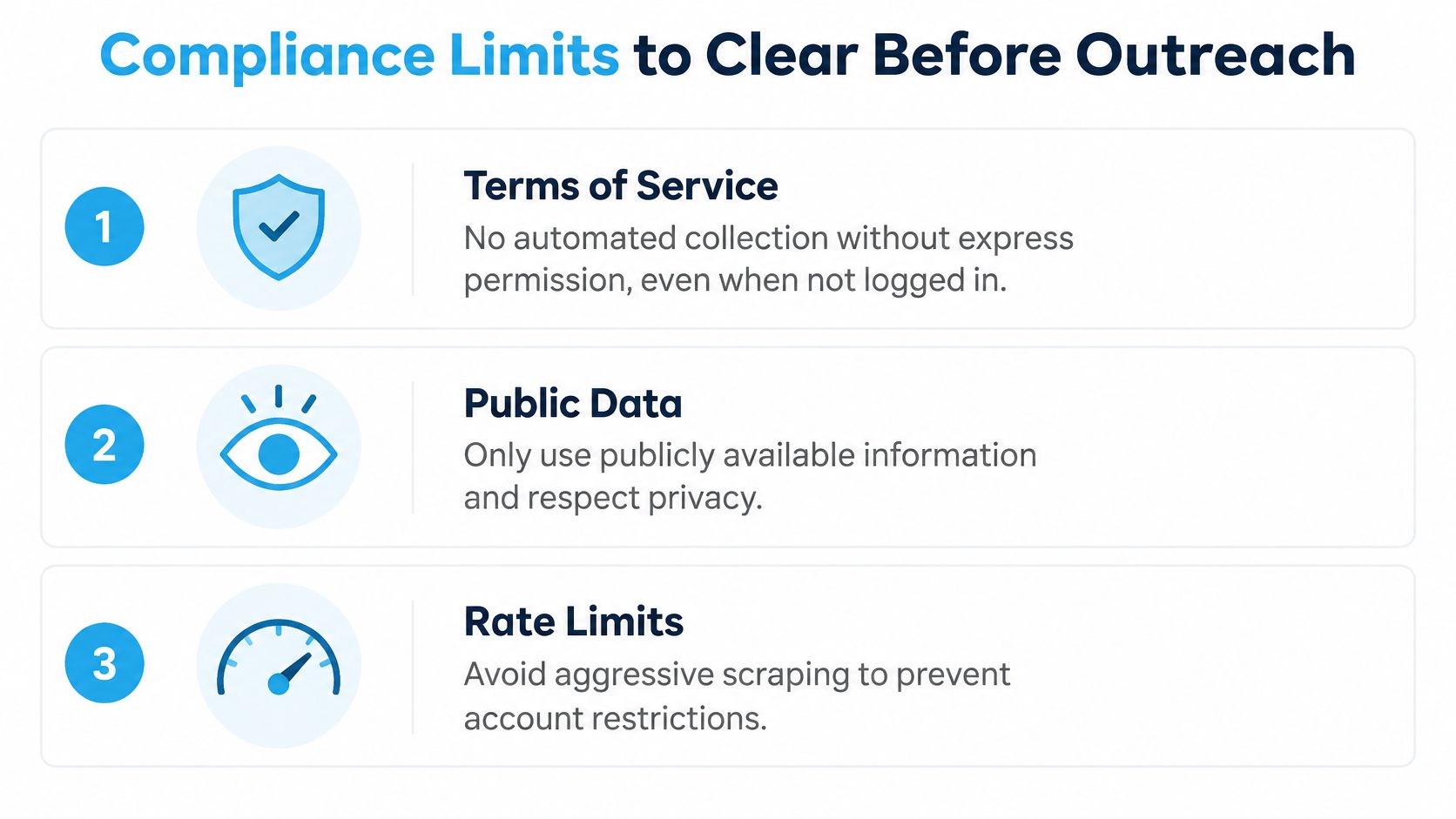
The rate-limit reminder doesn't create an exception to the permission requirement. Collecting more slowly doesn't, by itself, make an otherwise unauthorized method acceptable.
Document the intended use
Before importing contacts into a sending tool, write down answers to these questions:
- Source audience. Where did the profiles come from, and what permission supports the collection method?
- Fields collected. Which fields are necessary for your purpose, and which should you discard?
- Country targeting. Where are the recipients located, and how reliable is that classification?
- Consent status and legal basis. What supports processing and outreach in each applicable market?
- Opt-out workflow. Who handles objections, and how are suppressed contacts prevented from re-entering future campaigns?
- Data age. When was the information collected, and when will you review it?
- Deletion process. Who can remove records, and how will removal reach connected systems?
Don't infer a contact's country from a name or language alone. If location remains uncertain, retain that uncertainty instead of assigning a convenient jurisdiction. Our GDPR email marketing guide can help organize the questions to discuss with a qualified adviser.
Limit access and prepare responsibly
Decide how long the file will remain in your CRM, who can export it and which systems receive copies. Assign an owner for retention reviews and deletion requests. A suppression process should prevent accidental recontact without retaining unnecessary profile information.
Once outreach has been cleared, assess your sending setup separately. You can check your DMARC record with mailX as an authentication diagnostic, but a successful check doesn't establish consent or lawful use.
Confirm the applicable privacy and electronic-marketing rules for every target market before sending. If you can't explain the collection permission or intended legal basis, pause the campaign rather than treating the free trial as approval.
Decide Whether to Order the Full File
Order more only when the sample passes your relevance, quality and lawful-use checks. Set your acceptance criteria before reviewing the result so an attractive row count doesn't persuade you to lower your standards.
The decision should be based on the cleaned file, not the progress counter.
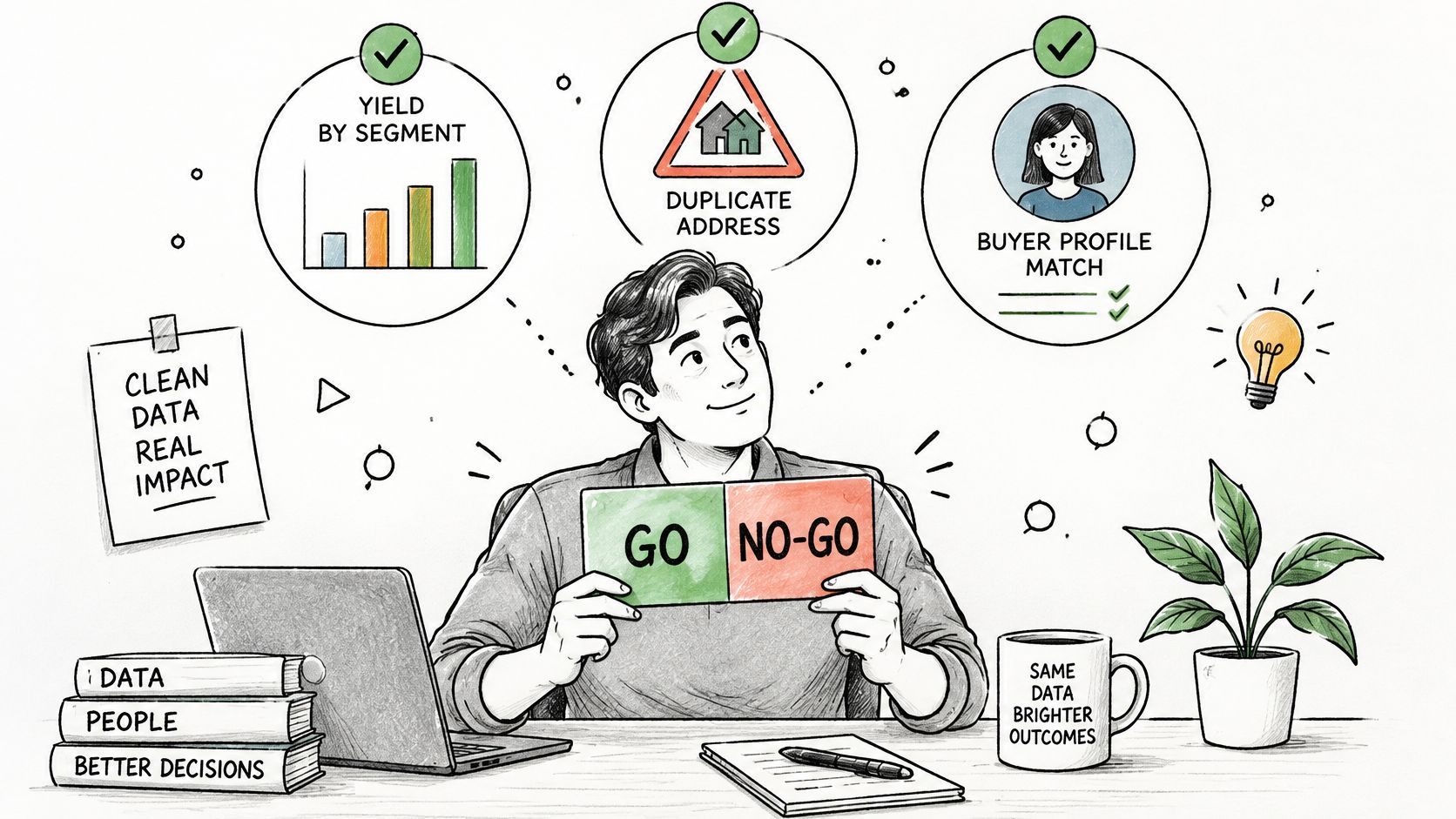
Price the contacts you can actually use
Our followers-scraping price ladder gives you the order cost. Your measured, relevant contact yield determines whether that cost makes sense.
Followers scraping price ladder
| Order size | Price |
|---|---|
| 1,000 users | $3 |
| 10,000 users | $12 |
| 100,000 users | $49 |
| 250,000 users | $99 |
Estimate cost per usable contact by dividing the order price by the expected number of valid, relevant contacts you can lawfully use. Don't divide by every row or assume the sample's yield will hold across a broader audience. Our sample CSV download also lets you preview columns and formatting before paying.
Use a straightforward decision rule:
- Proceed when your chosen segments meet your threshold, cleanup requirements are manageable and recipients match your buyer definition.
- Retest when relevance is promising but the source is too broad or the delivery needs clarification.
- Stop when collection permission, downstream use or contact quality remains unresolved.
Scale in steps rather than choosing the largest file first. After approval, import only the cleaned copy into your CRM, populate source and collection-date fields, apply suppression controls and retain only the columns needed for the campaign.
This week, select a narrowly defined audience, record the trial's segment-level results and complete the compliance checklist. Make the purchase decision from that record, not from the size of the audience available.
HarvestMyData offers an on-request Instagram audience trial with structured CSV or Excel delivery, so you can inspect public contact data before ordering a larger file. Visit HarvestMyData to preview the sample CSV and request a focused trial you can evaluate for relevance, quality and lawful use.
We built HarvestMyData to handle all of this for you.
No proxies, no code, no account needed.