B2B Email Marketing Leads: How to Qualify Them in 2026

Email generated nearly 40 times as many customers as Facebook and Twitter combined in the U.S. acquisition analysis that McKinsey published on why marketers should keep sending email. Nobody reads that and concludes the inbox is a side channel. They conclude it's worth defending, which is exactly the moment list quality starts to matter.
A founder holding a 12,000-row CSV feels wealthy. It's closer to a stack of unopened job applications: the pile is impressive, the number of people you could hire from it is small, and every unusable one costs time to discover.
The measure worth reporting is qualified reachable accounts per 1,000 profiles. That's the count of contacts that clear every check and can be emailed today, expressed against the audience you started from, so two sources finally become comparable. It also forces the second half of the argument: finding an address on a public profile proves neither that it works nor that the person agreed to hear from you.
Table of Contents
- Why the raw count lies - The nine-criterion scorecard - The five-contact test
- The checks, in order - What authentication proves
- What to keep for every lead - The workflow that holds up
- The first batch - When to expand
What Makes a B2B Email Lead Qualified
A qualified B2B email lead is a named, reachable business contact who fits your buyer profile, came from a source you can document, and can be emailed under the rules that apply in their country. Four conditions, and a contact that misses any one of them is a guess with an address attached.
The qualification habit exists because the channel rewards it. The DMA's Marketer Email Tracker 2019 found that 91% of marketers considered email important to their multichannel strategy, and respondents estimated an average return of just over £42 for every £1 spent, up from roughly £32.28 in the previous study. A return that size depends entirely on messages arriving at real inboxes and being relevant when they do.
Why the raw count lies
Say two founders each collect 1,000 profiles this week. The first ends up with 150 emails, many of them shared company addresses, wrong departments or wrong countries. The second ends up with 95, each carrying a role, a company and a collection date. Six weeks later the second founder is booking meetings, because every row that survived could be sent to without eroding the sending domain.
The smaller file held more qualified reachable accounts per 1,000 profiles. That is the number that predicts meetings, and the raw email count hides it completely.
A file of 5,000 unverified rows isn't an asset. It's a queue of decisions nobody has made yet.
The nine-criterion scorecard
Nine rows, applied to every contact. A contact passes only when it clears all nine.
| Criterion | What to check | Qualified signal | Red flag |
|---|---|---|---|
| Email validity | Syntax, domain and mailbox status | Mailbox confirmed | Hard bounce or cannot be verified |
| Role fit | Job title against the buyer role | Decision-maker or relevant function | Generic or unrelated role |
| Company fit | Business type and size against the target profile | Matches the ideal customer profile | Unrelated sector or size |
| Source audience | Where the contact was found | A relevant audience, such as the following list of target peers | Broad or unrelated hashtag |
| Freshness date | When the contact was collected | Recent, with the date recorded | Old or undated record |
| Enrichment confidence | Whether details were confirmed on the profile | Confirmed on the public profile | Inferred or guessed |
| Duplicate status | Whether it already exists in your CRM | Unique record | Duplicate across lists |
| Suppression history | Opt-outs, complaints and previous bounces | Clean record | Previously opted out or complained |
| Jurisdiction | Country and the rules that apply | Country known and basis documented | Country unknown |
One failure holds the contact back. That reads as harsh until a single weak cohort drags placement down for every campaign sent after it.
Two rows get skipped most often. Suppression history is invisible in a fresh export, so someone who asked to be left alone last year reappears as new inventory. Jurisdiction gets skipped because it needs a decision rather than a filter: until you know where a contact sits, you cannot know which sending rules apply, and ignoring that question does not make it go away. Enrichment confidence matters for a related reason. A job title inferred from a bio is a guess, while a title confirmed on a public business profile is something you can act on.
Sales teams already run a version of this judgment when they decide whether a lead deserves a call. Big Moves Marketing on sales-ready leads covers that side of the decision; the scorecard adds the delivery checks a sales conversation never surfaces.
Qualification also works as the first control in a wider B2B lead generation process that ends in pipeline, not as a one-time gate at the door. A contact that fails here is far cheaper to drop than to explain later.
The five-contact test
Pull five contacts from any list you're holding right now, score each against the nine rows, and count how many pass all of them. Files pulled from broad audiences often return one or two out of five. Multiply that pass rate across the full list and you have a realistic estimate of what it is worth before you send a single message from it.
How to Build a Lead File From Public Audiences
Public social profiles offer five doors into an audience: the followers of an account, the accounts it follows, a hashtag, the people commenting on a post, and the people who liked it. Each door answers a different question, and the process below maps how they differ.
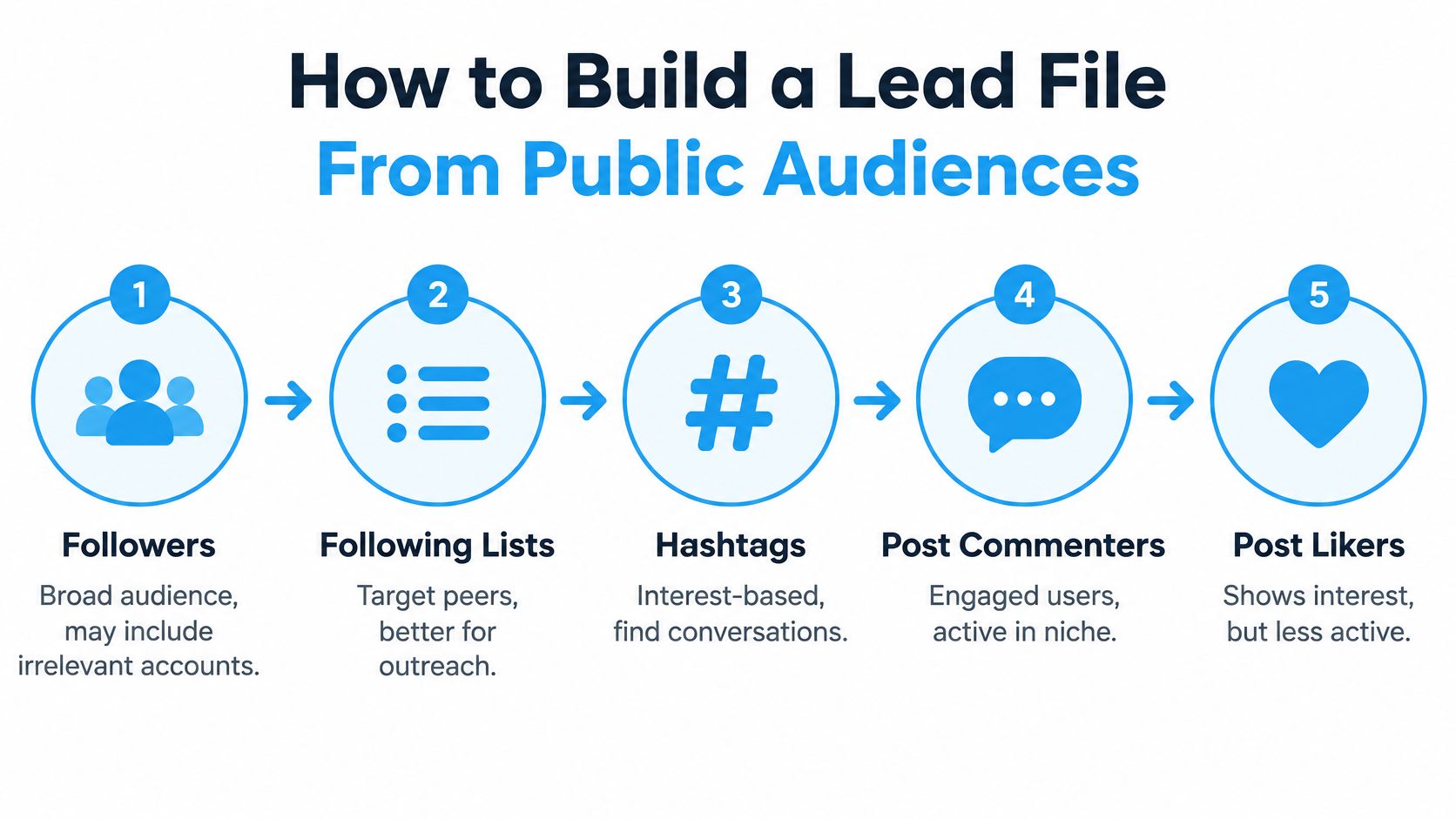
A following list usually beats a follower list for outreach. Following is a deliberate act: an account chose to track a competitor, a peer or a customer in its own market, so the signal is narrower than a follower list where anyone can tap once and forget. Followers are the biggest audience, not the closest one.
- Define the buyer profile first. Role, industry, company size, country. Write those four lines before you collect anything, because a profile defined afterwards always bends to fit the data you already pulled. The common slip is starting from a broad hashtag and promising yourself you'll sort relevance later.
- Match the source to the profile. A competitor's followers, a narrow niche hashtag, or the commenters under a post your buyers argue in will all produce recognizable peers. The slip is choosing the largest audience rather than the nearest one, then blaming the data for the mismatch.
- Set the job size and record the collection date. A 1,000-profile run is an experiment; a 25,000-profile run is a commitment, so size the job to the test you can send. Collecting 50,000 profiles in week one leaves you with no baseline to compare against.
- Read past the bio. A public email often sits in a business account's contact fields while the bio stays silent, and business pages, creators and coaches tend to list one more often than other account types. Our extraction checks every profile individually for a public email, phone, category and website rather than judging it from the bio line. The slip is discarding a contactable business because the bio was empty.
- Record provenance on every row. Source audience, collection date, and the profile fields you saw. A file of addresses with no memory of its origin can't be defended to a client and can't be debugged when bounces climb.
- Split by source cohort. One cohort per source, tested separately. Merging three sources into one send hides which of them caused a bounce spike.
The finished file holds one row per person: full name, role, company, website, email, source audience and collection date. Anything less and you're guessing which part of the list is working.
Verifying Contacts Before the First Send
Deliverability is a qualification gate, not a report you read after a campaign. Validity's 2025 benchmark measured average inbox placement at 83.6% for B2B traffic sent to Office 365 and Google Apps, which means about 16.4% of messages may never reach the primary inbox, before anyone opens, clicks or replies (2025 Validity Benchmark Report).
That gap changes what "qualified" means. A contact whose message lands in spam isn't a lead. It's a cost with a name attached.
The checks, in order
Run them cheapest first, because a failed mailbox makes everything below it pointless.
- Validate syntax, domain and mailbox status. A confirmed mailbox is the entry ticket. A catch-all answer isn't confirmation.
- Match the suppression list. Opt-outs, complaints and previous hard bounces come out before anything else touches the file.
- Remove role-based and abandoned addresses. info@ and sales@ reach a shared inbox, and a shared inbox rarely buys.
- Match company and domain to the buyer profile. A perfect role at the wrong company is still the wrong contact.
- Segment by source cohort. Keep every source distinct so results can be attributed back to the audience they came from.
Bounces and complaints don't just waste one send. They lower future placement for every campaign from the same domain, so a poor cohort taxes the next one. Track placement, hard-bounce rate, complaint rate and positive reply rate by cohort, never by aggregate open rate.
| Benchmark | Value | What it means for your leads |
|---|---|---|
| Gmail bulk-sender threshold | Close to 5,000 messages to personal Gmail accounts in 24 hours | Authentication with SPF, DKIM and DMARC plus easy unsubscribe is required |
| Spam-rate ceiling | 0.3% | Stop expanding a cohort as complaints approach this level |
| Average B2B inbox placement, 2025 | 83.6% | About 16.4% of messages may miss the primary inbox |
| B2B bounce rate, 2025 benchmark | 2% | Compare each new cohort's bounces against this baseline |
| B2B click-through rate, 2025 benchmark | 3.2% | Compare engagement of new cohorts with established ones |
| B2B unsubscribe rate, 2025 benchmark | 0.24% | Unsubscribes well above baseline point to weak targeting |
The last three figures come from a 2025 B2B email marketing benchmark summary, and they work as tripwires. A new cohort that doubles the baseline bounce rate is telling you something about its source, not about your copy.
What authentication proves
SPF authorizes the servers that send for your domain, DKIM signs each message cryptographically, and DMARC checks that the authenticated domain matches the visible From address. Gmail's bulk sender rules define a bulk sender as one sending close to 5,000 or more messages to personal Gmail accounts within 24 hours, require authentication and easy unsubscribing, and name a 0.3% spam-rate ceiling (Gmail's bulk sender guidelines). None of that makes a list good. It stops your domain from being treated as an impersonator while you find out whether the list is.
Scaling rule: separate prospecting from transactional mail, ramp new domains slowly, and pause any cohort whose bounce or complaint numbers clearly exceed your established baseline.
The final pass is enrichment, and it's where lists get fixed or ruined. Contact data enrichment should return a confirmed mailbox status and a verified company domain, not a plausible guess. A guessed address behaves exactly like a bad one the moment it bounces.
Why Public Availability Is Not Permission
A work email printed on a company profile feels like an invitation to write. It's a business address, published in public, sitting next to a logo and a phone number.

Under GDPR, that named work address can still be personal data, and B2B email isn't automatically exempt, as Sender.net's guide to GDPR email marketing sets out. Country-level ePrivacy rules may require consent outright, and the treatment of professional addresses varies between EU countries. Legitimate interest isn't a free pass either. It requires a balancing test covering what you're sending, why this particular person, and whether someone in their role would reasonably expect it.
Here's the part that trips up small teams moving from a US list to a European one.
CAN-SPAM and the European framework differ materially, and a file collected without country data can't be routed through the right rules in the first place. The email marketing under GDPR picture is manageable, but only when the jurisdiction travels with the lead instead of being reconstructed months later.
What to keep for every lead
Six fields turn a CSV of addresses into something you can defend:
- Source audience: the account, hashtag or post the contact came from.
- Collection date: when you pulled it, not when you first used it.
- Public context: what the profile showed.
- Business relevance: why this role at this company fits the offer.
- Legal basis: legitimate interest with the balancing recorded, or consent where the country demands it.
- Opt-out status: current, checked at send time, not at export time.
The workflow that holds up
Segment by business relevance so the message is about their work, not your list. Say in the first message why you're contacting them, in one sentence, because an unexplained cold email reads as a bulk email. Offer a one-click opt-out, suppress the address the moment someone uses it, and never describe public availability as consent.
Permission also pays commercially, and why consent drives better deliverability explains the mechanics: engaged recipients open and reply, and mailbox providers notice.
We collect from public profiles only. Our extraction doesn't access private accounts or protected content, and customers agree to use the data for lawful purposes, comply with anti-spam law, avoid harassment, keep raw data off resale lists and honour opt-outs. Those terms exist because the responsibility sits with whoever presses send. A contact you can explain is worth more than ten you can't.
A Worked Example of a Qualified Lead File
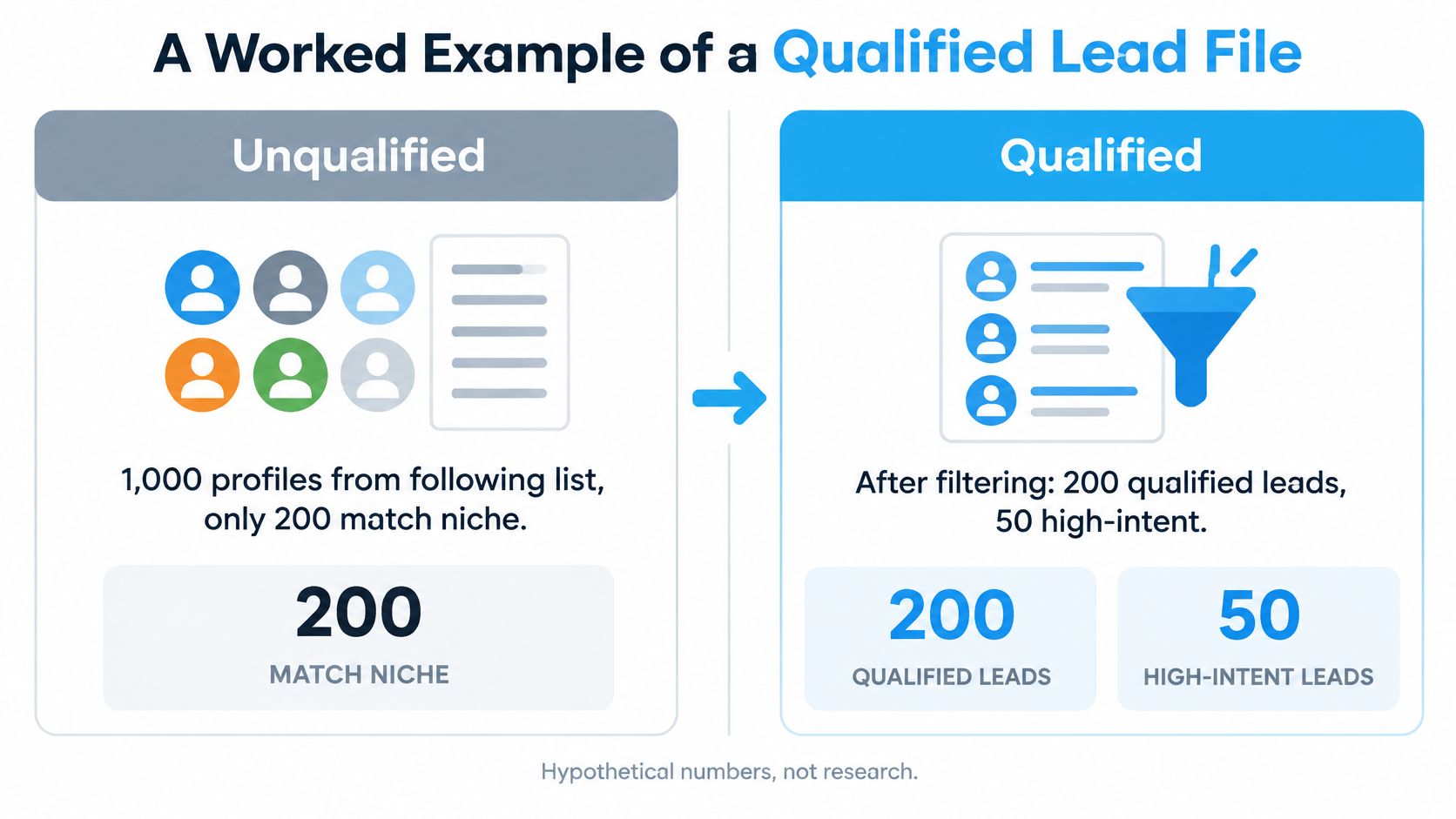
A raw export works like ore from a mine: most of the weight is rock, and the value only shows up after refining. The figures below are illustrative, but the sequence of checks is the part worth copying.
A SaaS founder sells scheduling software to e-commerce agencies. She collects 1,000 profiles from the following list of an account whose audience is agency owners, and 150 of those profiles carry a public email. That yield fits what business-focused niches typically return, around 15 to 30 percent, and following lists tend to out-pull follower lists from the same account type.
Then the checks run in sequence:
| Stage | Removed | Remaining |
|---|---|---|
| Profiles collected from following list | Not applicable | 1,000 |
| Public email found | 850 profiles with no public email | 150 |
| Mailbox validation | 12 | 138 |
| Role screening | 9 | 129 |
| CRM duplicate check | 6 | 123 |
| Suppression matching | 4 | 119 |
Twelve invalid mailboxes go first, because a dead address poisons the send regardless of how good the fit was. Nine generic addresses follow. A shared inbox at a twelve-person agency might still read the email, but nobody there owns the buying decision, and role-based addresses drag reply rates down even when they do get through. Six contacts already sit in her CRM from a trade show list, so they merge rather than duplicate. Four match a previous opt-out, and those stay suppressed permanently.
What's left is 119 qualified reachable accounts per 1,000 profiles. She reports 119, because it is the figure she can measure the next source against. The raw 150 was never comparable to anything, since nobody knew how much of it was real.
She runs the same arithmetic on a second source, a broad hashtag pull in the same niche. It returns a similar count of public emails, but a smaller share survives validation, role screening and suppression, so the hashtag source lands well under 119 qualified reachable accounts per 1,000. The following list wins on the metric that matters, and that is where her next collection goes.
At the start the file looked like 150 leads. After the checks it supports 119 sendable contacts, and that gap is the difference between a list and a liability. The number worth carrying forward is the ratio: 119 sendable contacts per 1,000 profiles pulled. Every future source gets judged against it.
Confirm Each Lead Passes the Scorecard Before You Send
Every contact ends in one of two places: sent, or held. One rule decides which, and it isn't a feeling about the lead. The contact clears every row and its basis for contact is written down, or it waits.
The order matters:
- Confirm validity and freshness. A confirmed mailbox with a recent collection date. An undated row is stale by default.
- Confirm role and company fit. The person owns or influences the decision, at a business that matches the profile.
- Check duplicates and suppression. One record, no prior opt-out, no previous complaint.
- Confirm jurisdiction and documented basis. Country known, legal basis recorded.
- Send only to contacts that clear all of it. No exceptions for a contact that looks promising but fails a row.
Hold is not a failure. It's a record. Failed rows go to a hold list with the reason attached, and the cohort gets re-sourced instead of pushed through.
The first batch
Start with 50 to 100 contacts from a single cohort. Score them against the nine rows, then send the first monitored batch. Compare that batch's bounce, complaint, unsubscribe and reply rates against the baselines you set for the cohort before you sent.
Expansion is conditional, not automatic. Bounce and complaint rates need to sit near baseline and well below the provider's complaint ceiling. Reply rate needs to show that the audience recognizes the message.
When to expand
If rates rise, pause the cohort, add no volume, and trace the source before sending again. More volume has never repaired a reputation problem. It only spreads the damage across a bigger send.
Externally sourced files get scored exactly the same way, whoever collected them, including a file you paid for. A vendor's quality claim is not a row on the scorecard. Verified mailbox status is.
A lead is qualified when it passes every check and you can document it, not when it appears in a list. That's the whole discipline, and it's why qualified reachable accounts per 1,000 profiles is the only number worth reporting to a founder.
If you'd rather start from a documented audience than a file of unknown origin, HarvestMyData turns a defined Instagram audience, such as the followers or following list of a target account, into a CSV or Excel file of public emails and profile fields, delivered by email, usually within an hour. You pick the audience, we check each profile individually for a public email, phone, category and website, and you score the results against the nine rows before anything sends. Run a small job first, score it, and see what your qualified reachable accounts per 1,000 profiles looks like at HarvestMyData.
We built HarvestMyData to handle all of this for you.
No proxies, no code, no account needed.