Instagram Influencer Marketing: A Practical 2026 Playbook

You can run a clean-looking Instagram campaign and still end up with nothing but screenshots, a few comments, and a vague sense that the creator “did well.” That's the usual failure mode. The post goes live, the Story expires, the invoice gets paid, and nobody can tell whether the creator moved revenue, improved trust, or just filled a report with activity that looked impressive in the moment.
The fix is not another list of creator types or another generic KPI dashboard. instagram influencer marketing works when the measurement system is designed before outreach, the creator shortlist is built on fit instead of follower count, and disclosure is handled as part of the workflow rather than an afterthought. A practical campaign starts with those constraints, not with the post.
Table of Contents
- Why Most Instagram Influencer Campaigns Underperform
- How Instagram Became the Default Influencer Channel
- Why the channel fits commercial creator work
- Reels for discovery and scale - Stories for click intent - In-feed posts for permanence - Lives and ambassadorships for trust
- Build the measurement stack first - Keep awareness and conversion KPIs separate
- The agency version - The in-house ecommerce version
- Why trust suffers even when the label is there
Why Most Instagram Influencer Campaigns Underperform
The most common pattern is painfully familiar. A brand picks a creator because the feed looks polished, ships product, approves a Story, and then waits for “results” that never get translated into business terms. The campaign may generate likes and a few link taps, but if the team never defined what success looked like beyond exposure, the post becomes a content asset with no operational value.
That failure usually comes from three places. First, teams lean on vanity metrics and treat follower count as a proxy for commercial fit. Second, they confuse “good content” with “good creator fit,” even though the audience may not match the offer. Third, they skip disclosure review, which can damage credibility even when the creative itself is strong.
A better workflow starts before the first outreach message. Define the goal, decide which KPI family matters, shortlist creators against audience and category relevance, and put compliance into the approval path. A useful external reference for shaping the overall campaign structure is the FindClout creator campaign playbook, especially if you're trying to move from ad hoc posting to a repeatable process.
Practical rule: If you can't explain how a creator post connects to revenue, lead quality, or a clear brand objective, you don't have a campaign yet. You have a content purchase.
The strongest Instagram programs don't chase a viral moment. They build a system that can be repeated with different creators, different formats, and different offers without having to reinvent measurement every time.
How Instagram Became the Default Influencer Channel
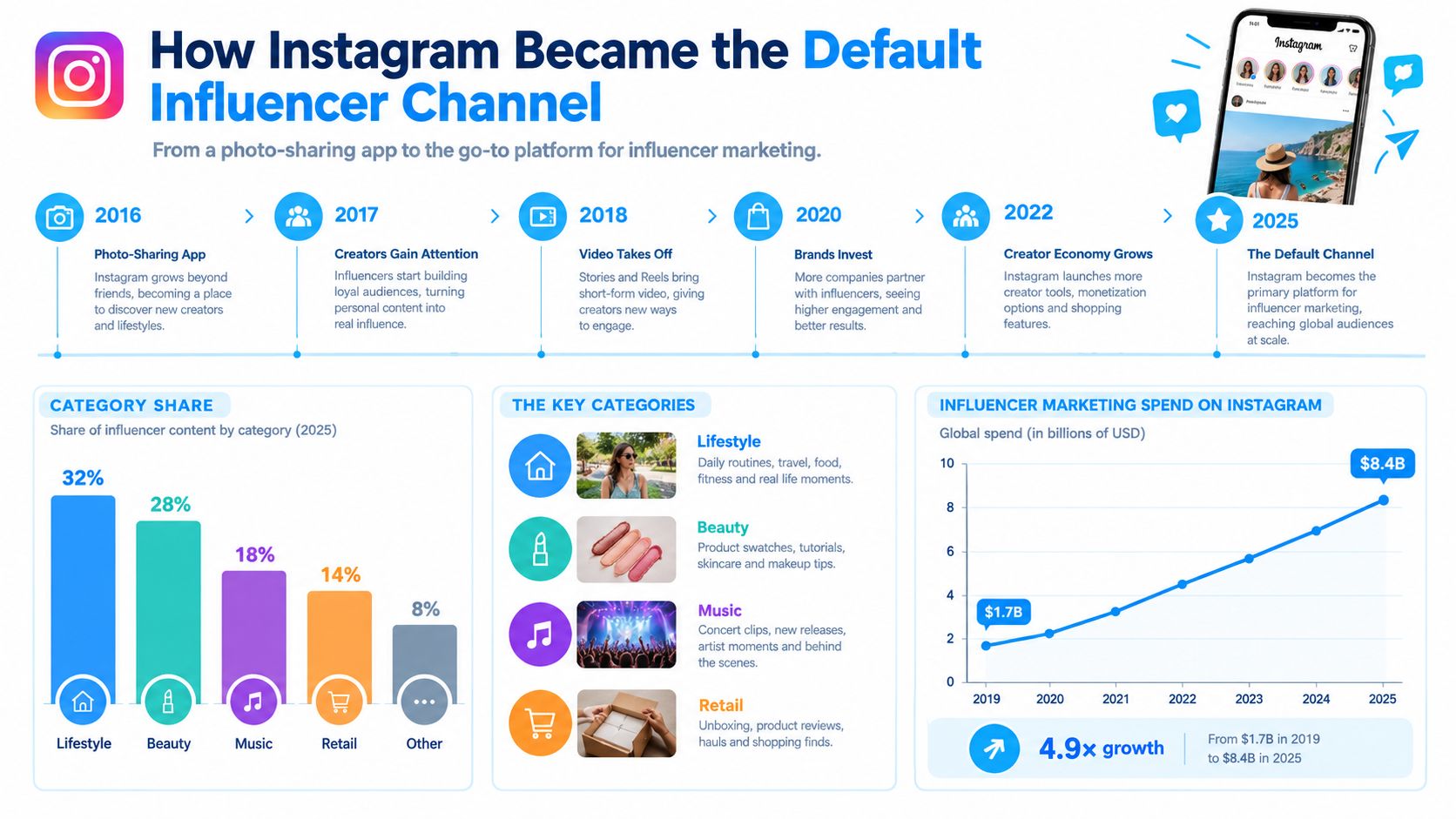
A brand can do everything right on creative and still underperform if the channel does not match how creator recommendations spread. Instagram became the default because it combines visual posts, short-form video, Stories, and creator-led recommendations in one place, so teams can buy reach and endorsement at the same time. In January 2024, nearly 80% of marketing professionals reported using Instagram in their digital marketing activities, and a 2024 industry report named Instagram the leading influencer-marketing platform, with 39.1% of marketers selecting it as their top platform (Statista topic on Instagram marketing).
The platform also fits a wide range of brand categories. Lifestyle was the most common Instagram influencer category in 2023, followed by music and beauty. That mix makes sense. Lifestyle content shows routines and habits, beauty works well for product demonstration, and music performs through short clips that feel immediate and personal. The category spread is one reason Instagram scaled beyond a single niche and into a default channel for creator campaigns.
Why the channel fits commercial creator work
Instagram supports discovery and endorsement in the same feed. A creator can introduce a product in a Reel, reinforce the message in Stories, and keep it visible in a feed post after the initial push. For lifestyle, retail, and creator-led commerce, that matters because buyers often need repeated exposure before they act.
The growth behind the channel is just as clear. Industry estimates place the global influencer-marketing market at about $1.7 billion in 2016 and $21.1 billion in 2023, while Instagram's own segment passed $2 billion in 2020 (Phyllo market history summary). That is not the profile of a passing test. It is a channel that moved from experimentation into operating infrastructure.
In practice, that shift changes the questions teams ask. The useful question is no longer whether creator marketing deserves a trial. It is which creator mix, content format, and measurement setup will make Instagram pay back in revenue, qualified leads, or a clearly defined brand outcome.
Choosing the Right Campaign Format for Your Goal
The format should follow the job, not the other way around. A Reel is not interchangeable with a Story, and a one-time post doesn't behave like an ongoing ambassadorship. If you pick the format first, you usually overpay for the wrong kind of attention.
Reels for discovery and scale
Reels work when the brand needs broad awareness, fast creative testing, or a second life in paid media. They're strongest when the hook is visual, the product solves a visible problem, or the creator can demonstrate a before-and-after in seconds. In practice, Reels tend to suit larger audiences or creators whose content already performs well with non-followers.
Stories for click intent
Stories are better when the ask is direct, the offer is time-sensitive, or the goal is to move people toward a link, code, or reply. They work well for smaller, warmer audiences because the friction is low and the message can feel conversational. If you want immediate traffic or a limited-time offer to land, Stories usually give you a cleaner read than a feed post.
In-feed posts for permanence
In-feed posts are the right choice when you want the content to live longer and act as a reference point. They're useful for launches, category education, and products that benefit from explanation rather than just exposure. Because the post stays visible, it can also support later retargeting or organic discovery.
Lives and ambassadorships for trust
Lives are harder to scale, but they can work when the product needs explanation, Q&A, or live credibility. Long-term ambassadorships are the better option when trust matters more than one-off reach. Repeated exposure from the same creator usually gives the audience a clearer sense of whether the recommendation is real or just transactional.
A sensible quarter often blends formats. Start with one creator-led asset for awareness, layer Stories for direct response, and reserve longer partnerships for creators whose audience response is consistently strong. That sequencing gives you compounding exposure instead of isolated spikes that disappear after the post window closes.
Scoring Creators Beyond Follower Count
Follower count is the easiest number to check and the least useful one to trust. A creator with a huge audience can still be a weak commercial partner if the audience doesn't match your category or if the community rarely acts on sponsored posts. A smaller creator with a tighter niche can outperform that profile because the audience is more relevant and more responsive.
A 2023 Journal of Advertising Research study analyzed 180 influencers across Instagram and other major platforms using more than 35,000 posts, and found that KPI patterns vary by platform maturity and influencer expertise (Journal of Advertising Research study). That's the operational lesson. Don't treat a creator profile like a vanity leaderboard. Treat it like a prospect file.
A practical scoring rubric
| Criterion | What to Measure | Weight |
|---|---|---|
| Engagement quality | Median likes, comments, saves, and shares on recent posts | High |
| Audience relevance | Geography, niche alignment, and audience fit with the offer | High |
| Posting cadence | Consistency over the last several posts, not just one breakout week | Medium |
| Category expertise | Evidence that the creator actually lives in the category | High |
| Disclosure behavior | Whether sponsored content is clearly labeled and consistent | Medium |
| Conversion fit | Past signs that the audience clicks, replies, or buys | High |
A scorecard like this does two things. It keeps you from overvaluing a large but passive audience, and it gives procurement or leadership a defensible reason for why one creator costs more than another. If two creators have similar reach, the one with better category relevance and cleaner engagement usually deserves the first test.
For audience discovery workflows, one useful operational tool is HarvestMyData's Instagram influencer finder, which can help surface public audience lists and profile fields for prospecting. The important part is to use extracted data as a starting point, then verify fit with platform-native performance signals before you send a brief.
Operational note: If a creator's recent posts don't show a pattern you'd trust with your own budget, don't try to “make the math work.” Move on.
Designing a KPI System Before You Reach Out
Teams often choose creators first and measurement second. That's backwards. If you don't know how you'll attribute results, you'll end up judging the campaign by whatever metric happened to be easiest to capture, usually likes or comments, even when the true question is whether the post created demand.
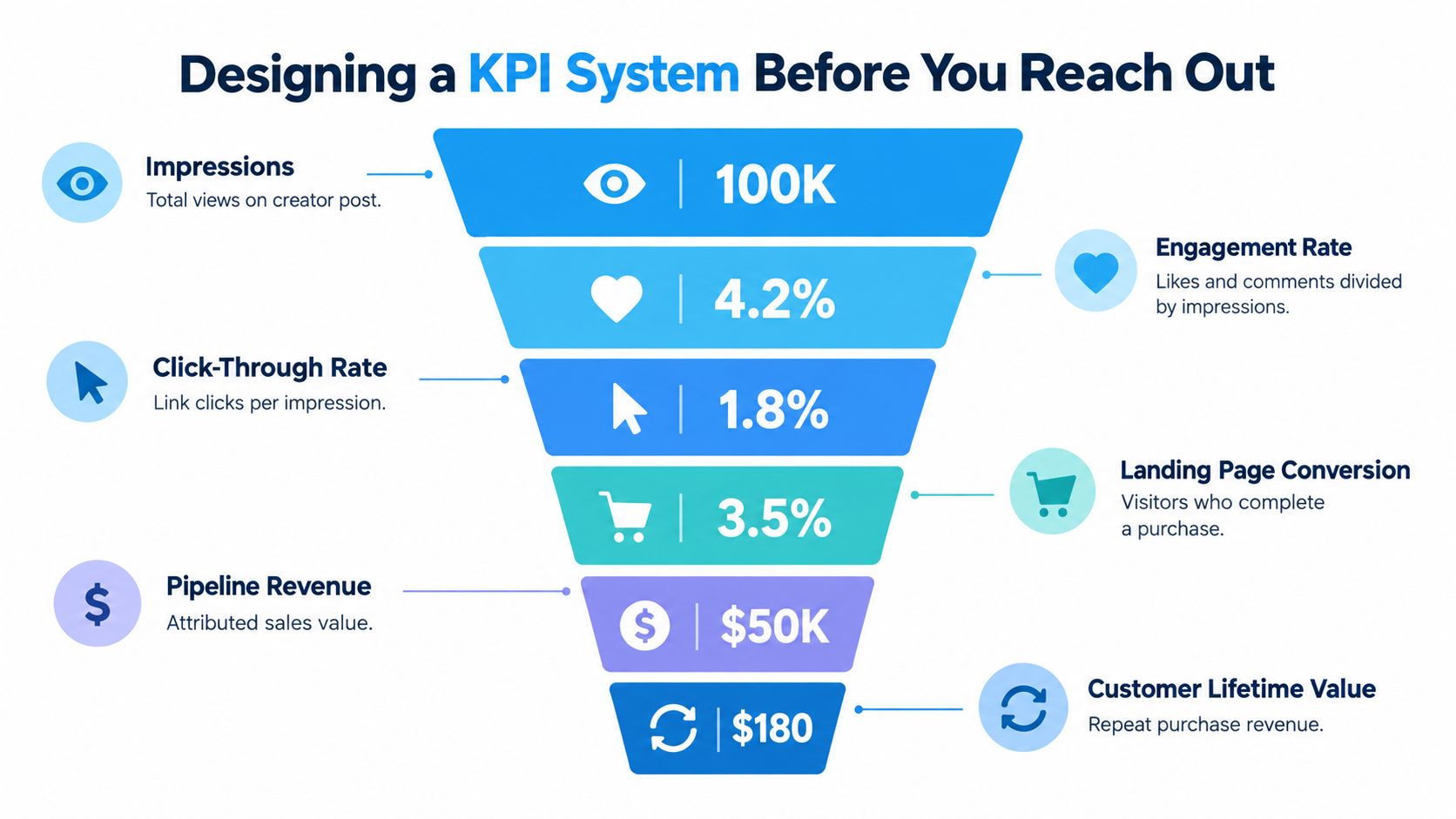
The cleanest setup is a layered attribution stack. Use creator-specific discount codes, UTM parameters, dedicated landing pages, and post-purchase survey questions so a single post can be traced through discovery, click, conversion, and repeat purchase. The Cometly attribution breakdown for influencer marketing is a helpful reference if you need a practical view of how attribution windows and source tracking fit together.
Build the measurement stack first
Before outreach, set up the fields and dashboards that will be used after the campaign launches. At minimum, that means a creator ID, campaign name, offer type, landing page, code, source/medium tags, and an agreed attribution window. If the brand uses CRM or ecommerce reporting, make sure those fields can be exported without manual cleanup.
The key is to separate three layers. Exposure tells you how many people saw the content. Interaction tells you how many people acted on it. Business outcome tells you whether the action was valuable. If those are blended together, a post with strong engagement can mask weak sales.
Keep awareness and conversion KPIs separate
Awareness campaigns can live on reach, impressions, and post engagement. Direct-response campaigns need click-through, landing-page conversion, qualified leads, and attributed revenue. If you judge both campaign types on the same metric, you'll either underfund brand lift or overpay for activity that never turns into demand.
The biggest mistake is retrofitting attribution after the post goes live. By then, the data is already fragmented. The smarter move is to decide in advance what counts as success, what the reporting cadence is, and which signal will settle the debate if the campaign underperforms.
HarvestMyData's ROI calculation guide is useful for teams that need to connect campaign outputs to financial return without turning the report into guesswork.
Two Real Workflows Compared
An agency running Instagram creator work for multiple DTC clients needs structure because every client brief has to be repeatable. An in-house ecommerce team can afford more flexibility because the brand, product line, and approval chain are already familiar. The same playbook still applies, but the operational details look different.
The agency version
An agency usually starts with a standardized creator brief, because it has to translate the same campaign logic across multiple accounts. The brief defines the objective, the offer, the disclosure language, the deliverables, and the reporting format before anyone contacts a creator. That keeps one client from drifting into a long approval cycle while another expects a fast turnaround.
Agencies also need tighter negotiation rules. If a team is managing several brands at once, it can't afford to renegotiate every scope detail from scratch. The creator roster, asset approvals, and delivery dates need to be tracked in a shared system so one campaign doesn't spill into the next.
The in-house ecommerce version
An in-house team usually works faster on product, pricing, and audience decisions because it already knows the catalog and the customer. That makes it easier to test different hooks, bundle offers, or landing pages without waiting for a cross-client approval process. The trade-off is that the team can become too comfortable with familiar creators and stop widening the search.
In-house teams also have an advantage in reporting. They can connect creator activity to site behavior, revenue, and repeat purchase patterns more directly because they own the ecommerce stack. That makes it easier to decide whether a creator deserves a second round or whether the partnership should stop after one test.
The workflows differ, but the discipline is the same. Brief clearly, track delivery, measure against the right KPI set, and feed the result back into the next creator search. If the team can't do that, it's not running a creator program. It's just buying posts.
Disclosure Rules and the Trust Layer Most Brands Skip
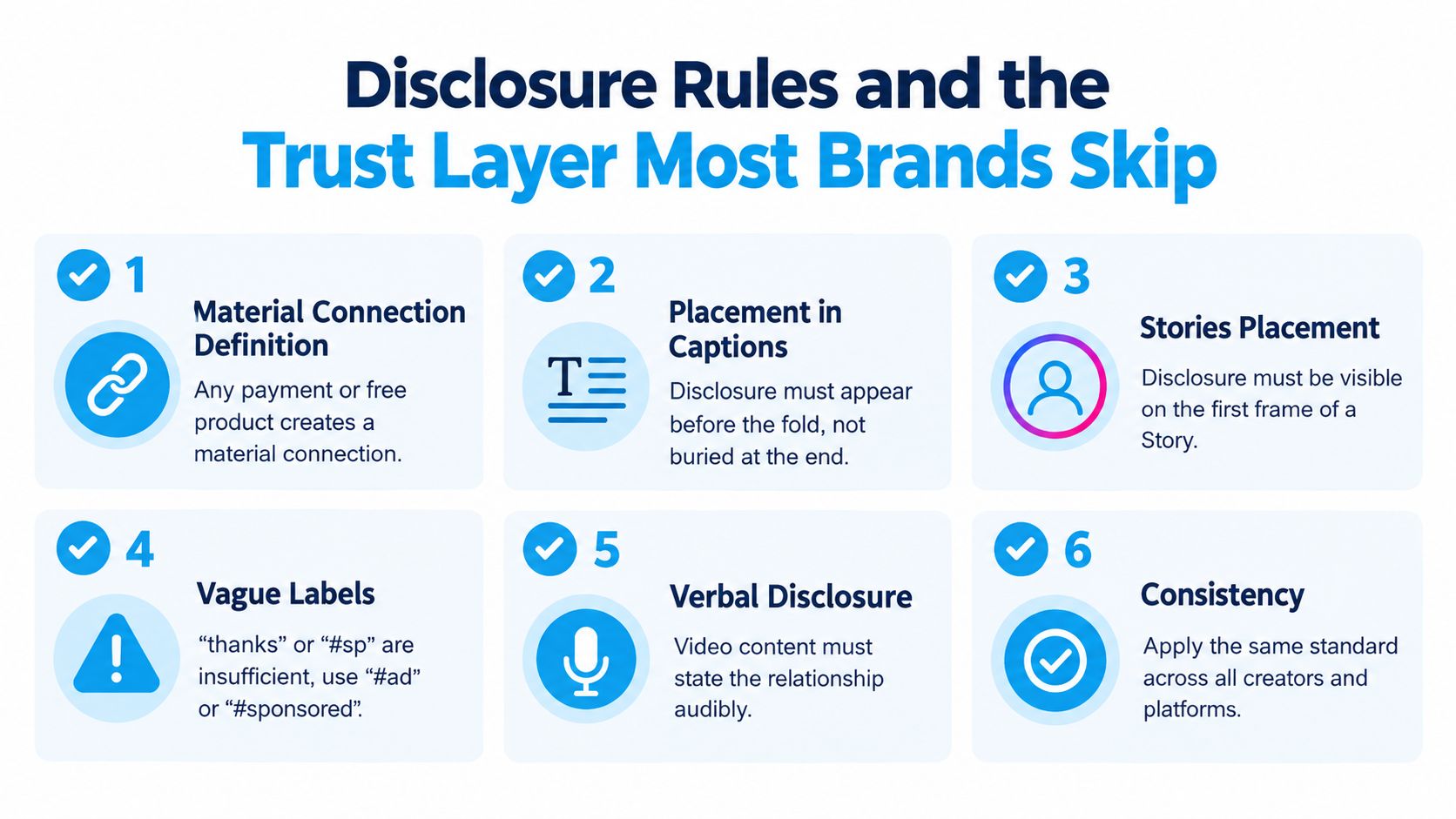
Disclosure sits inside the trust system, not at the end of production. The U.S. Federal Trade Commission defines a material connection broadly, covering payment, employment, family or personal relationships, and free or discounted products, and it requires disclosure to appear with the endorsement itself, including before someone expands a caption on Instagram (FTC influencer guide).
Placement matters because hidden disclosure defeats the point. Ambiguous labels like #sp, #spon, or #collab can leave the commercial relationship unclear, while ad or sponsored is easier to understand. For image-based Stories, the disclosure has to be visible on the content itself, not tucked away in supporting text.
Why trust suffers even when the label is there
Recent U.S. research shows the gap goes beyond compliance. The BBB 2025 Influencer Trust Index found that 74% of consumers trust influencer advertising, compared with 87% who trust advertising generally, and 26% say they don't trust influencers at all. It also found that non-disclosure is the leading source of distrust for 64% of respondents, 70% feel deceived when they later discover an undisclosed partnership, and only 14.8% say hashtags such as #ad or #sponsored make an endorsement more trustworthy (BBB 2025 Influencer Trust Index).
That is the tension. Disclosure is required, but disclosure by itself does not fix a sponsorship that feels off-brand. The partnership still has to match the creator's usual voice and audience expectations, or the label will read like a warning instead of a signal of honesty.
Practical rule: Review the disclosure before the post goes live, then review the audience reaction after publication. If viewers feel misled, the problem is strategic as much as legal.
Your End-to-End Campaign Workflow
Start with audience sourcing, not creator guessing. Public followers, following lists, hashtags, commenters, and likers can all help you build a prospecting pool, but those inputs are just raw material. The point is to move from broad audience discovery to a creator shortlist that matches the category, the goal, and the trust profile you need.
Next, score the creators against the rubric you built earlier. Then send a brief that states the objective, the required disclosure, the deliverables, the timeline, and the reporting expectations in plain language. If the outreach feels vague, the campaign usually becomes vague later too, which is where delays and revisions start to pile up.
Once the content is approved, run the campaign with the attribution system already in place. Monitor the agreed metrics, not every metric available, and separate awareness reporting from direct-response reporting. If a creator drives strong engagement but weak conversions, don't assume they failed. They may be better suited to the top of the funnel.
After publication, feed the results back into the next search. Which category fit worked, which audience segment converted, which disclosure style felt natural, and which offer moved people? That learning loop is where repeatable performance comes from.
For outreach execution, HarvestMyData's influencer outreach email guide is useful when you need contact data and a cleaner first message without turning the process into guesswork.
A strong checklist is simple: goal set, KPI stack defined, creators scored, disclosure approved, tracking live, and post-campaign review completed. If one of those pieces is missing, the campaign can still launch, but it won't teach you much.
If you want a cleaner way to source public Instagram audiences and turn them into outreach-ready creator lists, use HarvestMyData to support the discovery step before you contact anyone. It helps teams move from manual prospecting to structured audience files, which makes creator research, outreach, and campaign planning much easier to manage.
We built HarvestMyData to handle all of this for you.
No proxies, no code, no account needed.