How to Generate Local Leads with a Modern Playbook
Most advice on how to generate local leads still points to the same stack: local SEO, directory listings, review generation, and Google Business Profile cleanup. None of that is wrong. It's just incomplete.
If you need leads this quarter, not six months from now, waiting for inbound local visibility alone is a weak operating model. Search is valuable, but crowded. Directory listings are easy to copy. Review velocity is uneven. And most businesses end up spreading effort across too many channels without a clear answer to which one should get budget first.
A faster play is to treat local lead generation like audience mapping plus direct outreach. Instead of waiting for nearby buyers to search, you identify public, location-specific audiences where they already gather online, build a clean prospect list, and contact the right people with context that feels local rather than generic. For many service businesses, agencies, and neighborhood brands, Instagram is one of the most overlooked places to do that.
Table of Contents
- Saturation makes good advice less useful - Inbound-only is too passive for most small teams - The better question to ask
- Start with geography, not demographics - Find the local Instagram hubs - Pressure-test the profile before list building
- Three list sources that actually produce relevant local prospects - What to collect and what to ignore - How to turn raw profiles into an outreach-ready CSV
- What weak local outreach sounds like - What relevant local outreach sounds like - A simple follow-up rhythm that doesn't burn the market
- The operational pipeline - Where automation helps and where it hurts
- Why this becomes a moat - Online data should create offline opportunities
Why Traditional Local Lead Generation Is Broken
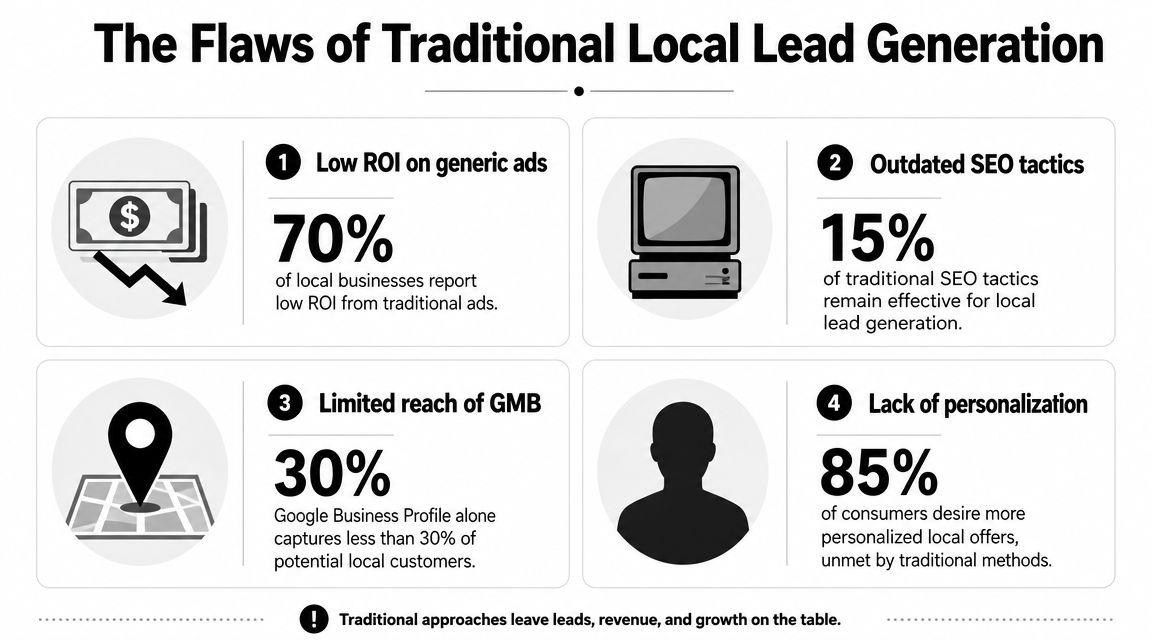
Local demand is real. 46% of all Google searches have local intent, and 76% of people who search for something nearby on a smartphone visit a related business within a day, according to Google's local lead generation overview. That's exactly why so many businesses keep pouring time and money into search-first tactics.
The problem isn't that local search lacks value. The problem is that nearly everyone is chasing it the same way.
Saturation makes good advice less useful
Most mainstream guidance still leans on local SEO, reviews, geo-targeted ads, directories, and events. A significant challenge is that this advice rarely tells you which channel should win based on business model, budget, or speed-to-lead needs. Birdeye's discussion of local lead generation points to that exact gap, noting that search-first tactics are crowded and expensive, while businesses still lack clear decision guidance.
That's what breaks traditional local lead generation in practice. Not the tactics themselves. The way they're usually deployed.
A local dentist, roofer, photographer, or agency can do everything “right” and still wait months for meaningful compounding from search visibility. Meanwhile, competitors bid on the same geography, copy similar landing pages, and show up in the same directories. If everyone is using the same playbook, execution speed becomes the only differentiator.
Inbound-only is too passive for most small teams
Relying only on inbound assumes prospects will discover you, compare options, and contact you before someone else gets there first. That happens. It just doesn't happen consistently enough for many local businesses trying to control pipeline.
Practical rule: Use inbound to capture demand. Use outreach to create it.
Direct-response channels still matter. If you already run paid social, reviewing proven Facebook ad techniques is useful because the same principle applies here: narrower audience definition usually beats broader reach when budget and attention are limited.
The better question to ask
The wrong question is, “How do I show up better in local search?”
The better one is, “Where does my local market already gather, and how quickly can I turn that attention into conversations?”
For a lot of niches, Instagram answers that question. Community accounts, local venues, neighborhood creators, trade professionals, real estate operators, and service businesses all cluster there in public. That gives you a direct path to generate local leads without waiting for rankings, review volume, or map-pack movement to carry the entire load.
Define Your Ideal Local Customer Profile
Most businesses define an ICP too loosely. They describe age, industry, income, or company size, then jump into outreach. For local campaigns, that's backwards.
Local targeting starts with place. Not just a city name. The actual pockets of demand inside that city.

Start with geography, not demographics
A practical workflow begins by defining target neighborhoods, cities, or ZIP codes, then segmenting prospects by location before outreach. Artisan's local lead generation guide also notes that some paid tests start around $100-$200 before teams scale the best-performing area or audience.
That same discipline works for Instagram prospecting.
Instead of saying “we want local business owners,” get more precise:
- Service radius first: Are you targeting one neighborhood, a metro core, commuter suburbs, or multiple adjacent towns?
- Commercial context: Are your buyers concentrated near retail corridors, residential zones, business districts, or specific event-heavy areas?
- Sales practicality: Can you serve leads from every area on the list, or are some ZIP codes operationally expensive?
A local campaign breaks when marketing targets areas ops can't support profitably.
Find the local Instagram hubs
Once geography is fixed, identify the Instagram accounts your local buyers already watch. These are usually more useful than broad interest targeting because they reflect real community overlap.
Three hub types matter most:
- Community pages: Neighborhood accounts, city lifestyle pages, local event roundups, “best of” accounts.
- Commercial anchors: Popular cafés, gyms, coworking spaces, salons, venues, markets, and boutique retailers.
- Industry-adjacent accounts: Local photographers, realtors, creators, business associations, or niche service providers with followers in your target area.
If you sell B2B services, don't just chase competitor followers. Often the stronger list comes from shared ecosystem accounts. A local accountant may find better leads in the followers of a chamber-style business page than in the followers of another accountant.
A local audience is easier to reach when you identify where it self-sorts in public.
Pressure-test the profile before list building
A useful ICP for Instagram-based local outreach should answer four questions:
| ICP Question | Why It Matters |
|---|---|
| Which exact locations matter most? | Prevents wasted outreach outside your real service area |
| Which public accounts attract that audience? | Gives you list sources with built-in local relevance |
| Which buyer signals appear in bios and posts? | Helps you filter for businesses, creators, or consumers |
| Which offer matches local context? | Makes outreach feel timely instead of generic |
If your team struggles to narrow audience definitions, Growth 4 Trades' profiling guide is a useful reference because it focuses on common targeting mistakes that create weak campaigns before outreach even starts.
The point isn't to build a perfect persona. It's to create a map. Once you know the geography, the hubs, and the business signals, Instagram stops being a social platform and starts behaving like a local prospect database.
Building Hyper-Targeted Local Prospect Lists From Instagram
Traditional local list building usually starts with directories, stale databases, or broad ad audiences. Instagram gives you something better: public, behavior-based clustering. People reveal where they are, what they do, who they follow, and which local scenes they belong to.
That matters because relevance starts before the first message.
Three list sources that actually produce relevant local prospects
The best local Instagram prospect lists usually come from three public sources.
Followers of local competitors and hub accounts
This is the fastest source when you already know the market. Pull followers from:
- local competitors
- neighborhood business pages
- city-specific creators
- event and venue accounts
- trade-adjacent local brands
The logic is simple. If someone follows a neighborhood med spa, real estate page, fitness studio, or business community account, they've already signaled local relevance.
For B2B campaigns, the following list can be even stronger than followers. Businesses often follow vendors, partners, and ecosystem players with intent.
Location-tagged users
Users who post from a specific venue or place tag often have stronger geographic relevance than people who merely mention a city in bio. This works especially well for hospitality, fitness, real estate, beauty, events, and retail.
Look at recurring local locations, not just famous landmarks. A coworking space, market hall, wedding venue, or niche studio often gives you a tighter audience than a broad city tag.
Local hashtags
Hashtags remain useful when they describe commercial identity plus place. Think in combinations like service + city, niche + neighborhood, or profession + metro.
Examples include city-specific tags tied to agents, creators, food businesses, trades, wellness operators, or event vendors. The strongest ones are rarely the largest. Mid-density hashtags often produce cleaner lists because they carry clearer intent.
What to collect and what to ignore
A raw Instagram username isn't enough. You need fields that help you qualify and personalize quickly.
Useful fields include:
- Full name: Helps you write like a human instead of addressing a handle.
- Bio text: Often reveals service type, local keywords, and commercial intent.
- Follower count: Useful for segmenting owner-operators, local creators, and larger brands.
- Category and website URL: Helps distinguish hobby accounts from real businesses.
- Public business contact data: Critical for compliant outreach workflows.
Ignore vanity clues that don't move outreach quality. A polished feed doesn't always signal a good lead. A plain-looking profile with a clear bio, website, and public contact details is often more sales-ready.
The other mistake is over-collecting. If a field won't affect filtering, routing, or message relevance, it's clutter.
How to turn raw profiles into an outreach-ready CSV
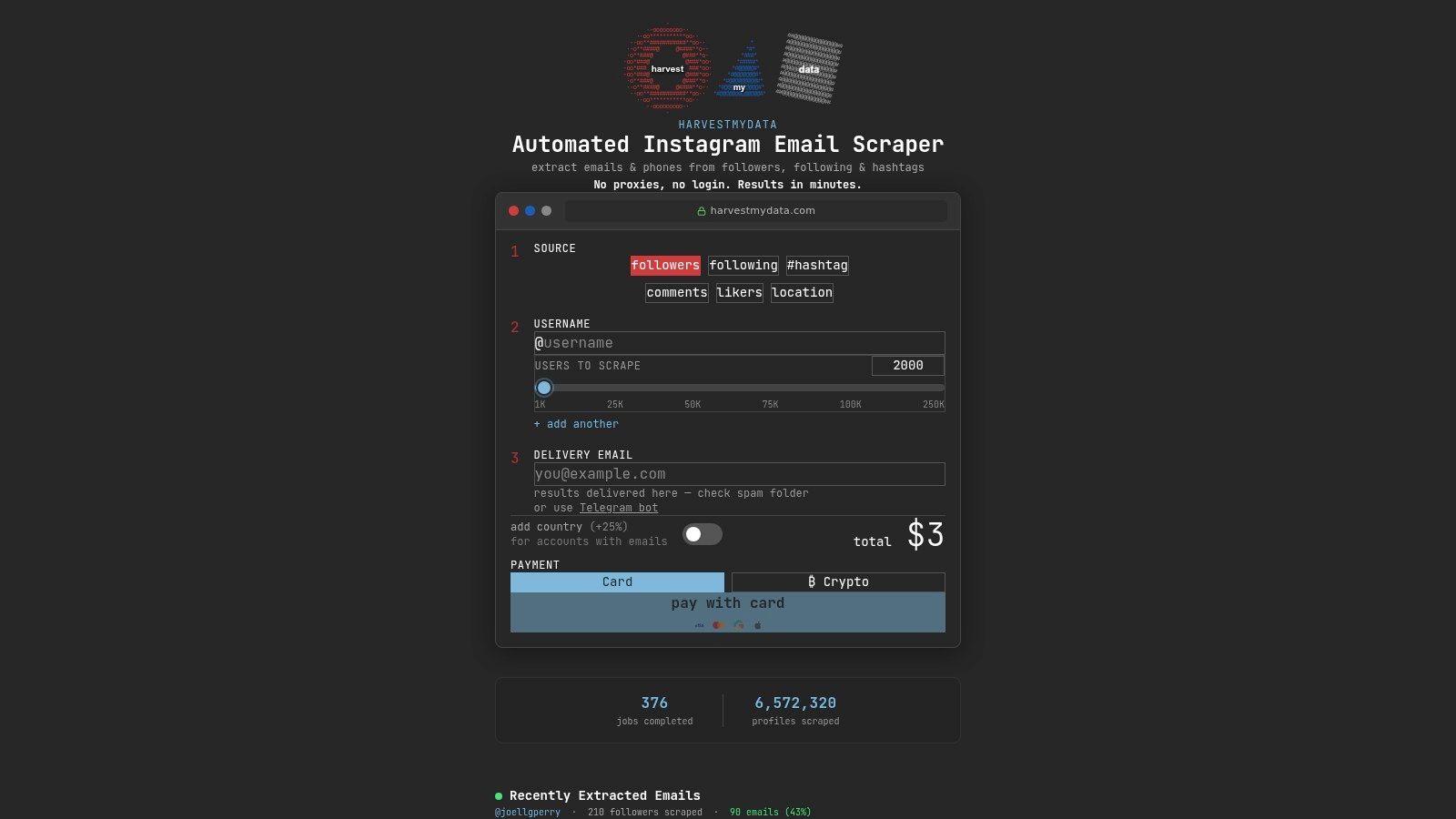
Effective tooling is key. Browser extensions, manual copying, and logged-in scraping setups create friction and unnecessary account risk. A cloud-based option like HarvestMyData's guide to finding business emails is relevant here because the workflow focuses on extracting publicly listed business contact information from Instagram audiences rather than looking up a single account.
HarvestMyData is one example of this approach. It runs in the cloud, works from public Instagram audiences, and can pull fields such as full name, bio, follower count, category, website URL, and public contact data into a CSV without requiring browser extensions or account logins.
A clean local workflow usually looks like this:
- Choose one source type at a time: competitor followers, a location tag, or a hashtag.
- Run small pulls first: check whether the audience is local and commercially relevant.
- Filter the export: remove personal accounts, inactive profiles, and profiles with no business context.
- Tag by segment: neighborhood, niche, source account, and buyer type.
- Route for outreach: send only qualified rows into your CRM or campaign sheet.
Here's a simple planning table for local Instagram niches.
| Local Niche Target | Average Email Yield |
|---|---|
| Real estate agents in one metro | Qualitatively strong when bios are business-focused |
| Photographers and creators in one city | Often higher than broad consumer categories |
| Local coaches and consultants | Strong when targeting following lists of niche hubs |
| Retail and hospitality operators | Mixed, depends on how often business contact info is public |
Later, once you know which sources produce the cleanest lists, you can standardize the pull criteria and handoff.
A short walkthrough helps if your team is visual:
Don't confuse list size with list quality. For local outreach, smaller and cleaner usually wins.
Crafting Outreach That Resonates Locally
A strong list only gets you permission to start. The message decides whether anything happens next.
Most local cold outreach fails for one reason. It sounds like it was written for everyone. No neighborhood signal, no contextual clue, no reason this person was contacted now instead of anyone else.
What weak local outreach sounds like
Here's the kind of email that gets ignored:
Hi, we help businesses grow online with marketing services. I'd love to show you how we can increase leads for your company. Are you available this week?
Nothing in that message proves local relevance. It could've been sent to a business in any city, any country, any niche.
It also wastes the advantage you earned when you built the list. If you scraped public data from a neighborhood audience, use it.
What relevant local outreach sounds like
The better approach is to pull one or two cues from the data and make them do real work.
For example:
- shared local audience source
- location named in bio
- neighborhood venue, creator, or community page they follow
- service category from bio
- website offer or booking CTA
- recent local event, market, opening, or seasonal pattern
A stronger opener sounds like this:
Subject: Quick idea for [Neighborhood] bookings
Hi [Name], I came across your profile while reviewing businesses connected to [local hub account or location]. You're already visible in [area], but I think there's an opening to turn that local attention into more direct inquiries.
I noticed [specific observation from bio, offer, or website]. If useful, I can send over a short idea for reaching more people around [city/neighborhood] without relying only on search traffic.
Another example for B2B services:
Subject: Saw you're active around [City]
Hi [Name], I've been mapping businesses in [city/neighborhood] that are already attracting the right local audience on Instagram. Your profile stood out because of [specific niche cue].
I have a simple idea for building a cleaner prospect list from nearby audiences and turning it into outbound. Want me to send it?
That works because it feels observed, not mass-blasted.
Field note: One local detail is persuasive. Five local details feel invasive.
A simple follow-up rhythm that doesn't burn the market
Local markets are smaller. That changes outreach behavior. If you send aggressive sequences, people remember.
A practical cadence is:
- First touch: brief, contextual, low-friction
- Second touch: clarify the benefit with one sharper observation
- Third touch: offer a simple asset, idea, or breakdown
- Last touch: polite closeout with a light door left open
If you're sending email, keep it compliant and focused on publicly listed business contact information. Don't treat scraped data as a license to spray every channel. Use business context, honor opt-out requests, and stay within responsible B2B outreach norms.
For message structure and deliverability hygiene, HarvestMyData's cold email best practices article is a practical reference.
What usually works best locally isn't “personalization” in the abstract. It's specificity with restraint. Mention the shared geography, the relevant audience source, and one believable reason your offer fits. Then stop talking.
Integrating And Automating Your Local Lead Flow
A lot of teams can build a local list once. Fewer can turn it into a repeatable pipeline.
That's the difference between a tactic and a system. If list extraction, qualification, routing, outreach, and reporting live in separate spreadsheets and inboxes, the process breaks the moment volume rises.
The operational pipeline
A usable local lead engine is simple enough to run weekly and structured enough to improve over time.
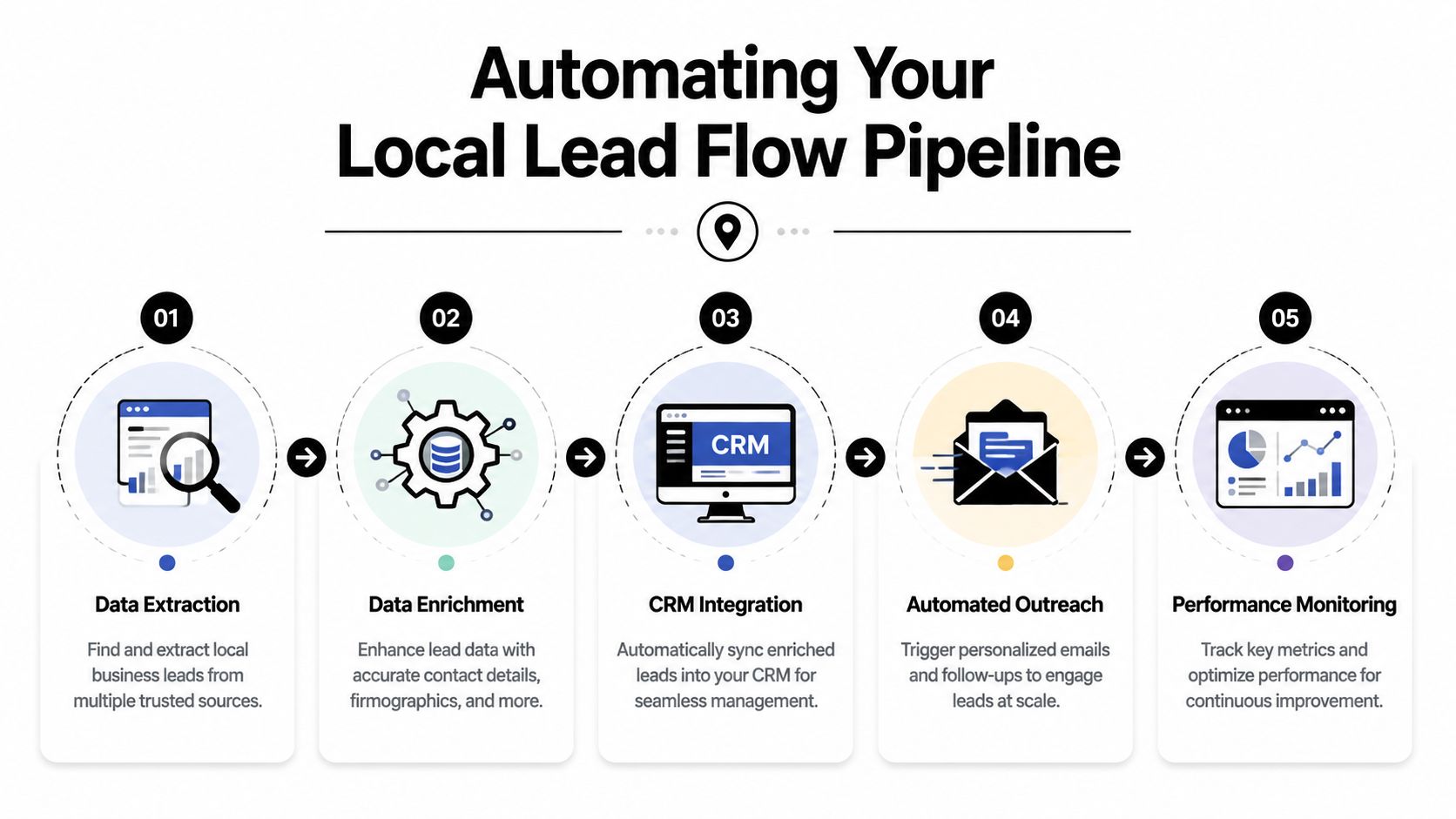
A clean workflow often looks like this:
- Extract from one audience source
Pull from a competitor audience, local hashtag, or place-based cluster.
- Enrich and qualify
Keep the fields that help routing and messaging. Remove noise.
- Push into a CRM
Send qualified rows into HubSpot, Pipedrive, or your preferred system with tags for location, niche, and source.
- Launch sequenced outreach
Trigger the appropriate email sequence or assign a rep based on territory.
- Review response quality
Compare source quality by meetings booked, reply quality, or sales acceptance.
The hidden win here is feedback. Once your CRM stores source tags, you can stop debating which local audience “feels right” and start seeing which one produces conversations.
Where automation helps and where it hurts
Automation is valuable when it removes repetitive work. It's damaging when it removes judgment.
Lead scoring is one place where automation helps. Improvado's lead generation guide notes that gated lead assets are commonly cited as converting at 20%–30%, while optimized landing pages average about 23% conversion in one 2026 guide, and it also recommends automated lead scoring so sales teams stop chasing low-intent leads.
That principle applies here even though the source is outbound. If your team scores based on location fit, business type, contact completeness, and commercial signals, reps stop wasting time on low-fit rows that happened to make it into the sheet.
Useful automations include:
- Field normalization: Standardize city, niche, and source naming.
- Routing rules: Send leads to the right owner based on area or vertical.
- Sequence triggers: Launch the correct outreach track after qualification.
- Suppression logic: Exclude existing customers, closed-lost accounts, and bad-fit geographies.
A helpful supporting stack can include social media lead generation tools that fit multi-step workflows, especially if you're connecting audience extraction to CRM and outreach platforms.
Automation should handle movement, not messaging judgment.
The common failure is trying to automate too early. Teams dump every scraped row into a sequence, then blame the channel when replies are weak. The channel isn't the issue. The qualification layer is.
Conclusion Building Your Local Moat
Local SEO still has a place. It is not a moat by itself, especially in crowded service categories where every competitor is chasing the same directories, reviews, and map pack visibility.
A stronger position comes from owning a private pipeline of local demand. The practical advantage is simple: you are not waiting for rankings to move or for referral volume to bounce back. You are identifying the local audiences that already cluster around your market, pulling qualified prospects from public signals, and starting conversations with context that sounds specific to the area.
That system gets harder to copy over time.
Why this becomes a moat
Any competitor can clean up listings, ask for more reviews, or rewrite their Google Business Profile. Fewer teams can consistently do the work that compounds in a local market:
- identify which neighborhood or city-specific Instagram audiences produce good prospects
- refresh those prospect pools before the data goes stale
- segment by geography, business type, and buying signal
- write outreach that reflects the local context instead of generic personalization
- route replies and follow-up to the right rep, branch, or operator
That is where defensibility comes from. Not from one channel, but from a repeatable operating system that keeps producing conversations while slower inbound channels keep maturing in the background.
There is a trade-off. Direct outreach requires tighter qualification and better message control than passive inbound. If the list quality slips, reply rates drop fast. If the local context is weak, messages read like scraped outreach. Teams that handle those two issues well usually see results faster than teams waiting on traditional local tactics alone.
Online data should create offline opportunities
The strongest local campaigns do not end in the inbox. They create familiarity in the actual market.
Use outreach to set up coffee meetings with nearby operators, invite prospects to a small local event, reference a district-level issue that matters to their business, or spot partnership opportunities with complementary companies that showed up during audience research. The point is not to collect contacts for a spreadsheet. The point is to turn public audience data into real conversations in a defined geography.
If your current plan is still centered on publishing more content, improving your GBP, and hoping visibility compounds, keep those channels running. Add a direct-response layer you control.
That is how you generate local leads without depending on saturated channels to carry the full load.
If you want a faster way to build local outreach lists from public Instagram audiences, HarvestMyData can help you extract publicly listed business contact information, profile details, and audience data into a CSV for qualification and outreach. It fits teams that want a direct-response workflow instead of relying only on slow local inbound.
We built HarvestMyData to handle all of this for you.
No proxies, no code, no account needed.