How to Build Email List That Actually Converts

The most popular advice on how to build an email list tells you to grow the file as fast as possible. Add a form, export contacts, scrape more profiles. That advice misses the question that decides whether the list works. Can you deliver mail to these people, will they recognize you, and do you have permission to keep mailing them?
Table of Contents
- What Founders and SDRs Actually Need - The Test for Every New Contact
- Start With the Exchange, Not the Export - What UK Guidance Makes Clear
- Manual Prospecting Finds Context and Burns Hours - Automated Extraction Solves the Discovery Bottleneck - Ways to Source Contacts Before Opt-In
- Small Percentages Are Not Small Problems - What a List Worth Mailing Looks Like
- Clean Before You Compare - Opens Will Mislead You
- One Narrow Build, Start to Finish - Judge the Send, Then Decide
Why a Bigger Email List Is the Wrong Goal
On 3 May 1978, Gary Thuerk of Digital Equipment Corporation sent a promotional message through ARPANET to approximately 400 potential business customers, often documented as 397 recipients, and DEC attributed nearly $13 million in sales to that campaign promoting DEC computer systems, as the early history of commercial email marketing records. That story still shapes bad instincts today. If a small defined database can produce large attributed sales at very low distribution cost, surely a much larger database must be better.
It isn't. The same mailing also generated complaints because recipients hadn't explicitly requested the message. The result shouldn't be treated as a modern benchmark either. The audience was unusually small, the market was highly specialized, and email infrastructure was radically different from today's environment.
That tension is the whole argument. A relevant offer can convert a passive contact database into revenue. A permissionless blast can also expose reputational and legal risk from the first send.
What Founders and SDRs Actually Need
Founders, SDRs, agencies, and ecommerce brands don't need the largest file their tools can produce. They need people who can receive the message, recognize the sender, and have a reason to click. A larger list that fails those tests isn't an asset. It's a deliverability liability you added to yourself.
This is also why an email list matters in the first place. It should be an owned audience, not reach borrowed from a feed. That logic connects directly to audience ownership for independent publishers, where control over the relationship matters more than raw follower counts.
Low distribution cost doesn't make an address a subscriber. It only makes a mistake cheaper to send at scale.
The Test for Every New Contact
Before you add anyone, ask four questions. Do you have relevance, data quality, consent you can demonstrate, and a measurable conversion goal? If you can't answer those, you haven't started to build an email list. You've started collecting rows.
That distinction changes the job. Discovery still matters, especially when your buyers are visible on Instagram or other public platforms. But finding a contact and earning the right to mail that contact are two separate steps, and collapsing them into one step is how scraped lists die in the spam folder. Judge growth by delivery and clicks from a defined audience, not by how many addresses you can add before the next campaign deadline.
Turn Public Audiences Into Real Opt-Ins
Instagram followers, following lists, hashtag participants, commenters, likers, and business profiles are a discovery layer, not a mailing list. A publicly visible email tells you where someone can be reached. It doesn't tell you they've agreed to receive your newsletter, your partner offers, or your weekly promotions.
Public availability does not by itself establish marketing permission.
The workflow below shows the shift from discovered audience to permissioned list.
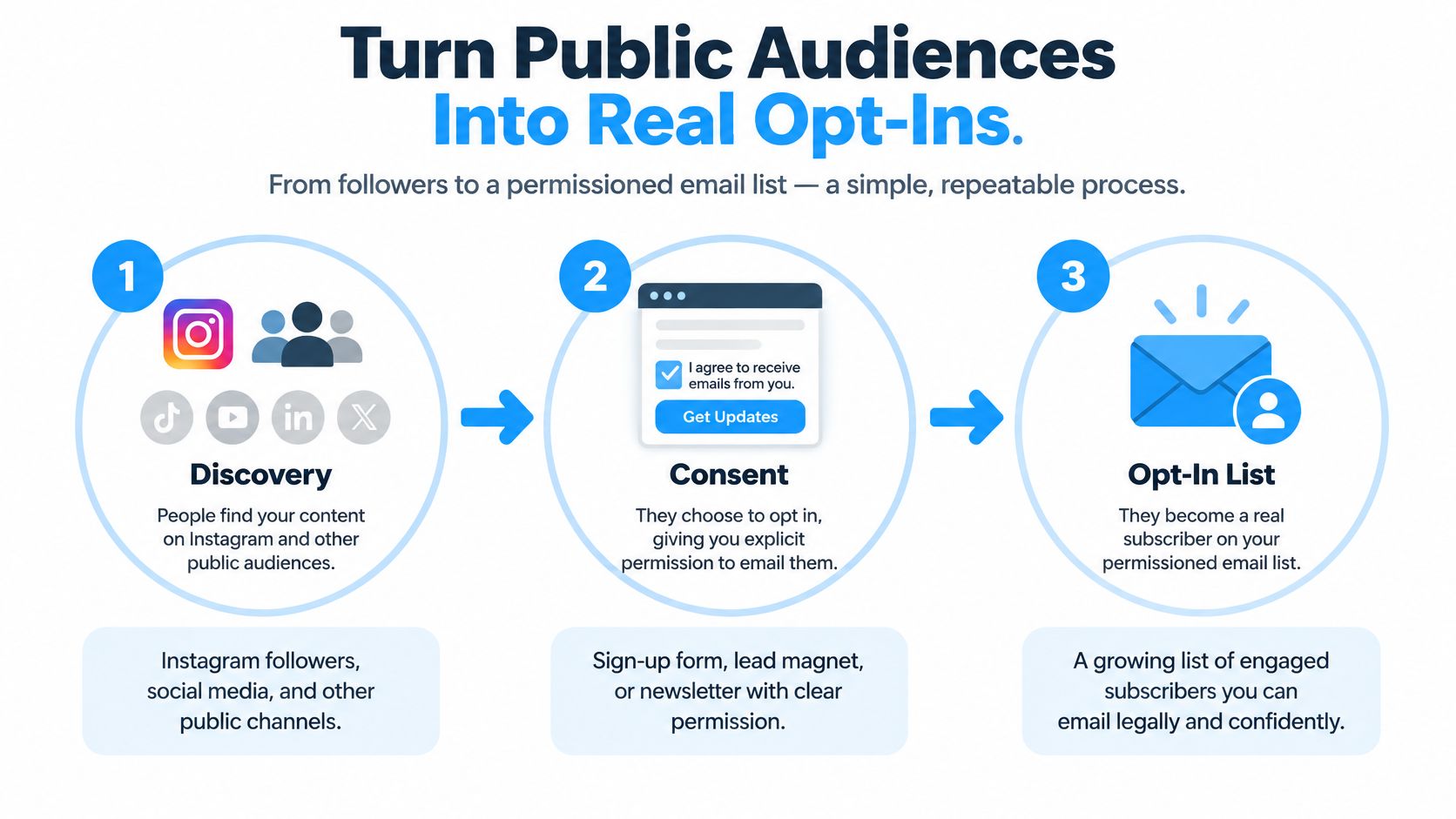
Start With the Exchange, Not the Export
Define the audience and the value exchange first. A guide, a benchmark, a discount, or a product alert gives a specific segment a reason to subscribe. Then place a short form on a focused landing page that exists for that exchange, not a generic page asking everyone to join everything.
State the sender identity, the message purpose, and the expected frequency on that page. Where required, use a separate, unchecked marketing-consent control so the permission is distinguishable from unrelated terms. If proof of opt-in is valuable, send a confirmation email and treat the click as the moment the contact becomes a subscriber.
That record keeping is part of the build, not admin after it. Store the timestamp, source URL, consent wording, and IP or equivalent audit metadata. A disciplined approach to first-party data collection practices and why first-party data drives marketing points in the same direction. Data you collected with a documented purpose is usable. Data you repurposed without one is fragile.
What UK Guidance Makes Clear
UK regulator guidance on complying with electronic mail marketing rules says consent must be freely given, specific, informed, and unambiguous, and marketing consent should be distinguishable from unrelated terms and conditions. If personal data is used for email marketing, you also need a lawful basis under applicable privacy law. Consent and legitimate interests are commonly relevant, but the appropriate basis depends on the scenario, the jurisdiction, the relationship, and the message type.
The failure modes are familiar because they're convenient.
- Prechecked boxes: The contact never made an active choice.
- Vague partner language: Phrases like offers from partners don't tell people who'll mail them or why.
- No frequency disclosure: People agree to something they can't picture, then complain when reality arrives.
- Scraped address as permission: A visible address goes straight into a newsletter with no opt-in event at all.
A one-to-one sales note and a subscribed broadcast aren't the same thing. Where prospecting rules allow a compliant personal message, its job is context setting and routing the person to an opt-in page. It isn't permission to add nonresponders to recurring campaigns. Suppress people who never respond, suppress unsubscribed and bounced addresses before every send, and provide one-click unsubscribe in every message.
The short video below is a useful companion if you're mapping this consent step into your own signup flow.
Double opt-in is the safer default when proof matters. It's slightly slower. It's also the step that turns a discovered audience into a list you can defend to a mailbox provider, a regulator, and your own sales team.
Choose a Collection Method That Fits
Three methods can feed an opt-in workflow. They don't solve the same problem, and choosing the wrong one wastes either time or permission quality.
On-site forms and lead magnets work best when someone already wants the offer. A focused landing page with a guide or benchmark produces clean, documented permission because the contact chose the exchange. The limit is speed and targeting. Forms wait for traffic, and they don't help much when you need a defined lookalike audience, such as followers of a competitor, commenters on a buying-intent post, or participants in a niche hashtag.
Manual Prospecting Finds Context and Burns Hours
Opening profiles one by one gives you context a form can't. You see the bio, the category, the website, and whether the account looks like a real buyer. For a short list of high-value accounts, that judgment is worth paying for in time.
It breaks down as soon as the audience grows. An SDR checking follower lists manually spends the day copying usernames instead of writing relevant outreach. Notes end up in inconsistent spreadsheets, source information gets lost, and the permission gap remains. You still found a public contact. You didn't earn a subscriber.
Automated Extraction Solves the Discovery Bottleneck
A cloud extraction job fits when you already know the audience and need structured rows fast. HarvestMyData pulls publicly listed emails and phones from Instagram business and creator profiles using followers, following lists, hashtags, commenters, or likers. Each row can include username, name, bio, follower count, category, and website, with optional country data on profiles that have emails.
Orders run on the web or Telegram, from 1,000 to 250,000 profiles, with card or crypto payment, CSV or Excel delivery, live progress, and a free trial up to 1,000 accounts. No customer Instagram login, API key, proxy, or install is required, and each order is scraped in real time rather than sold from a recycled database. Typical email yield is around 10%, higher in business and niche segments, at about two minutes per 1,000 profiles.
Treat that file correctly. It's discovery output, not a newsletter list. You still validate addresses, segment by source, and earn opt-in before broadcast mail, in line with your own obligations around GDPR and email marketing requirements.
Ways to Source Contacts Before Opt-In
| Method | Best audience | What you get | Speed | Permission status |
|---|---|---|---|---|
| On-site forms and lead magnets | Visitors already interested in a specific offer | Email plus documented consent event | Slow, tied to traffic | Strongest, subscriber opted in |
| Manual Instagram prospecting | Small set of high-value profiles | Public contact details plus human context | Slow, labor intensive | No marketing permission yet |
| Automated profile extraction | Defined follower, hashtag, commenter, or liker audiences | Structured public emails, phones, and profile fields | Fast, cloud processed | Discovery only, opt-in still required |
The comparison makes the decision simpler. Use forms when intent already exists, manual research when judgment matters more than volume, and extraction when the audience is defined and time is the constraint. None of the three removes the consent step. The fastest method only gets you to that step sooner.
Judge the List by Mail That Lands
List size is the easiest number to report and the least useful one to manage. A list earns its value when mail is delivered, accepted, and clicked by the intended segment. The benchmark data shows how narrow the margin for dirty data really is.
The panel below reframes list quality around deliverability rather than total contacts.
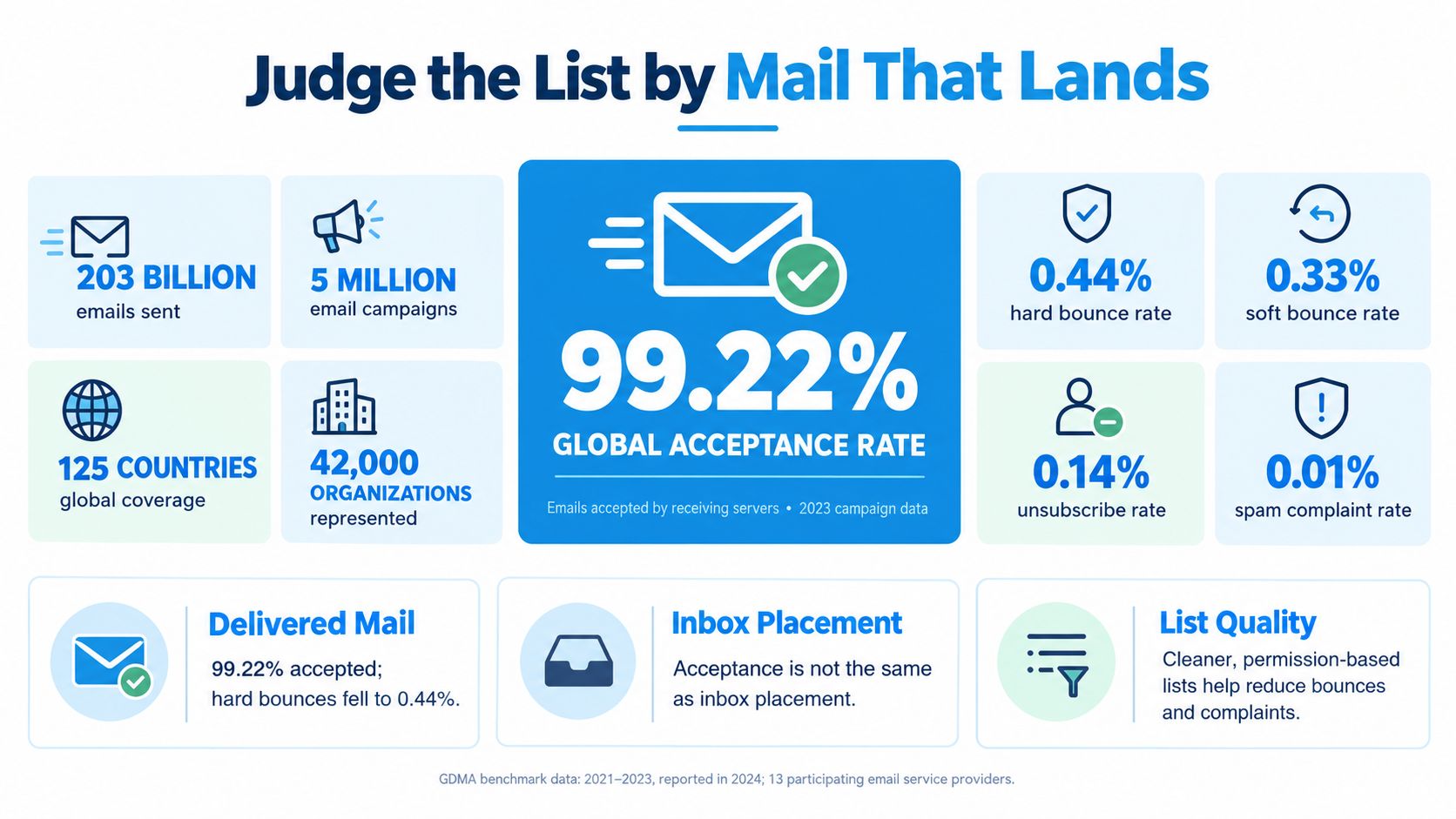
The 2024 GDMA International Email Benchmark analyzed 5 million campaigns involving 203 billion emails sent by 42,000 organizations across 125 countries, using anonymized data from participating email service providers, as detailed in the GDMA international email benchmark findings. Across that dataset, the delivery rate reached 99.22%, up from 98.24% the previous year. Hard bounces were 0.44%, soft bounces were 0.33%, the reported open rate was 34.12%, and the click-through rate was 3.56%. Unsubscribe rates were 0.14%, while spam complaints represented 0.01% of accepted emails.
Small Percentages Are Not Small Problems
Read those rates as operational math. A 1% deterioration in deliverability across one million messages can prevent roughly 10,000 emails from reaching inboxes. A 0.01% complaint rate still produces 100 complaints at that same scale.
Now connect that math to acquisition. A hashtag export full of role accounts, dead domains, or people who never opted in will move your bounce and complaint rates long before it moves revenue. Your sending platform sees the damage first. Your pipeline feels it later, when legitimate campaigns to good subscribers start landing worse.
Operator rule: If a source can lift complaints faster than it can lift clicks, it isn't a growth channel yet.
What a List Worth Mailing Looks Like
The practical target is a reachable, accurate, and appropriately targeted list. List hygiene, accurate contact data, authentication, segmentation, and relevant content directly affect the usable value of the database. Those aren't cleanup tasks you schedule after list building fails. They're part of how you build an email list that keeps working.
Use the benchmark as a reference frame for email deliverability rates and list health, not as a promise your next campaign will match global averages. Your market, offer, and acquisition sources will differ. The conclusion doesn't change. A smaller list that holds near-benchmark delivery and low complaints is worth more than a larger file that drags every future send toward the spam folder.
Spot the Sources Quietly Damaging Deliverability
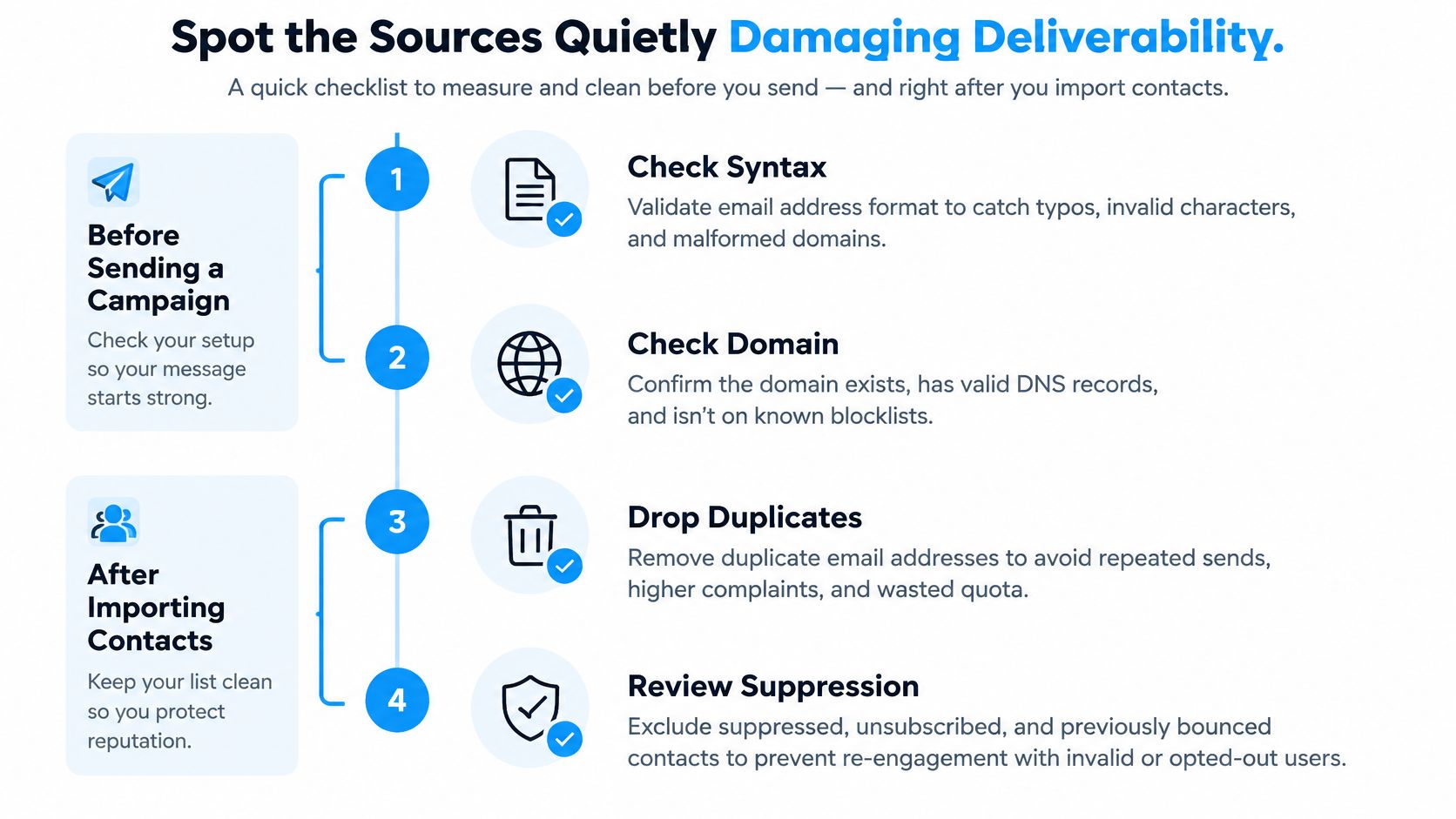
A benchmark tells you what healthy looks like. It doesn't tell you which acquisition source is poisoning your next send. That requires a measurement loop that starts before import and judges every source separately.
The checklist below covers the pre-send hygiene loop in compact form.
Clean Before You Compare
Validate syntax and domain before any new contacts enter your platform. Remove duplicates and role accounts where they don't belong. Then segment by acquisition source, geography, industry, and declared intent, because an average across the whole database hides the one source doing the damage.
Send a low-risk welcome or confirmation message first. Compare click, conversion, complaint, bounce, and unsubscribe rates by segment. Pause sources producing abnormal hard bounces or complaints, and re-permission or suppress persistently inactive subscribers instead of mailing them forever out of habit. Teams working to protect inbox placement for lifecycle campaigns end up at the same discipline. Protect the sender reputation before you chase the next batch.
Opens Will Mislead You
Open rate is a weak primary KPI because Apple Mail Privacy Protection can inflate it. MailerLite's 2025 email performance benchmark, based on more than 3.6 million campaigns from 181,000 approved accounts, reported a 43.46% average open rate, a 2.09% click rate, a 6.81% click-to-open rate, and a 0.22% unsubscribe rate. Treat those figures as directional, not guaranteed targets.
Use a funnel instead. Delivered, then unique click, then qualified action. A 100,000-recipient campaign producing a 2.09% click rate yields roughly 2,090 clicks before landing-page conversion is considered. Rising unsubscribes, sudden bounce spikes, or low clicks despite high opens point to poor targeting, stale data, misleading subject lines, or excessive frequency.
Permission quality shows up in inbox placement too. Gmail, Yahoo, and Apple recommend double opt-in, countries with stronger double-opt-in practices outperform the United States by roughly six percentage points in inbox placement, and Europe recorded an 89.1% inbox-placement rate in the 2025 deliverability benchmark report. The same research context reports that 55% of people mark an email as spam when the sender did not request permission, and 47% do so when there is no unsubscribe option.
Isolate the offending acquisition source. Don't remail the entire database and hope the average improves.
Mail One Clean Segment This Week
Don't launch a platform-wide list program to test this approach. Run one narrow build, judge it fairly, and keep or kill the source based on what the first send proves.
Pick one audience that already matches a specific offer. A competitor's followers, buyers using one hashtag, commenters on a relevant post, or the following list of an adjacent creator all work because the audience definition carries relevance with it. Vague audiences produce vague permission asks, and vague asks produce subscribers who don't remember joining.
One Narrow Build, Start to Finish
If that audience lives on Instagram, order a real-time public-profile extract and export CSV or Excel into the sheet or CRM your sales team already uses. Start with a small trial batch if the fit is unproven. You're testing source quality, not trying to set a volume record before anyone has clicked anything.
Then refuse the shortcut. Remove duplicates and obvious role accounts. Keep only contacts whose source and purpose you can document. If the file goes into your CRM with no acquisition source attached, you've already lost the ability to diagnose it later.
- Document the source: Record which audience, which profile set, and which purpose produced each contact.
- Route to the right next step: Send a compliant one-to-one note where prospecting rules allow it, or direct people to the opt-in page for newsletter permission.
- Record the consent event: Keep the timestamp, page, and wording tied to the subscriber record.
- Suppress nonresponders: Silence isn't permission to keep trying through broadcast campaigns.
Judge the Send, Then Decide
Mail only the confirmed segment, with a one-click unsubscribe in the message. Judge that first send by delivery, hard bounces, complaints, and clicks. Keep the source if it performs like a healthy segment. Kill it if it damages deliverability, even if the raw address count looked impressive in the spreadsheet.
That discipline feels slower on day one. It's faster by the third campaign, because you aren't rebuilding sender reputation while trying to sell. You'll finish with something more valuable than a bigger file. You'll have a list you can defend, segment, and send to.
Start with one defined Instagram audience and turn public business and creator profiles into a structured CSV or Excel file you can validate, segment, and route through your opt-in process. Visit HarvestMyData to run a real-time extraction without an Instagram login, API key, or install, and build your next segment from discovery data you can document.
We built HarvestMyData to handle all of this for you.
No proxies, no code, no account needed.